
Video Production: A Practical Guide to Real Business Results in video production
When we talk about video production, we’re talking about the entire journey of creating a video—from that first spark of an idea all the way to the finished piece you share with the world. It’s not just a case of pointing a camera and hitting record; it’s a strategic process that fuses creative vision with technical skill to hit a very specific business goal.
What Exactly Is Professional Video Production?
Think of it like building a bespoke piece of furniture. You wouldn’t just start sawing wood without a detailed design. The same goes for video. Professional video production is a carefully structured process designed to take an abstract concept and shape it into a powerful communication tool that genuinely connects with your audience.
This isn’t about just capturing footage. It’s a deliberate journey through distinct stages—strategy, scripting, filming, editing, and distribution. Each step is crucial, building upon the last to ensure the final video isn’t just good-looking, but effective. The aim is to create a genuine business asset, not just another video to add to the pile.
More Than Just Hitting Record
At its heart, professional video production is storytelling with a clear purpose. Are you trying to generate more leads? Train new team members? Build a loyal community around your brand? Whatever your goal is, every decision made during the production process circles back to it. This strategic focus is what ensures your final video doesn’t just get views, but gets results.
So, what separates the pros from the amateurs?
- Clear Messaging: A focused script that gets a core idea across without any fluff or confusion.
- High Technical Quality: Sharp visuals, crystal-clear audio, and polished editing that reflect the quality of your brand.
- Audience-Centric Approach: Content crafted specifically to resonate with your target viewer’s wants, needs, and pain points.
- Strategic Distribution: A solid plan for getting your video in front of the right eyeballs on the right platforms.
A Collaborative Discipline
Making a great video is almost never a one-person show. It’s a team sport, bringing together the specialised talents of writers, directors, camera operators, editors, and sound designers. Each expert adds their own layer of polish, skill, and creativity to lift the project from good to great. If you want to see how these roles fit together, you can get a feel for the different stages of professional video and animation production.
That collaboration includes you, the client. Your knowledge of your industry and your brand is the fuel that powers the creative team. And in today’s world, a huge part of professional production is ensuring your content is accessible to everyone, which includes understanding subtitles and closed captions to reach the widest possible audience.
Professional video production transforms an idea into a strategic asset. It’s the disciplined process of planning, creating, and refining visual content to meet a specific business objective, ensuring every frame works towards a defined goal.
Ultimately, this methodical, goal-driven approach is what makes all the difference. It’s what turns a simple recording into a compelling story that moves people to action. Getting your head around this is the first real step towards creating video content that truly delivers for your business.
Mapping Your Video Production Journey
Jumping into a video project can feel a bit like setting off on an expedition without a map. You know the destination—a brilliant video—but the path to get there seems complex, full of specialised roles and technical steps that all have to click into place.
The good news? It’s not as chaotic as it seems. The entire process follows a clear, five-stage roadmap. Understanding this journey isn’t just for the production crew; it’s crucial for you as a business leader. When you know what’s happening at each stage, you can provide the right input at the right time, keep expectations realistic, and see exactly how every decision shapes the final product.
This visual gives you a bird’s-eye view of how a simple idea evolves through strategy and planning to become a tangible video asset.
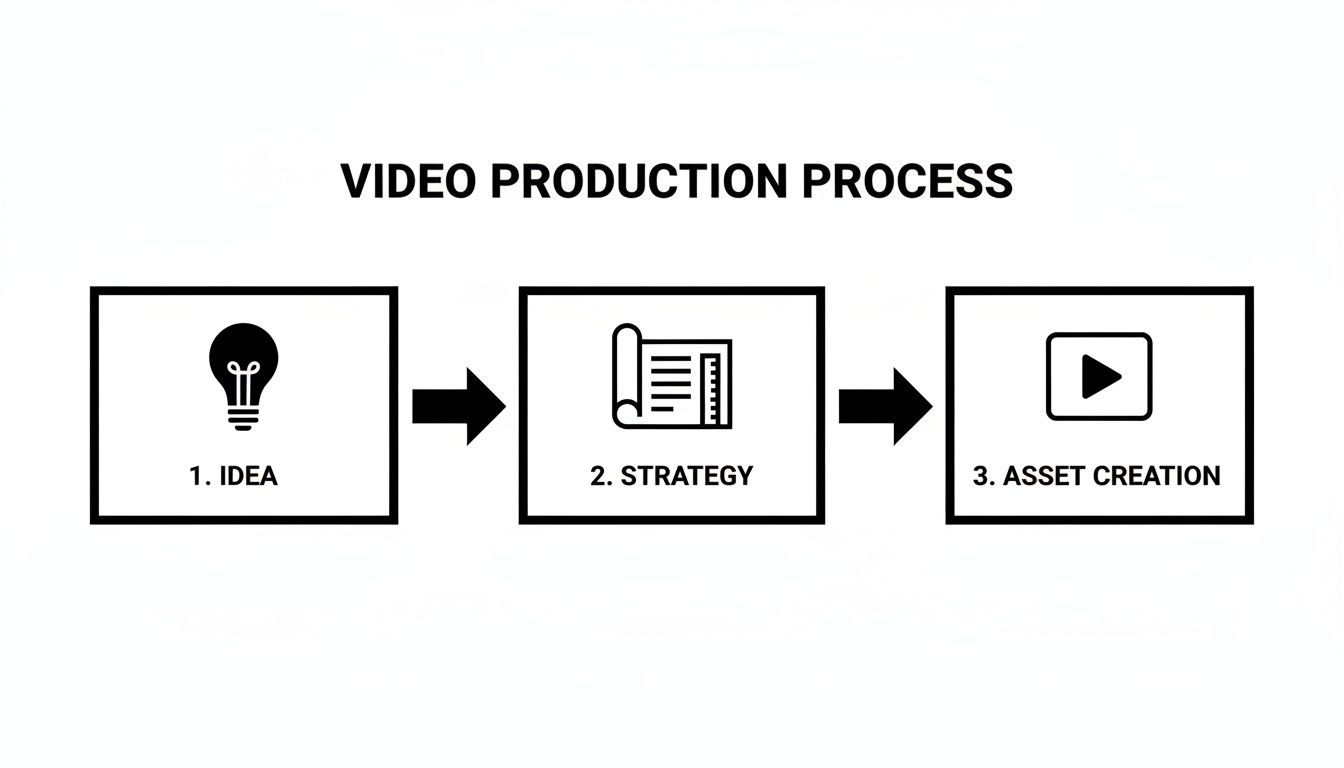
The main thing to remember is that a solid strategy is the bridge connecting a great creative idea to a video that actually delivers results.
To make this crystal clear, here’s a quick breakdown of the five stages, what we aim to achieve in each, and the key activities involved.
The Five Stages of Video Production
| Stage | Primary Goal | Key Activities |
|---|---|---|
| 1. Strategy & Concept | To define the “why” and establish a solid creative and strategic foundation. | Setting business objectives, analysing the audience, crafting the core message, brainstorming creative concepts. |
| 2. Pre-Production | To meticulously plan every detail of the shoot to ensure a smooth, on-budget production. | Storyboarding, casting, location scouting, assembling the crew, scheduling, and arranging logistics. |
| 3. Production | To capture all the high-quality visual and audio elements needed to tell the story. | Filming live-action scenes, recording interviews or voice-overs, creating core animated sequences. |
| 4. Post-Production | To assemble, refine, and polish the raw materials into a cohesive and compelling final video. | Editing footage, colour grading, sound design and mixing, adding graphics and visual effects. |
| 5. Distribution | To ensure the finished video reaches the right audience through the right channels. | Developing a launch plan, promoting across social media, embedding on websites, running paid ad campaigns. |
Each of these stages builds on the last, creating a logical flow from initial idea to final impact. Let’s dig a little deeper into what happens in each one.
Stage 1: The Strategy and Concept Phase
Before a single camera is switched on, the most important work has to happen. This is the bedrock of the entire project, where we lock down the why behind your video. It’s where your business goals and creative ideas meet to form a bulletproof plan. Without this strategic direction, even the most beautifully shot video is doomed to fall flat.
The key activities here are all about asking the right questions:
- Defining Objectives: What, specifically, must this video accomplish? Boost sales by 15%? Cut down on customer support tickets? Shift how people see your brand?
- Audience Analysis: Who are we talking to? What keeps them up at night, what do they care about, and where do they watch videos?
- Core Message Development: If your audience remembers only one thing, what should it be? We need to distil your message to its powerful core.
- Creative Concepting: This is where we brainstorm the actual story. What tone, style, and narrative approach will connect with your audience and deliver that core message?
Think of the scriptwriter and creative director as the architects here. They take your business needs and draw up the blueprint for a compelling story that will guide every decision from here on out.
Stage 2: The Pre-Production Phase
With a signed-off concept in hand, we dive into pre-production. This is the logistical engine room of the journey. It’s all about planning and preparation, organising every last detail to make sure the actual shoot is smooth, efficient, and stays on budget.
This stage is a flurry of coordinated activity:
- Storyboarding and Shot Lists: We visualise the entire video, scene by scene, creating a frame-by-frame guide for the camera crew.
- Casting and Location Scouting: This means finding the perfect actors or interviewees and securing the ideal backdrops for your story.
- Crew Assembly: We bring together the dream team: the director, cinematographer, sound technicians, and all the other experts needed on set.
- Scheduling and Logistics: A detailed shooting schedule is created, and we handle all the arrangements for equipment, props, and any necessary permits.
Pre-production is where we solve problems before they even happen. A thorough pre-production phase is the single best predictor of a successful, stress-free shoot.
Proper planning here prevents costly delays and makes sure everyone on set knows exactly what to do and when. It’s the meticulous groundwork that makes on-set magic possible.
Stage 3: The Production Phase
This is what most people imagine when they hear video production—the lights, the camera, the action. It’s where all that careful planning comes to life. The director guides the talent and crew to capture every shot and sound needed for the story.
For animated projects, this stage looks a little different. Instead of filming, it’s about creating the core animated scenes and assets. If you’re curious about the nitty-gritty, you can explore our full animation production pipeline.
Whether we’re on a live-action set or at a workstation, the goal is the same: execute the creative plan perfectly and capture high-quality raw materials for the final video.
Stage 4: The Post-Production Phase
Once the shoot is wrapped, the project moves into the edit suite. This is where the story is truly born. The raw footage is like a pile of words and sentences; the editor’s job is to arrange them into a powerful and coherent narrative.
Post-production is a craft with several layers:
- Editing: The video editor pieces together the best takes, following the script and storyboard to build the video’s pacing and flow.
- Colour Correction and Grading: The colourist gets to work, adjusting the footage to ensure everything looks consistent and to create a specific mood or feeling.
- Sound Design and Mixing: Audio engineers clean up dialogue, add sound effects, and weave in a music track to create a rich, immersive soundscape.
- Visual Effects and Motion Graphics: Finally, animators add any on-screen text, logos, or other graphic elements that enhance the story.
This phase is deeply collaborative, often involving a few rounds of feedback to tweak the edit until it hits every mark and aligns perfectly with the project’s goals.
Stage 5: The Distribution Phase
The video is finished and polished. But the job isn’t done. The distribution phase is all about getting your masterpiece in front of the right eyeballs. After all, a brilliant video that nobody sees is just an expensive file on a hard drive.
This requires a smart plan for launching and promoting the content across the channels your audience actually uses. That could be your website, social media feeds, email newsletters, or paid advertising campaigns.
Getting this last step right is a huge deal. Just look at the numbers: Poland’s Film, Video & Television Programme Distribution industry is projected to hit a market size of about €519.3 million in 2025. This shows just how vital effective monetisation and distribution strategies are in today’s media world.
Choosing the Right Type of Video for Your Goal
Once your strategy is locked in, the next big decision is picking the right creative format. Think of it like choosing a vehicle. You wouldn’t take a sports car on a rugged off-road trail, and you wouldn’t enter a 4×4 in a Grand Prix. Both are fantastic machines, but they’re built for different missions. Using the wrong one gets you nowhere fast.
The same logic holds true for video production. Your choice between live-action, animation, or motion graphics isn’t just about aesthetics. It’s a strategic move that directly shapes how your message lands with your audience and whether you hit your business targets.
Each style has its own unique power. Getting this choice right ensures your story is told in the most compelling way possible. Let’s break down the three main types to help you match your goal to the perfect execution.
Live-Action Video for Authenticity and Connection
Live-action video is all about capturing reality. We’re talking real people, real places, and real events, filmed with a camera. Its greatest strength? Building trust and forging a genuine human connection.
Seeing a real customer share their success story or a passionate CEO explaining their vision creates an instant sense of authenticity that’s tough to replicate. This format is the perfect choice when you want to showcase the human side of your brand, demonstrate a physical product, or capture the buzz of a live event. It makes your business feel tangible and relatable.
Best Use Cases for Live-Action Video:
- Customer Testimonials: Let your happy clients do the selling for you. Real voices telling real stories build powerful social proof.
- Company Culture Videos: Introduce the people behind your logo to attract top talent and build a stronger employer brand.
- Product Demonstrations: Show your product working in a real-world context, answering questions before they’re even asked.
- Brand Films: Tell the story of your company’s mission and values through powerful, cinematic storytelling.
Animation for Simplifying Complexity
What happens when your idea is too abstract or just too complex to capture with a camera? This is where the magic of animation comes in. Both 2D and 3D animation give you total creative freedom to bring any concept to life, completely unbound by the laws of physics.
This makes animation the perfect tool for explaining an intricate process or a complex service in a way that’s simple, engaging, and easy to digest. It allows you to visualise the invisible, making the complicated feel crystal clear.
Animation excels at turning abstract concepts into concrete, memorable visuals. It’s the ultimate problem-solver for ideas that are too complex or conceptual for a live-action shoot.
Motion Graphics for Dynamic Data and Information
Motion graphics are a specialised type of animation focused on bringing text, logos, charts, and other graphic elements to life. Think of it as graphic design in motion. It’s less about telling a character-driven story and more about presenting information in a dynamic and digestible way.
If you need to make statistics pop, explain a multi-step process, or create an energetic promo video, motion graphics are your go-to. They grab attention and make data-heavy content feel exciting instead of dry.
Common Applications for Motion Graphics:
- Explainer Videos: Break down your service or business model into simple, animated steps.
- Data Visualisation: Turn boring reports into compelling, easy-to-understand animated infographics.
- Social Media Ads: Create short, eye-catching video ads that stop the scroll and deliver a quick message.
- Title Sequences and Logos: Add a professional polish to any video with animated intros, outros, and branding.
Matching the right video type to your goals is a foundational step in any successful video marketing strategy. Forecasts estimate Poland’s TV & Video market revenue will reach approximately US$5.22 billion in 2025, with video advertising achieving an impressive 61.6% visibility rate. This shows just how much commercial value there is in choosing the right format to capture attention. To dive deeper into integrating these formats, check out our guide on developing a powerful strategy for marketing with video.
How to Approach Video Timelines and Budgets
Let’s get right to it and tackle the two questions on every client’s mind: “How long is this going to take?” and “How much will it cost?” It would be fantastic if we could just hand you a price list, but the reality is that every video we create is a unique piece of work. The timeline and the budget are shaped entirely by the scope of your vision.
Think of it like this: asking for the cost of a “video” is like asking for the cost of a “meal.” You’ve got your quick takeaway sandwich on one end and a seven-course tasting menu on the other. Both are technically meals, but the time, skill, and cost involved are worlds apart. The same logic holds true for video. A simple animated clip for social media is like a blog post—fast to produce and great for a specific goal. A cinematic brand film with multiple actors and locations, however, is more like an in-depth whitepaper—a serious investment that demands deep research and expert execution.
Key Factors That Influence Your Budget
The final price tag on a video project isn’t just a number we pull out of thin air. It’s a direct reflection of the resources, talent, and time needed to bring your idea to life. Once you understand what drives the cost, you can see exactly where your investment is going and how tweaking the scope can affect the bottom line.
Here are the main things that determine a video production budget:
- Complexity and Concept: A straightforward interview in a single location is far simpler than a multi-scene narrative packed with complex visual effects. The more intricate the creative idea, the more resources it’s going to need.
- Production Crew Size: For a basic testimonial, a lean crew might just be a camera operator and a sound technician. A larger commercial shoot? That could easily involve a director, producers, gaffers, grips, and a full art department.
- Shoot Days and Locations: Every single day of filming adds costs for the crew, equipment rental, and location fees. Shooting in multiple spots also ramps up the logistical complexity and travel expenses.
- Talent and Casting: Using professional actors, voice-over artists, or even getting experts on camera for interviews will all be factored into the budget.
- Animation Style: When it comes to animation, a simple 2D motion graphics piece is much less resource-intensive than a highly detailed, character-driven 3D animation.
The biggest variable in any video budget is time—the hours it takes for skilled professionals to plan, shoot, edit, and animate your content to an exceptional standard. More complexity always means more time.
This is exactly why a clear, detailed brief is so crucial. When you can define your objectives, audience, and core message right from the start, a production partner can give you an accurate estimate of the resources needed to hit your goals.
Understanding Video Production Timelines
Just like the budget, the project timeline is directly linked to its complexity. There’s no such thing as a “standard” turnaround time, but we can look at some general estimates to help set realistic expectations.
- Simple Projects (e.g., Testimonial or Event Recap): You’re typically looking at 3-5 weeks. This covers a quick pre-production phase, a single day of filming, and a straightforward editing process.
- Moderate Projects (e.g., Explainer Video, Corporate Film): These often take 6-10 weeks. They involve more detailed scripting, storyboarding, and potentially more complex animation or post-production work.
- Complex Projects (e.g., Brand Film, Detailed 3D Animation): These can easily take 12+ weeks. Large-scale productions like these require extensive pre-production, multiple shoot days, and a highly detailed post-production phase with visual effects and intricate sound design.
It’s also important to remember that these timelines depend heavily on your team’s availability for feedback. Delays in approving scripts, storyboards, or edited cuts will naturally extend the project’s overall length. Throughout this critical phase, mastering financial management for creative projects is essential for keeping your video production on track and within budget. Clear communication and timely approvals are the best way to keep everything moving forward smoothly.
Finding and Briefing the Right Production Partner

The ultimate success of your video often rests on the shoulders of the team you bring on board. Picking the right video production company isn’t like finding a supplier; it’s about starting a creative partnership. This is the team that will take your business goals and spin them into a visual story that connects, so it’s a choice you really want to get right.
Start by taking a deep dive into their past work. A company’s portfolio is its visual CV, giving you a direct window into their style, quality, and what they’re truly capable of. Look past the glossy finish and ask yourself: does this feel like our brand? Does their tone match ours?
Checking out a wide range of projects, like the ones in our video and animation portfolio, helps you find a partner whose creative instincts just click with yours.
Evaluating Potential Partners
Once you have a shortlist, you need to look beyond the videos themselves. The goal is to find a partner with not just the technical chops, but also a history of running smooth, collaborative projects. It’s time to put on your detective hat.
Here are a few key areas to dig into:
- Client Testimonials and Case Studies: Hunt for detailed feedback from people they’ve worked with before. Do clients talk about clear communication, hitting deadlines, and a real sense of teamwork? Those are the hallmarks of a professional and reliable crew.
- Industry Specialisation: Have they worked in your world before? A partner who already knows the ins and outs of your industry—whether it’s tech, healthcare, or finance—will get up to speed much quicker.
- Process Transparency: Ask them to walk you through how they work. A confident partner will have no problem explaining every stage, from the initial idea to the final delivery, and showing you where your feedback is vital.
Doing this homework ensures you find a team that can not only make a stunning video but also act as a strategic guide from start to finish.
The Power of a Great Creative Brief
After you’ve chosen your partner, the next critical step is briefing them properly. A well-written creative brief is the single most important document in the entire production process. It’s not a simple list of instructions; it’s the blueprint for success. It gets everyone on the same page about the project’s purpose, audience, and message right from day one.
A vague brief leads to guesswork, endless revisions, and a final video that just misses the mark. On the flip side, a sharp, detailed brief gives your creative partner the clarity they need to do their best work, making sure the final video hits all your strategic goals.
A great brief doesn’t just list what you want; it explains why you want it. It provides the strategic context that allows creativity to flourish within the right boundaries, turning a good idea into a results-driven video.
To craft a brief that delivers, make sure it covers these essentials:
- Project Objectives: What is the main business goal? Define a clear, measurable target (e.g., “Increase landing page conversions by 10%“).
- Target Audience: Who are you really talking to? Paint a picture of them—their demographics, problems, and what motivates them.
- Core Message: If the viewer only remembers one thing, what should it be?
- Key Calls to Action: What do you want people to do right after they finish watching?
- Tone and Style: What’s the vibe? Should it be inspiring, educational, urgent, or maybe a bit funny?
This clarity is more important than ever as viewing habits change. Polish audiences, for instance, are shifting more and more to on-demand platforms, with streaming set to grab a 10.1% share of total TV time. Working with a team that gets how to create content for platforms like YouTube is key to connecting with today’s viewers. You can find more insights on shifting viewer patterns in Poland on ppc.land.
Answering Your Questions About the Video Production Process
Even with a clear plan, stepping into professional video production for the first time can feel a bit daunting. We find that most businesses have a few practical questions pop up along the way, so let’s get you some straightforward answers. Getting clarity on these common points will help you move forward with total confidence.
How Long Does It Take to Produce a Corporate Video?
This is the big one, and the timeline is always tied directly to the video’s complexity. While there’s no single, one-size-fits-all answer, we can definitely give you a good idea of what to expect.
A fairly straightforward project, like a 2-minute client testimonial filmed at a single location, might take around 3-4 weeks from our first chat to the final file delivery. The pre-production is quick, and the edit is more direct.
On the other hand, a more involved project like a detailed animated explainer video or a brand film shot across multiple locations with actors can easily take 8-12 weeks, sometimes more. The most time-intensive stages are usually pre-production—nailing the script and storyboard—and post-production, where the magic of editing, animation, and sound design happens.
The single biggest factor in keeping a project on track is your timely and clear feedback. When you can provide decisive approvals at key milestones, like signing off on the script or reviewing the first cut, the whole process flows much more smoothly.
What Is the Difference Between a Production Company and a Video Agency?
Understanding this distinction is key to finding the right partner. Think of a production company as the master craftspeople—the expert builders. Their focus is purely on the high-quality, technical execution of bringing a video to life through filming, editing, and animation. They are masters of the craft.
A video agency, in contrast, is more like an architect and builder rolled into one. They offer a much wider range of strategic services that extend beyond just making the video. This can include campaign development, deep audience research, and planning your distribution strategy.
- Choose a production company when you already have a strong creative vision and just need a team of technical experts to execute it beautifully.
- Choose a video agency when you’re looking for a partner to help with the entire strategy, from the initial concept right through to the campaign launch and measuring its success.
How Much Input Will I Have During the Process?
Your input isn’t just welcome—it’s absolutely crucial. The best videos are always the result of a tight collaboration. You’re the expert on your brand, your customers, and what you need to achieve. A great production partner acts as a channel for that expertise, turning it into a compelling video.
A professional workflow is built around specific approval points. You’ll be asked to sign off on the script and storyboard during pre-production to make sure the story is perfect. Later, in post-production, you’ll review different versions of the edit (often called ‘cuts’) to give feedback on the pacing, visuals, and messaging. This partnership ensures the final video is exactly what you envisioned.
Can I Repurpose Video Content for Different Platforms?
Absolutely, and you really should! Repurposing is the smartest way to get the maximum return on your video production investment. A single, high-quality flagship video can be a goldmine of content, giving you a huge amount of material to extend its life and reach.
For example, a longer brand film can be snipped into short, punchy clips perfect for social media platforms like LinkedIn or Instagram. A key quote from a customer testimonial can be transformed into a striking graphic or a quick YouTube Short.
The trick is to plan for this right from the start. Talk about your distribution goals with your production partner during the initial strategy phase. That way, they can shoot and edit with repurposing in mind—capturing footage in different orientations (like horizontal for your website and vertical for social media stories) to make sure every single piece of content is perfectly optimised for every channel. Thinking ahead like this ensures you squeeze every last drop of value out of your footage.
Ready to bring your ideas to life with a powerful video? The team at Simple Frame specialises in creating high-quality video and animation that delivers real business results. Start your project with us today.
Article created using Outrank