
A Strategic Guide to the Main Types of Animation
Animation is a phenomenal way to tell a story, but picking the right style is what separates a good project from a great one. You’ve got a whole world of options—from classic 2D and realistic 3D to slick motion graphics and hands-on stop motion. Each one has its own unique strengths, and figuring those out is the first step to creating something that truly resonates.
Charting Your Path Through Animation Styles
Choosing an animation style isn’t just about what looks cool; it’s a strategic decision. It has a direct impact on your budget, your timeline, and the very soul of your message. Think of each style as a different language. Some are perfect for telling warm, character-driven stories, while others are built to dissect complex data or show off a product in stunning, photorealistic detail. The best choice always aligns with your brand’s voice, your audience, and what you’re trying to achieve.
This guide is for decision-makers who need to go beyond basic definitions and get to the practical stuff: What does it take to produce? What will it cost? What does it do for my business? We’ll break it all down, style by style. Consider this your roadmap for connecting creative ideas with concrete business goals.
Making the Initial Decision
Before we get into the weeds, a simple decision tree can help you get your bearings. It all starts with one fundamental question about how you want your project to look. This infographic shows how the need for realism often creates the first big fork in the road.
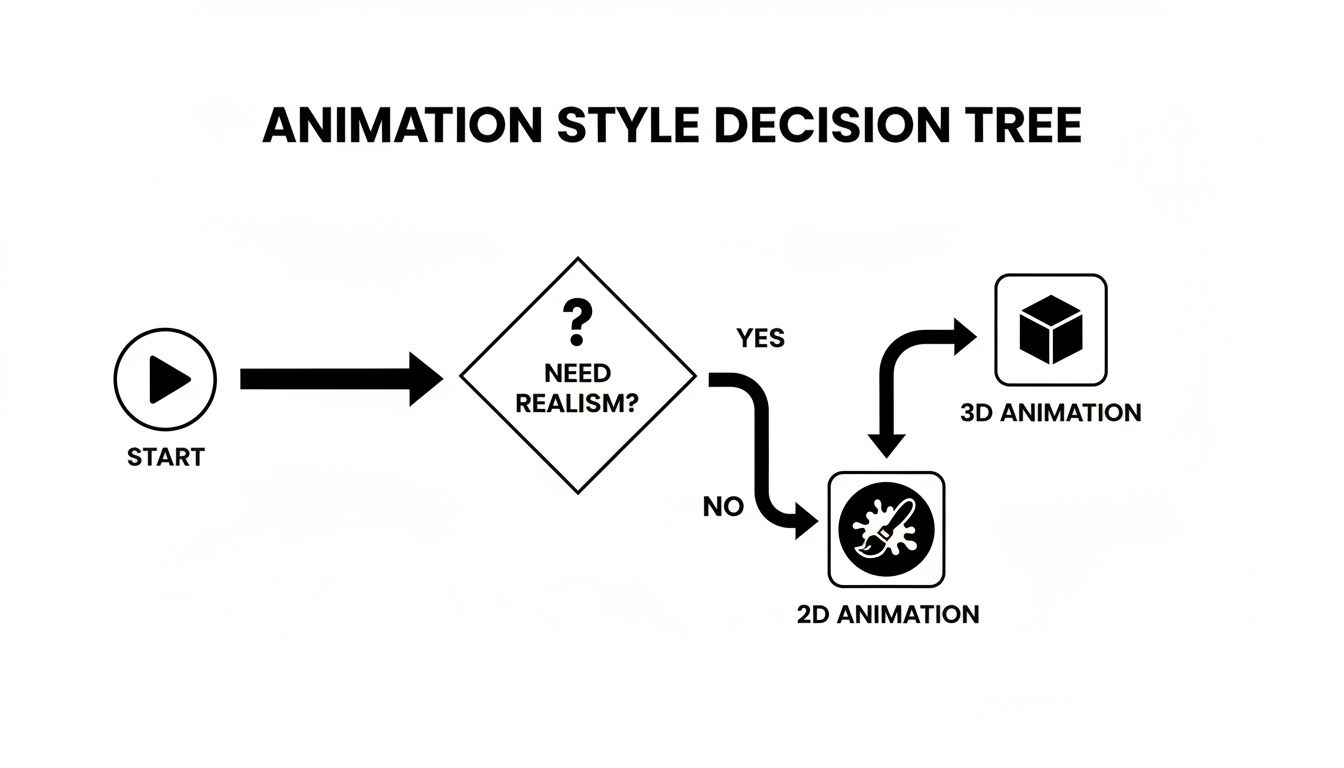
As you can see, if your project needs lifelike product renders or immersive, realistic environments, you’re almost certainly heading down the 3D path. On the other hand, if you’re after stylistic expression, abstract concepts, or classic storytelling, 2D and its variations offer a much wider creative canvas.
The most crucial step is to define your project’s primary goal. Is it to educate, entertain, persuade, or demonstrate? The answer will naturally guide you toward the animation style best equipped to achieve that objective effectively and efficiently.
Knowing how to use these visual tools is a core part of any successful campaign. For a deeper look at how animated content fits into a wider strategy, our guide to marketing with video offers some fantastic insights.
Understanding the Timeless Appeal of 2D Animation
When you picture “animation,” what comes to mind? For most people, it’s the classic, hand-drawn cartoons that shaped our childhoods. That’s the magic of 2D animation—a technique that creates movement in a two-dimensional world. It’s the very foundation of the animation industry, yet it remains just as powerful and relevant today.
At its heart, 2D animation works by showing a series of individual drawings in quick succession. Each drawing is slightly different from the one before it, creating the illusion of movement. Think of it as a highly sophisticated flipbook. This can be achieved the old-fashioned way, with artists drawing on paper or celluloid sheets, or digitally with modern software and tablets.
The real power of 2D animation is its artistic freedom. It isn’t constrained by the laws of physics or reality, which opens the door to incredible creativity and expression. This makes it the perfect choice for storytelling that needs a strong emotional core or a one-of-a-kind visual style, from nostalgic brand campaigns to crystal-clear explainer videos.
The Two Faces of 2D Production
Modern 2D animation typically follows one of two paths. Knowing the difference between them is key to understanding your project’s potential timeline and budget.
- Traditional 2D: This is the classic frame-by-frame approach, where artists draw every single movement. Digital tools have largely replaced paper and ink, but the principle is the same. It’s a labour-intensive process that offers unmatched fluidity and deeply expressive character performance.
- Vector-Based 2D: This more recent technique uses digitally built characters and assets that have “bones” or “rigs.” Instead of redrawing the character for every frame, animators simply manipulate the rig. It’s much faster and more cost-effective, making it a go-to for web series, corporate videos, and projects on a tight schedule.
The choice between traditional and vector-based animation directly shapes the project’s budget and final feel. While vector animation is efficient, the handcrafted quality of traditional 2D can give a brand a truly distinct and organic look. For a deeper dive, you can explore our portfolio of 2D animation production.
Why 2D Still Dominates in Storytelling
Even with the rise of hyper-realistic 3D worlds, 2D animation still has a firm grip on the market, and for good reason. Its simplicity is its greatest asset. It allows viewers to focus on the character, emotion, and story without being distracted by photorealistic details. This directness makes it an incredibly effective communication tool.
2D animation excels at simplifying complex ideas. By stripping away unnecessary visual noise, it can make abstract concepts tangible and easy to grasp, which is why it’s a favourite for educational content and corporate explainers.
The Polish animation scene is a perfect example of this balance. While known for its advanced 3D and VFX, traditional 2D animation still holds a significant 35% of the domestic market share. This is driven by its effectiveness in television series and culturally-rooted storytelling—a trend we see across Europe. You can learn more about the vibrant Polish animation landscape on Vitrina.ai. This lasting popularity proves just how well 2D builds strong narratives without breaking the bank.
Evaluating the Pros and Cons of 2D Animation
Making the right choice for your project means looking at both sides of the coin. 2D offers amazing creative benefits, but it’s important to weigh them against its practical limits to ensure it’s the right fit for your goals.
Key Advantages:
- Artistic Freedom: The stylistic possibilities are endless, from minimalist designs to lush, detailed worlds.
- Emotional Connection: The handcrafted, often imperfect, feel can create a stronger, more personal bond with your audience.
- Cost-Effectiveness: It’s generally cheaper and quicker to produce than 3D, especially when using vector techniques.
- Clarity of Message: Perfect for breaking down complex services or data into a simple, digestible format.
Potential Drawbacks:
- Labour-Intensive: Traditional frame-by-frame 2D demands a huge amount of time and artistic skill.
- Limited Realism: It can’t achieve the photorealism needed for things like product visualisations or architectural renders.
- Revisions Can Be Difficult: With traditional 2D, making changes late in the game can be a difficult and costly affair.
Entering the Immersive World of 3D Animation
If 2D animation is like painting on a flat canvas, then 3D animation is like sculpting in a digital world. It’s not about drawing frames; it’s about building digital objects, characters, and environments that have real depth, volume, and perspective. This leap into the third dimension opens up a universe of realism that 2D simply can’t touch.
Think of a sculptor carving a character from a block of virtual clay. That’s the essence of 3D. Artists use specialised software to construct models, wrap them in detailed textures, and arrange them in digitally built scenes. This depth allows for fluid camera movements, realistic lighting, and shadows that behave just as they would in the real world, creating a truly immersive experience for anyone watching.
This incredible level of realism makes 3D an essential tool for any business that needs to show off a product with precision. From jaw-dropping game trailers to photorealistic architectural visualisations, 3D animation brings concepts to life with a level of detail and believability that is second to none.
Demystifying the 3D Production Pipeline
Creating a 3D animation is a highly technical, multi-stage process. It’s a different beast entirely from 2D. Every step meticulously builds on the one before it, layering in complexity and detail to get to that polished final shot. Understanding this workflow is key to seeing why 3D projects often demand more time and a bigger budget.
The journey from a blank screen to a fully rendered animation breaks down into three core stages.
- Modelling: This is the sculpting phase. Here, artists create the 3D models of characters, props, and entire environments, defining their shape and structure.
- Layout and Animation: Once the models are ready, they’re arranged within a digital scene. For characters, this means giving them a digital skeleton, or “rig,” which allows animators to pose and move them frame by frame, almost like virtual puppeteers.
- Rendering: This is the final, and most computer-intensive, step. The software takes all the data—lighting, shadows, textures, reflections—and calculates it all to generate the final images. A single, complex frame can sometimes take hours to render.
This methodical pipeline gives creators precise control over every last detail, from a character’s slightest change in expression to the way light glints off a metallic surface. You can see how this process leads to stunning results by exploring our dedicated showcase of 3D animation projects.
When to Choose 3D Animation
Going with 3D animation is a strategic choice, usually driven by a need for realism, complexity, and sheer visual impact. It truly shines in any situation where you need to explain a physical product or help someone visualise a real-world space.
3D animation is the go-to for product visualisation. It gives companies the power to demonstrate a product’s features and functions from every conceivable angle—even showing how its internal parts work—long before a physical prototype ever exists.
Here are a few common business scenarios where 3D has a clear advantage.
- Product Demos and Visualisations: Perfect for showing how complex machinery operates or launching a new gadget in a sleek, polished video.
- Architectural Walkthroughs: Allows clients to virtually step inside and experience a building before a single brick has been laid.
- Medical and Technical Explanations: Absolutely essential for illustrating intricate biological processes or complex engineering concepts with total clarity.
- Cinematic Advertising: Delivers the high-end, visually spectacular commercials that are needed to grab an audience’s attention in today’s crowded market.
Weighing the Pros and Cons of 3D
Like any creative medium, 3D animation has its own set of powerful strengths and very real challenges. You have to weigh its unparalleled visual prowess against the significant investment of time and resources it requires.
Key Advantages:
- Unmatched Realism: It can deliver photorealistic visuals that are incredibly persuasive and captivating.
- Dynamic Camera Movement: You have total freedom to move the virtual camera anywhere in a scene, creating dramatic, cinematic shots that would be impossible in real life.
- Reusability of Assets: Once a 3D model is built, it can be repurposed from different angles or in completely new animations, saving a lot of time on future projects.
Potential Drawbacks:
- High Technical Skill Required: The production demands highly specialised artists and technicians, which can drive up costs.
- Significant Render Times: Rendering is an extremely time-consuming process that needs serious computing power, which can extend project timelines and budgets.
- Higher Production Costs: The mix of specialised talent, powerful software, and long render times naturally makes 3D one of the most expensive animation styles.
Unlocking the Power of Motion Graphics
While 2D and 3D animation often revolve around characters and telling narrative stories, motion graphics are the unsung heroes of corporate and brand communication. The best way to think of them isn’t as cartoons, but as graphic design that’s been brought to life. Their main goal is to get a message across—clearly, stylishly, and with maximum impact.
Instead of telling a story about who, motion graphics tell a story about what. They take static elements we’re all familiar with—text, logos, charts, and icons—and set them in motion to create a fluid and engaging visual experience. This versatility has made motion graphics an absolute cornerstone of modern branding and digital marketing.
From the slick animated logo that kicks off a corporate video to the dynamic charts that make a financial report understandable, motion graphics make information easier to digest. They have a knack for turning abstract data and complex ideas into clear, compelling visuals that grab and hold an audience’s attention.
Where Do Motion Graphics Shine?
Because motion graphics are built from the ground up to explain and inform, their applications in the business world are almost endless. They are the engine behind some of today’s most effective and widely used types of video content.
You’ll find them powering:
- Explainer Videos: Breaking down a service or product into simple, easy-to-follow steps.
- Data Visualisation: Transforming dull spreadsheets and statistics into engaging animated infographics.
- UI/UX Animations: Guiding users through an app or website with smooth, intuitive on-screen transitions.
- Brand Identity: Creating memorable animated logos and title sequences for videos and presentations.
This huge range of applications is exactly why the technique has become so popular. To see how these principles look in real-world projects, check out our work in motion design.
The Business Case for Motion Graphics
For many companies, motion graphics hit the sweet spot, offering the perfect balance of visual flair, production speed, and cost-effectiveness. They deliver a polished, professional look without the massive production pipeline required for character-driven 2D or 3D projects.
Motion graphics are fundamentally about clarity and efficiency. They are designed to convey a message as quickly and memorably as possible, making them an invaluable tool for businesses that need to cut through the noise and communicate with precision.
This efficiency is a massive advantage. The production timeline for a motion graphics video is often significantly shorter than for other animation styles, mainly because it relies on animating existing design assets rather than creating characters and entire worlds from scratch. This makes it a highly practical and budget-friendly choice for many campaigns.
The Polish animation industry certainly reflects this growing demand. Over 20 major studios, like Platige Image, have worked on more than 50 international projects recently. While 3D still dominates film and gaming, emerging motion graphics animations now represent a solid 10% of the market. This growth is largely fuelled by an 18% increase in their use by Polish brands for advertising campaigns.
Weighing the Pros and Cons
Like any creative style, motion graphics have distinct strengths and weaknesses that make them a perfect fit for some projects but less suitable for others.
Key Advantages:
- Cost-Effective: Generally more affordable to produce than detailed 3D or traditional 2D animation.
- Rapid Production: Timelines are typically much shorter, allowing for quick turnarounds when you need them.
- Clarity of Communication: Superb for simplifying complex information and presenting data in a visually appealing way.
- Modern Aesthetic: Delivers a clean, professional, and contemporary feel that aligns perfectly with modern brand identities.
Potential Drawbacks:
- Less Emotional Storytelling: Not as effective for creating deep character connections or complex, narrative-driven stories.
- Can Feel Impersonal: If not executed with a creative touch, it can sometimes come across as overly corporate or lacking a human element.
Ultimately, motion graphics are a powerful tool for visual communication, especially in the corporate world. To dive deeper into this dynamic field, take a look at this guide on effective motion graphics for social media.
Exploring Tangible Styles Like Stop Motion
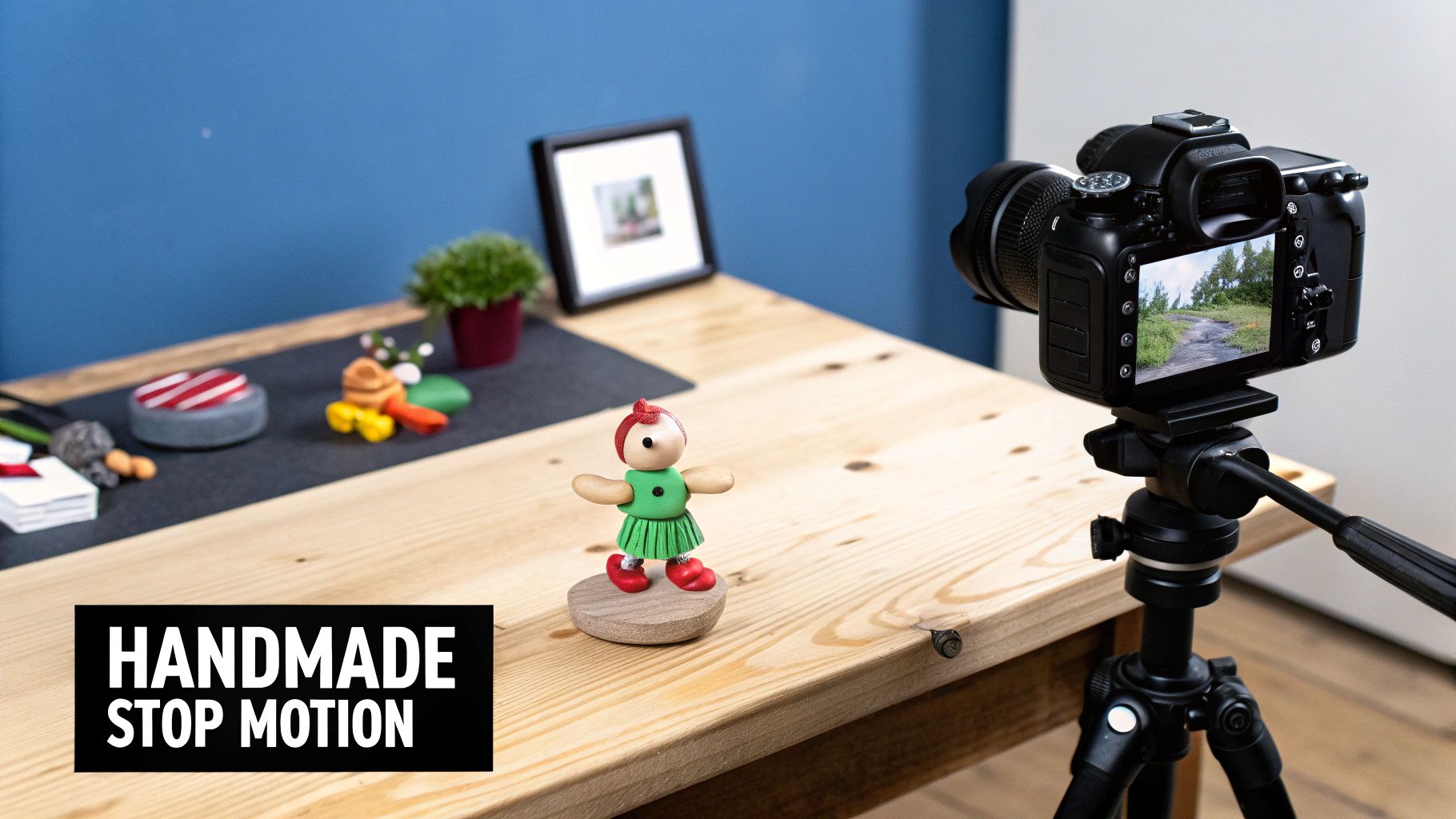
Let’s step away from the purely digital world for a moment and look at animation styles grounded in the physical. These tangible techniques, with stop motion leading the pack, are all about manipulating real-world objects and capturing them frame by painstaking frame. The result is a uniquely handcrafted feel that digital methods can’t quite replicate, giving it a powerful, authentic voice.
Think of it this way: an artist moves a clay puppet a single millimetre, takes a photo, then moves it another millimetre and snaps another picture. Repeat that thousands of times. When you play all those photos back in sequence, the puppet magically moves on its own. That’s the heart of stop motion—a meticulous process that breathes life into physical objects with a distinct, slightly imperfect charm.
This hands-on method creates an immediate, genuine connection with the audience. Its slightly jerky yet deliberate movement feels honest and personal, making it a brilliant choice for brand stories that need to ooze warmth, creativity, and craftsmanship.
Different Approaches to Stop Motion
While the core idea is the same, “stop motion” is actually an umbrella term for several distinct styles. Each one offers a different visual texture and creative potential, opening up a huge range of artistic expression.
- Claymation: This is probably the one you know best, using malleable clay or plasticine figures. It allows for incredibly fluid and expressive character work, made famous by studios like Aardman Animations.
- Puppet Animation: This style uses more structured puppets, often built with internal skeletons or armatures. This gives animators precise control over every movement, making it perfect for detailed, character-driven stories.
- Cut-Out Animation: One of the simplest forms, this involves moving 2D pieces of paper or fabric across a flat background. It can create highly stylistic and graphic results, often feeling like a storybook coming to life.
To truly get a feel for the unique charm of this method, it’s worth exploring the wide world of stop motion animation examples.
This tangible approach has a rich history right here in Poland. The nation’s animation boom in the 1990s was heavily influenced by the work of Se-ma-for, the studio behind the Oscar-winning short ‘Peter and the Wolf’. That film masterfully blended stop motion with digital effects, captivating over 5 million viewers worldwide and proving just how much global appeal physical animation has.
Analysing the Pros and Cons
Committing to a labour-intensive style like stop motion is a big decision. While it delivers an aesthetic that’s second to none, it comes with practical considerations that every project manager needs to weigh up.
Stop motion’s greatest strength is its undeniable authenticity. In a world saturated with slick digital content, the handcrafted feel of physical animation can cut through the noise and create a lasting, memorable impression on viewers.
Key Advantages:
- Distinctive Aesthetic: It has a unique, tactile quality that instantly sets your project apart from the usual computer-generated content.
- High Engagement: That novelty and visible craftsmanship often hook viewers, leading to higher engagement and better brand recall.
- Creative Versatility: If you can physically move it, you can animate it. This opens the door to endless creative possibilities.
Potential Drawbacks:
- Extremely Time-Consuming: The frame-by-frame process is incredibly slow. It demands immense patience and precision from the entire team.
- Difficult to Revise: Unlike digital files, there’s no “undo” button. A small mistake or a late-stage change could mean reshooting an entire sequence.
- Higher Production Cost: All that time, plus the need for specialised artists and dedicated studio space, can often make it a more expensive route to take.
Specialised and Emerging Animation Techniques
Beyond the big players like 2D and 3D, there’s a fascinating world of specialised animation techniques designed to solve very specific business problems. These methods move past traditional storytelling to focus on precision, immersion, and efficiency, offering powerful new ways to communicate complex ideas. For anyone making decisions about content, understanding these niche styles opens the door to more effective training, marketing, and educational material.
From visualising the invisible to building interactive brand worlds, these advanced forms are pushing the boundaries of what animation can do. They represent a new frontier in visual communication, where technical accuracy and user experience are everything.
Precision in Technical and Medical Animation
Some concepts are just too complex, too small, or too internal for a live-action camera to capture. This is where technical and medical animation comes in. It transforms intricate processes into clear, understandable visuals. Think of it as a digital microscope that can zoom right into a machine’s inner workings or illustrate a complex surgical procedure with flawless accuracy.
This style isn’t about artistic flair; it’s about absolute clarity. It’s an indispensable tool for:
- Corporate Training: Demonstrating how to assemble complex equipment or follow critical safety procedures.
- Medical Education: Explaining how a new drug works in the body or showing anatomical functions to students and patients.
- Product Engineering: Visualising prototypes and mechanical processes with pinpoint detail long before a physical model exists.
Immersive Worlds of VR and AR Animation
Virtual Reality (VR) and Augmented Reality (AR) aren’t just for gaming anymore. They’ve become powerful business tools that place the user directly inside an animated experience. VR animation builds fully immersive, 360-degree digital worlds, while AR animation overlays digital information onto the real world through a device like a smartphone.
This screenshot of a VR headset shows the gateway to these incredibly immersive animated experiences.
What this really highlights is the personal, all-encompassing nature of VR. That’s the key to its power in creating unforgettable, interactive brand encounters or incredibly realistic training simulations.
These immersive technologies shift the user from being a passive viewer to an active participant. In marketing, this means creating unforgettable product demonstrations or virtual showrooms that drive deep engagement and brand loyalty.
As Poland leverages its fantastic balance of cost and quality, its animation market is increasingly focusing on these advanced formats. The country’s output is becoming a key player on the global stage, with 40% now dedicated to gaming and AR/VR development. You can find more insights on the Polish animation market’s growth on Data Bridge Market Research.
Cost-Effective Corporate Communication Tools
Not every project needs the horsepower of 3D or VR. For clear and efficient corporate messaging, styles like whiteboard animation and animated infographics offer a compelling, budget-friendly alternative.
Whiteboard animation simulates a hand drawing illustrations on a screen, which creates a simple, engaging, and personal feel. It’s perfect for explaining concepts step-by-step. Similarly, animated infographics take static charts and data and bring them to life with motion, making dense statistics and trends much easier to digest. Both are excellent choices for internal communications, social media shorts, and educational videos where clarity and speed are the top priorities.
Still Have Questions About Animation? We Have Answers.
Stepping into the world of animation can bring up a lot of practical questions about money, time, and finding the right people for the job. To help you feel confident in your decision, let’s go through some of the most common things we hear from our corporate and agency partners.
Getting these questions answered early clears the path from a creative spark to a finished project that delivers real business results. It makes sure everyone—your team and our studio—is on the same page from day one.
How Do I Budget For an Animation Project?
There’s no one-size-fits-all answer here; the budget depends entirely on the style and complexity you’re after. A simple motion graphics explainer will naturally cost less than a detailed 3D product visualisation, which needs specialised software and a lot of rendering power.
A few key things will shape the final cost:
- Style Complexity: Frame-by-frame 2D and photorealistic 3D are the most labour-intensive and will sit at the higher end of the budget.
- Project Length: The longer the animation, the more time every stage of production will take.
- Production Timeline: Need it done yesterday? Rush projects often require a bigger budget to get them over the line on an accelerated schedule.
Think of it this way: a clean, simple whiteboard animation is often the most budget-friendly choice, while a cinematic stop-motion commercial is a significant creative investment.
What Is a Typical Animation Production Timeline?
Just like budgets, timelines can vary wildly. A straightforward 60-second motion graphics video might take 2-4 weeks from the initial idea to the final delivery. On the other hand, a 3-minute 3D animation could easily take 8-12 weeks or even longer because of the detailed modelling, rigging, and rendering stages involved.
A common mistake is not leaving enough time for feedback and revisions. Building some buffer time into the schedule for your team’s review is critical for keeping things on track without sacrificing quality.
This is especially true as the industry grows. The Poland animation market, valued at 2,736.33 USD Billion, is projected to hit 3,564.86 USD Billion by 2032. This growth is fuelled by increasingly complex projects where top studios blend different animation styles for major international productions, which naturally affects timelines. You can discover more about the thriving Polish animation market here.
How Do I Choose the Right Animation Partner?
Picking the right studio is about more than just a slick portfolio. You need a partner who gets your business goals and can act as a strategic advisor. A great studio won’t just ask about visual style; they’ll dig into your target audience and what success looks like for you.
When you’re looking at potential partners, ask for case studies from your industry and check their client testimonials. A strong creative partner will have a clear, transparent process and keep you in the loop every step of the way, ensuring the final animation hits all your strategic goals.