
Technical Video Production: Master Your Workflow with Expert Tips
When you need to explain something truly complex—like how a medical device works or the precise assembly steps for a new piece of machinery—words often fall short. That’s where technical video production comes in. It’s the art and science of turning dense, intricate information into visual content that is crystal clear, accurate, and engaging.
What Is Technical Video Production?
Imagine trying to describe the inner workings of a jet engine or the microscopic process of DNA sequencing using only a written manual. It’s a tall order. Technical video production is the bridge that connects expert-level knowledge with your audience, transforming that complexity into a visual story that people can actually follow and understand.
This is a world away from your standard marketing video. While a typical corporate film might focus on evoking brand emotion and delivering a broad message, a technical video is all about precision, detail, and educational value. The number one goal is to inform, train, or explain something with absolute accuracy, leaving zero room for guesswork or confusion.
The Core Purpose of Technical Videos
At its heart, this discipline is a specialised communication tool built to make the complex simple. It’s absolutely vital in industries where getting the details right is non-negotiable—from manufacturing and engineering to pharmaceuticals and software development.
Technical videos are usually created to:
- Clarify Complex Processes: Visualising multi-step procedures, like safety protocols or assembly instructions, in a way that’s impossible to misinterpret.
- Demonstrate Product Functionality: Showing exactly how a sophisticated piece of software or machinery works, highlighting features that are tough to capture in writing.
- Educate and Train: Getting new employees up to speed on complex equipment or providing ongoing education for medical professionals on new surgical techniques. For a deeper look into this field, especially for employee development, check out this ultimate guide to video production for corporate training.
How It Differs from Standard Production
The real difference boils down to the approach and the skills required. Let’s compare the two side-by-side to see what sets them apart.
Key Differences Between Standard and Technical Video Production
This table highlights the core distinctions in goals, content, and process between general corporate video and specialised technical video production.
| Aspect | Standard Video Production | Technical Video Production |
|---|---|---|
| Primary Goal | Evoke emotion, build brand awareness, persuade. | Educate, inform, train with complete accuracy. |
| Audience | Often a broad, general audience (customers, public). | A specialised audience (engineers, technicians, medical staff). |
| Core Message | Emotional, benefit-driven, high-level storytelling. | Factual, process-driven, detailed and specific. |
| Key Skillset | Cinematic storytelling, creative direction, marketing. | Subject matter expertise, instructional design, technical accuracy. |
| Success Metric | Engagement, brand lift, conversions. | Comprehension, knowledge retention, task performance. |
| SME Role | Consultative, providing background info. | Integral, a core part of the production team for validation. |
As you can see, the focus is entirely different. A standard video might use powerful storytelling to connect with viewers, but a technical video relies on a factual, logical narrative. The production team absolutely must work hand-in-glove with Subject Matter Experts (SMEs) to ensure every visual, animation, and line of narration is 100% correct.
Technical video production is less about cinematic flair and more about being an expert translator. Its success isn’t measured by how beautiful it looks, but by how effectively it transfers complex knowledge to the viewer.
This relentless focus on accuracy shapes the entire process. It demands a much deeper research and verification phase, often requiring the creation of detailed 3D models, precise animations, or meticulously scripted live-action demonstrations. Ultimately, it’s where creative skill meets engineering precision to create content that’s not just helpful, but indispensable.
The Technical Video Production Workflow Explained
Creating a technical video isn’t just about pointing a camera and shooting. It’s a structured journey that carefully transforms a complex, specialist idea into a visual story that’s crystal clear and compelling for its intended audience. Unlike more creatively-led projects, this process is built on precision and a step-by-step methodology to guarantee complete accuracy.
The whole thing can be broken down into five distinct phases, with each one building on the last.
Think of this workflow as a translation engine. It takes the raw, intricate concepts from an expert’s mind and methodically converts them into a visual format anyone can understand.
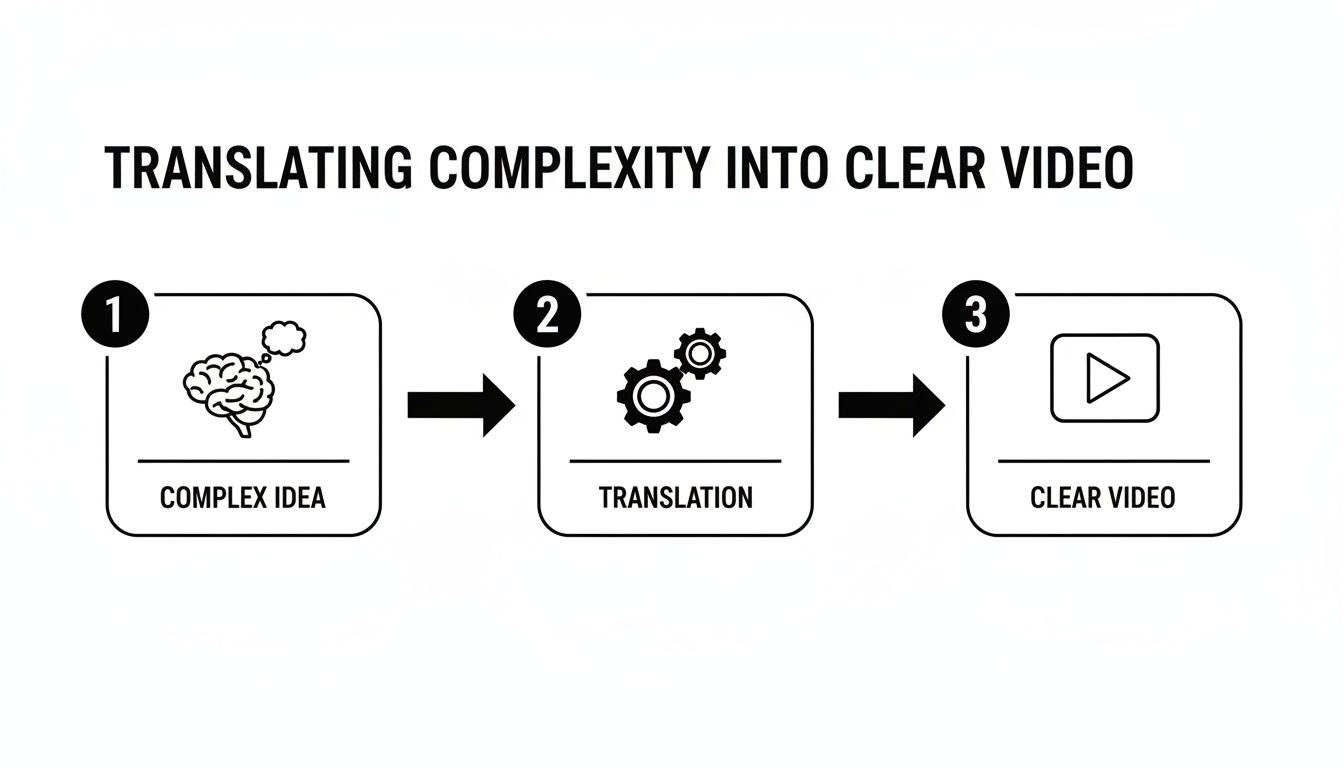
This process is designed to move from a complex idea, through a structured translation phase, and end with an accessible final video. Getting a handle on these steps is the key to managing a successful project and making sure the final product is both accurate and genuinely effective.
Phase 1: Discovery and Briefing
The first and most important stage is Discovery. This is where your production partner gets completely immersed in your world to truly understand the subject matter. It’s so much more than a simple kick-off meeting; it’s a deep dive into the technical nuts and bolts, the audience’s current level of knowledge, and what you need the video to achieve.
A crucial part of this phase is sitting down with your Subject Matter Experts (SMEs). These are your engineers, scientists, or technicians who live and breathe this stuff. The production team’s job is to ask the right questions, listen carefully, and pull out the exact information needed to build a factual foundation for the entire project.
This phase wraps up with a detailed creative brief, which becomes the project’s blueprint. It nails down:
- The main educational goal.
- A specific profile of the audience and what they already know.
- The key technical concepts that have to be explained.
- The desired tone, style, and visual direction.
Phase 2: Scripting and Storyboarding
With a solid brief locked in, we move into the Scripting and Storyboarding phase. This is where the abstract ideas from discovery start to take on a concrete visual shape. The scriptwriter works hand-in-hand with the SMEs to draft a script that is not only technically sound but is also written for the screen—making it clear, concise, and easy to follow when spoken.
Once the script gets the green light, a storyboard artist creates a visual mock-up of every scene. The best way to think of it is as a comic book version of your final video. Each frame in the storyboard details:
- The camera angle or shot composition.
- Any on-screen text or graphics.
- Key actions or animations.
- The matching part of the script’s voiceover.
This visual plan is priceless. It lets everyone involved, from stakeholders to the animation team, see exactly how the video will look and feel before any expensive production work begins. It’s really the last chance to make big structural changes without a major headache.
Phase 3: Production: Filming or Animation
Now it’s time to bring that storyboard to life. This is the Production phase. Depending on the project, this will either involve live-action filming or digital animation. For videos showing off physical products or processes, this could mean a professional crew filming on-site, using specialist lighting and camera gear to capture every last detail perfectly.
For ideas that are invisible or conceptual, like how software works or a complex biological process, this is where our animators step in. They use the storyboards to build 2D or 3D models and create motion graphics that make the abstract tangible. You can find out more about what’s possible by exploring different kinds of video and animation production.
In the production phase, precision is everything. A single millimetre of error in a 3D model or one slightly wrong step in a filmed procedure can completely undermine the video’s credibility. Constant check-ins with the SMEs are absolutely essential here.
Phase 4: Post-Production: Editing and Graphics
Once all the raw footage is captured or the animation scenes are rendered, the project moves into Post-Production. This is where all the separate pieces come together. An editor assembles the shots following the storyboard, timing the cuts to the narration and pacing the information for the best possible understanding.
This stage involves several key tasks:
- Editing: Weaving together the final sequence.
- Colour Correction: Ensuring a consistent and professional look.
- Sound Design: Adding music, sound effects, and professionally mixing all the audio.
- Motion Graphics: Adding on-screen text, callouts, and other visual aids to boost clarity.
The scale of this industry is huge. In Poland alone, the film and video production sector, which includes these highly specialised services, had an estimated market size of €825.8 million in 2025. This vast network of over 10,000 businesses provides the deep technical skill needed for professional post-production.
Phase 5: Final Delivery and Distribution
The final step is Delivery. After a meticulous review and approval process involving your team and SMEs, the final video file is rendered and exported in all the required formats. This might mean different versions optimised for a website, a trade show kiosk, or an internal training platform.
To help streamline things, it can be useful to look into modern resources like AI video generator tools which can sometimes help create initial drafts or social media snippets. Ultimately, having a clear distribution plan ensures your carefully crafted video reaches the right people and achieves its goals.
A Closer Look at Different Technical Video Formats
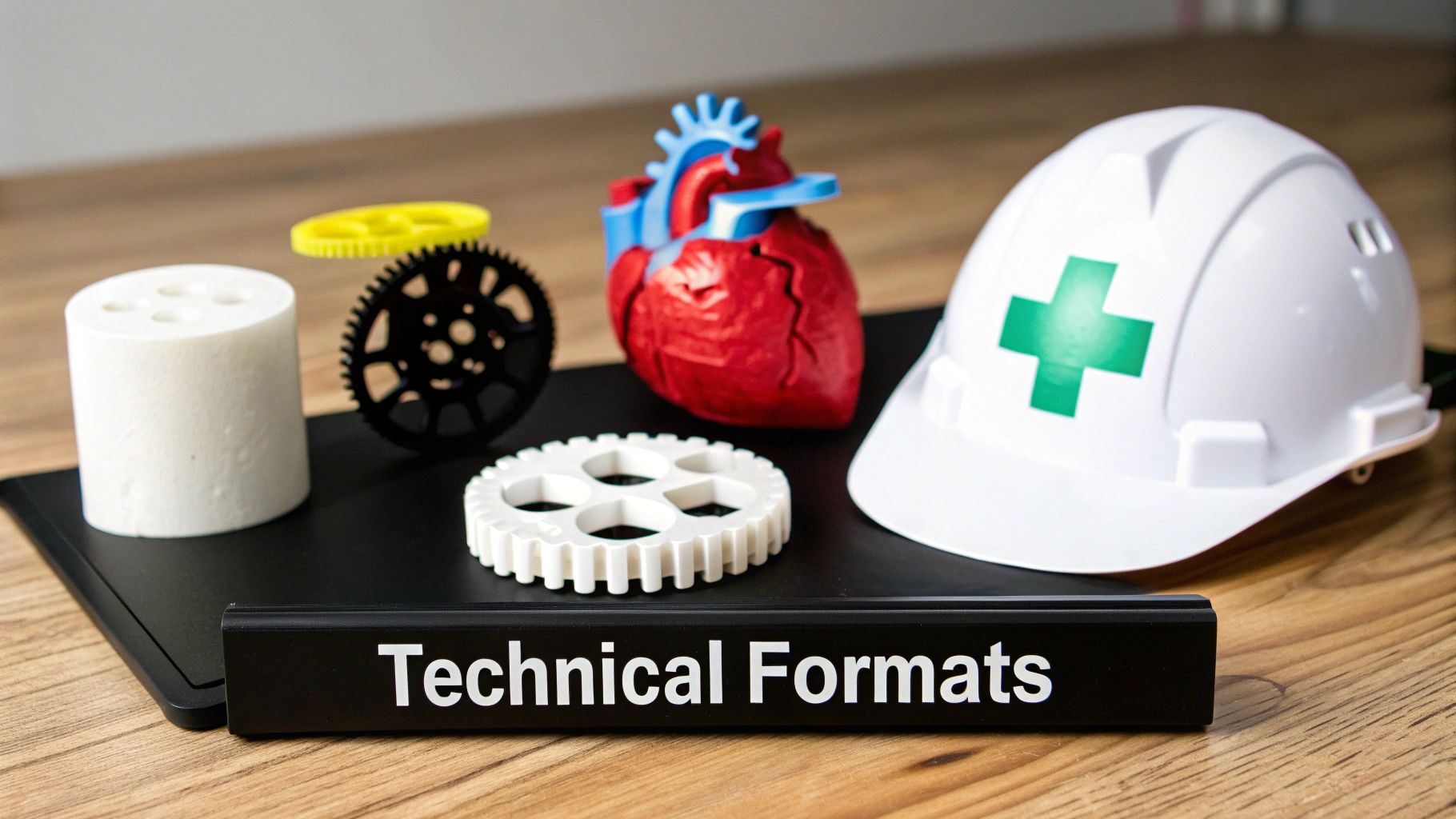
Technical video production isn’t a single, monolithic thing. Think of it more like a versatile toolkit, with different video formats designed to solve very specific communication problems. Choosing the right format is the crucial first step towards hitting your business goals, whether that’s getting more people to use your product, making your workplace safer, or training medical professionals.
It’s like picking the right tool for a job. You wouldn’t use a sledgehammer to hang a picture frame, right? In the same way, the video format you choose has to perfectly match your message and what your audience needs to understand. Let’s break down some of the most effective types and see where they really shine.
Product Explainer and Demonstration Videos
When you’re launching a product with complex features, a simple advert just won’t do the trick. Product explainer and demonstration videos are designed to show, not just tell. They essentially give viewers a guided tour of how a product works, making abstract ideas feel tangible and easy to grasp.
These videos are incredibly powerful because they build confidence. By showing someone how to use a challenging piece of software or assemble a new bit of kit, you can massively cut down on customer support queries and help new users get up to speed much faster.
A great technical explainer video doesn’t just list features; it translates those features into real-world benefits. Its goal is to create that “aha!” moment where a potential customer finally grasps the value your product offers.
For instance, a software firm might use an animated explainer to show off its data analytics dashboard. A machinery manufacturer could use a live-action video to demonstrate the correct setup and calibration for a new industrial lathe. These videos quickly become vital assets for both marketing and support teams.
Technical and Medical Animations
Let’s face it, some concepts are just impossible to film. They might be too small, too large, or completely invisible to the naked eye. This is exactly where technical and medical animations step in. Using 2D or 3D animation, our team can visualise literally anything—from the subatomic level to the inner workings of a satellite orbiting the globe.
In medicine, these animations are essential for explaining complex biological processes, walking through surgical procedures, or showing how a new drug interacts with the body. For engineers, an animation can deconstruct a complex machine layer by layer, revealing how all the internal parts work together in perfect sync. They make the unseen, seen. You can dive deeper into the world of 3D technical videos to see how we bring these intricate visualisations to life.
Procedural and Safety Training Videos
In high-stakes industries like manufacturing, energy, and construction, good training isn’t just a nice-to-have; it’s non-negotiable. Text-heavy manuals are often ignored or misunderstood, leading to expensive mistakes or, even worse, accidents. Procedural and safety videos deliver clear, step-by-step instructions that are easy to follow and, crucially, easy to remember.
This type of technical video focuses on showing the correct—and safe—way to perform specific tasks. That could be anything from lockout-tagout procedures to the proper way to handle hazardous materials.
Effective safety videos always include these key elements:
- Clear, Sequential Steps: Every action is shown in a logical order, leaving no room for guesswork.
- Visual Emphasis: On-screen text and graphics are used to highlight critical safety warnings and key actions.
- Real-World Context: Filming in the actual work environment makes the training far more relatable and impactful.
Broadcast Promos and On-Air Graphics
The broadcast world also leans heavily on technical video production, especially for creating promos and complex on-air graphics. While they might look purely creative, they are incredibly demanding from a technical standpoint, requiring precise timing, sticking to strict broadcast standards, and often integrating with live data feeds.
This is a growing area as viewing habits continue to shift. In Poland, for example, audience behaviour shows a massive move towards streaming. This is reshaping the demand for high-quality technical production, with streaming hitting a historic 10.1% of total TV-screen viewing in July 2025. That’s a 17.4% relative jump in just one year, proving the need for technically perfect content on every platform. These promos and graphics have to get information across quickly and effectively, from news programme intros to sports score overlays, all while keeping the brand’s look consistent.
Best Practices for Accuracy And Clarity
When it comes to technical video, a tiny mistake isn’t just a blooper—it can be a critical failure. Imagine a misplaced decimal point in an engineering animation or a wrong step in a safety procedure. The real-world consequences could be serious. That’s why a workflow built around accuracy and clarity isn’t just a nice-to-have; it’s the absolute foundation of the entire process.
This is what separates a genuinely helpful video from a potentially hazardous one. The whole project hinges on a set of practices designed to protect the integrity of the information you’re sharing. These principles guide every single step, from the first conversation with your experts to the final render, making sure the result is technically perfect and crystal clear for your audience.

Partner with Subject Matter Experts
The single most crucial relationship in any technical video project is between the production crew and your Subject Matter Experts (SMEs). These people are the guardians of technical truth. It’s not the production team’s job to be experts in your field; their job is to be expert translators, turning that deep, complex knowledge into a compelling visual story.
This has to be a real, ongoing collaboration. It’s far more than a single kick-off meeting. It needs a structured process of reviews and approvals at every key stage: script, storyboard, animation, and final edit. This is how you ensure accuracy is checked and double-checked, stopping errors before they ever have a chance to slip through.
The SME’s role isn’t just to hand over information but to validate it at every step. A successful project is a true partnership where the production team respects the SME’s knowledge and the SME trusts the team’s skill in communicating it visually.
Simplify Visually Without Losing Detail
Clarity in a technical video doesn’t mean “dumbing it down.” It means deliberately removing visual clutter and guiding the viewer’s eye to what really matters. It’s the art of subtraction—stripping away distractions to reveal the core message.
Here are a few powerful ways to do this:
- Use Clean Graphics and Models: Uncluttered 3D models and minimalist 2D graphics are perfect for isolating the specific part or process you’re explaining. You can explore great examples of how engineering and technical animation masters this with precision.
- Logical Pacing: Don’t throw everything at the viewer at once. Information needs to be introduced sequentially, building concepts piece by piece. This gives each new idea a moment to land before you move on to the next one.
- Strategic Use of Colour: Colour-coding is a fantastic tool. Use it to highlight key parts, show the difference between systems, or draw attention to safety-critical areas. A consistent colour key helps your audience follow along without even thinking about it.
Plan for Localisation And Accessibility from Day One
In today’s global market, your video will likely need to reach people who speak different languages and have different needs. Trying to tack on localisation and accessibility at the end of a project is a recipe for headaches and higher costs. The smart move is to plan for it from the very beginning.
This forward-thinking approach just takes a few key considerations:
- Script for Translation: Write your script using clear, straightforward language. Steer clear of idioms, slang, or cultural references that won’t make sense in other languages.
- Design for Text Expansion: When you’re designing on-screen text and graphics, leave some breathing room. Languages like German or Polish often use more characters than English, and you need space for that text to fit without looking cramped.
- Prioritise Subtitles and Captions: Make sure your video includes options for closed captions (for the hearing impaired) and subtitles (for different languages). This simple step makes your content useful to a much wider audience.
By building these practices into your workflow, you create a solid system that puts precision and understanding first. The result is a high-value technical video that you can be confident will educate, train, and inform with absolute clarity.
How To Budget For Your Video Project
Setting a realistic budget is one of the most important first steps when you’re planning a technical video. The costs aren’t pulled out of thin air; they’re directly tied to the complexity of your vision and the resources needed to bring it to life. Understanding what drives these costs is the key to creating a budget that works for your goals and avoids any nasty surprises later on.
Think of it like commissioning a custom piece of equipment. The final price depends on the sophistication of the parts, the precision of the engineering, and the time it takes to put it all together. A simple instructional video is like a basic, reliable tool. A detailed 3D medical animation? That’s a highly specialised, complex machine, and its price tag will reflect that.
Key Factors That Influence Your Budget
Several key variables have a direct impact on the total investment for your video. When you ask for a quote, any production partner worth their salt will be looking at your project through the lens of these primary factors.
- Project Complexity: A straightforward screen recording with a professional voiceover is going to cost much less than a multi-location shoot with actors, or a detailed 3D animation that needs to show intricate internal mechanics.
- Production Crew and Gear: The size of the crew matters. So does the type of cameras, specialised lighting, and sound equipment they need to use. A shoot in a controlled studio environment is a very different beast from a complex on-site shoot at an industrial facility.
- Post-Production Needs: This is where the magic happens, and it includes editing, colour correction, sound design, and motion graphics. The more sophisticated the graphics and visual effects, the more time and skill are required, which naturally affects the budget.
- Talent and Location: If your project needs professional actors, a specific rented location, or travel to remote sites, these costs will be factored into the overall expenses.
Understanding these elements helps you see exactly where your money is going. Your most powerful tool for getting an accurate quote is a well-defined project brief, as it gives your production partner all the clarity they need. For more ideas on how video can fit into your financial planning, have a look at our guide on marketing with video.
Setting Realistic Timelines
Just as important as the budget is a realistic timeline. It’s absolutely essential for managing expectations with everyone involved. Rushing the process, especially during the initial discovery and storyboarding phases, almost always leads to mistakes and expensive revisions down the line.
A common mistake we see is underestimating the time needed for feedback and approvals from all the stakeholders. Building buffer days into each phase of the production schedule is a smart move that keeps the project on track without sacrificing quality.
Here are some general timeline estimates to give you a rough idea for planning:
- Simple Explainer Video (2D Animation): You’re typically looking at 4-6 weeks. This covers scripting, storyboarding, the animation itself, and a couple of rounds of revisions.
- Live-Action Demonstration Video: This usually takes around 6-8 weeks. The timeline accounts for all the pre-production planning, a full day of shooting, and all the post-production work.
- Complex 3D Technical Animation: These projects can take anywhere from 10-16+ weeks. The longer timeline is because of the incredibly detailed work involved in modelling, texturing, rendering, and the essential, rigorous review process with your subject matter experts to guarantee technical accuracy.
The broader economy also has a part to play. In Poland, for instance, the total TV & Video market revenue is projected to hit an incredible US$5.22 billion in 2025. This huge figure, which includes massive advertising and production spending, helps set the scale for professional video services, influencing everything from crew rates to studio time. You can explore more of these market projections for Poland on Statista.com. This economic backdrop shapes the cost structure for high-calibre technical video production right across the country.
Choosing The Right Production Partner
Picking the right production company is easily the most critical decision you’ll make for your entire technical video project. The success or failure of your video comes down to one thing: finding a partner who not only has creative vision but truly respects and understands the need for technical accuracy. This is no time for a generalist; you need a specialist in your corner.
Start by looking past the flashy corporate showreels. Instead, take a deep dive into their portfolio. You’re looking for concrete examples of technical, industrial, or medical projects that echo what you’re trying to achieve. A team that’s already navigated the complexities of explaining a manufacturing process or visualising a delicate surgical procedure is already tuned into your world.
Vetting Their Process And Expertise
A solid portfolio is a great start, but it’s just that—a start. The real magic lies in their process. Any production partner worth their salt in the technical space will have a clearly defined workflow, especially for how they collaborate with Subject Matter Experts (SMEs). They should be able to get up to speed on complex topics quickly and ask the kind of intelligent, insightful questions that cut right to the core of the subject.
Think of them as expert translators. Their job is to turn dense, technical jargon into a story that’s clear, compelling, and visually engaging. This skill alone is what stops projects from getting hopelessly bogged down in miscommunication, ensuring the final video is both bang-on accurate and genuinely interesting for your audience.
Key Questions To Ask Potential Partners
When you start talking to potential partners, going in with the right questions is crucial. This is how you properly vet their skills and project management style, making sure there are no nasty surprises waiting for you down the line.
Before you even think about a contract, make sure you get clear, confident answers to these questions:
- Who are your in-house experts? Do they have their own dedicated animators, motion graphics artists, and editors, or are they patching a team together with freelancers?
- How do you manage SME collaboration? Ask for their specific process for handling feedback and getting approvals at the script, storyboard, and editing stages.
- Can you show us a project similar in complexity to ours? Get them to walk you through a relevant case study, explaining the challenges they faced and how they solved them.
- What does your revision process look like? Find out how many rounds of revisions are included in the price and what their system is for managing feedback to prevent the dreaded scope creep.
Finding the right partner isn’t about hiring a supplier; it’s about building a collaborative team. They should feel like an extension of your own company, completely invested in getting every single detail right.
Choosing a team with proven experience in technical video production is your best guarantee of getting a final product that isn’t just visually impressive, but more importantly, is technically sound and effective as an educational tool.
Got Questions? We’ve Got Answers
Stepping into the world of technical video production for the first time? It’s completely normal to have a few questions. We get it. To help clear things up and give you the confidence to move forward, we’ve put together some straightforward answers to the questions we hear most often.
Our aim is to take the mystery out of the process, especially when it comes to the two big ones: time and money. Let’s get right into it.
How Much Will a Technical Video Cost?
There’s no single price tag for a technical video, as the cost really hinges on its complexity. Think of it this way: a simple screencast tutorial is a relatively modest investment, while a detailed 3D medical animation showing a complex surgical procedure can naturally run into tens of thousands of pounds.
The main things that shape the budget are:
- Animation Complexity: The level of detail we need to build into the 2D or 3D models and motion graphics.
- Filming Requirements: Whether we need on-location shoots, a full crew, or specialised camera gear.
- Post-Production Work: The time spent on editing, colour grading, sound design, and any visual effects needed to bring it all together.
How Long Does The Production Process Take?
Just like the budget, the timeline is tailored to the project. A straightforward 2D explainer video can often be turned around in a swift 4-6 weeks, from our first conversation to final delivery.
Bigger ideas, however, need a bit more time to develop. A project involving intricate 3D animation or filming across multiple locations could easily take 3-6 months to perfect. It’s crucial not to rush the early discovery and storyboarding stages—they’re the foundation everything else is built on.
Do I Need to Write a Full Script?
Not at all. Your role is to bring the core technical knowledge to the table and, most importantly, give our team access to your Subject Matter Experts (SMEs). You’ve got the expertise; we’ve got the storytelling chops.
A great production partner won’t expect a polished script from you. Instead, we’ll work with your team to translate dense technical information into a clear, engaging narrative that’s built from the ground up for video.
What’s the Single Most Important Factor for Success?
If we had to pick just one thing, it would be the close, collaborative partnership between your internal Subject Matter Experts (SMEs) and our creative storytellers. This synergy is the absolute secret sauce for brilliant technical video production.
This relationship ensures the final video is not only 100% accurate but also clear, engaging, and easy for your audience to digest. When your experts and our creators are in sync, the result is a powerful educational tool that truly hits the mark.
Ready to turn your complex ideas into clear, compelling video? At Simple Frame, we specialise in creating technically accurate and visually stunning animations and videos that educate and inspire. Let’s build something incredible together. Start your project with us today.
Article created using Outrank