
A Complete Guide to Corporate Video Production
When we talk about corporate video production, we’re talking about much more than just hitting ‘record’. It’s the strategic craft of creating video content with a clear business purpose, whether that’s for an internal team or your external audience. This is a goal-driven discipline through and through, designed to achieve specific outcomes like building brand trust, training your staff, or launching a new product.
What Corporate Video Production Truly Means
A great way to think about it is like commissioning a custom-built vehicle. You wouldn’t just ask for “a car.” You’d have a specific purpose in mind. Is it a high-performance racer built for the track, or a rugged haulier designed to move heavy cargo? Its job dictates everything, from the engine’s power and the chassis design right down to the final cost.
It’s exactly the same with corporate video. The core purpose shapes the entire production. A video meant to welcome new hires will have a completely different look, feel, and tone from one created to get customers excited about a new product. That strategic alignment is what elevates professional production from amateur footage. It’s a true partnership focused on getting measurable business results.
The Strategic Foundation of Video
Long before any cameras start rolling, the essential groundwork has to be laid. This first phase is all about asking the right questions, making sure the final video actually delivers real value. Every decision that follows hinges on the answers to these fundamentals:
- What’s the primary goal? Are you looking to boost sales, improve employee engagement, build brand awareness, or simplify a complex process for your customers?
- Who is your target audience? Is this video for potential buyers, existing clients, your internal team, or key industry players? The tone, language, and style have to connect with that specific group.
- What is the core message? If a viewer could only remember one thing after watching, what should it be? Getting this crystal clear from the start prevents a confusing or unfocused final cut.
A well-defined strategy is the blueprint for a successful corporate video. It ensures that every creative choice, from the script to the soundtrack, serves a specific business objective and contributes to a tangible return on investment.
A Journey from Idea to Impact
The production process itself is a journey that transforms a simple concept into a polished, compelling business asset. While we’ll dive into the details later, it helps to see it as a structured progression. It starts with creative brainstorming and scriptwriting, flows through meticulous planning and the actual shoot, and finishes with editing, sound design, and professional colour grading.
Each stage builds on the last, demanding expertise and close collaboration to bring that initial vision to life. You can see the results of this careful process in professional work. Take a look at our corporate video production portfolio and you’ll notice how different goals lead to completely unique and distinct final products. At the end of the day, great corporate video production isn’t just about making something look good—it’s about creating a strategic tool that works hard for your business.
Choosing the Right Type of Corporate Video
Once you’ve grasped the strategic power of video, the next move is picking the right tool for the job. Just like a carpenter has a whole collection of saws and hammers, corporate video production offers a diverse range of formats. Each one is uniquely built for a specific purpose. Choosing the right one isn’t really about the video itself—it’s about the outcome you want to achieve.
Think of it this way: are you trying to build an emotional connection with your audience, or do you need to clearly explain how your complex software works? The answer to that question will steer you towards the perfect video format. This ensures your message not only reaches its audience but lands with real impact.
Building Your Brand with Brand Films
A brand film is the flagship of your video fleet. It’s not about selling a specific product. It’s about telling your story, communicating your values, and creating a powerful emotional bond. These videos often have higher production values and a more cinematic feel.
They are perfect for top-of-funnel goals where you want to build awareness and leave a lasting impression. By focusing on the “why” behind your business—your mission, your people, or your impact—you build a foundation of trust and loyalty that pays off for years to come.
Explaining the Complex with Explainer Videos
Sometimes, your product or service is brilliant but just isn’t easy to understand at a glance. This is where explainer videos shine. They are short, focused videos, often using animation or motion graphics, that break down complicated ideas into simple, digestible concepts.
The main goal here is clarity and education. A well-made explainer video answers key questions fast and demonstrates value, making it a must-have tool for landing pages, sales meetings, and customer onboarding. They cut straight through the noise and deliver your core value proposition in 90 seconds or less.
The most successful corporate videos are those that align perfectly with a specific business goal. A product demo aims for conversion, an internal training video seeks comprehension, and a brand film builds affinity. Clarity of purpose is everything.
Showcasing Value with Product and Promotional Videos
When your goal is to drive sales or spotlight a specific offering, product videos are your go-to format. These videos move beyond a list of features and focus on benefits, showing your product in action and demonstrating how it solves a real-world problem for the viewer.
They can range from clean, simple studio demonstrations to dynamic lifestyle shoots showing customers actually using the product. This format is crucial for moving prospects through the sales funnel, giving them the visual proof they need to make a purchase. For a closer look at how these videos are crafted for impact, explore our insights on promotional video production.
Capturing the Moment with Event Videos
Corporate events—whether they’re major industry conferences, product launches, or internal company meetings—represent a significant investment of time and resources. Event videos extend the value of these moments long after the day is over.
These videos can be used for multiple purposes:
- Highlight Reels: A short, energetic recap perfect for social media and promoting future events.
- Session Recordings: Valuable content for attendees who missed a talk or for those who couldn’t be there.
- Testimonial Capture: Events are a golden opportunity to capture authentic feedback from happy clients and partners.
This type of video production turns a one-time event into a lasting marketing asset that keeps on giving.
Matching Your Goal to the Right Video Format
To make the decision-making process a bit easier, it helps to match your primary objective directly to a video format. Each type is designed to connect with a specific audience on a platform where they are most receptive. The table below provides a quick reference to help guide your strategy.
| Video Type | Primary Goal | Target Audience | Common Platforms |
|---|---|---|---|
| Brand Film | Build brand awareness & affinity | New & existing customers | Website homepage, social media, events |
| Explainer Video | Simplify a complex idea or process | Potential customers, new users | Landing pages, product pages, email |
| Product Video | Drive conversions & showcase features | Prospects in the consideration stage | Product pages, social media ads, YouTube |
| Event Video | Extend reach & create marketing assets | Attendees, prospects, employees | Social media, internal portals, website |
Ultimately, choosing the right video is about pinpointing your business need first. Once you know what you want to achieve, selecting the perfect format becomes a much clearer and more strategic decision.
Navigating the Video Production Process Step by Step
Embarking on a corporate video project might seem like a huge undertaking, but it’s really a logical, well-structured journey. Think of it like building a house: you start with a clear idea, draw up the blueprints, lay the foundation, build the structure, and then add the finishing touches.
The entire process breaks down into five key phases: Strategy, Pre-Production, Production, Post-Production, and Distribution. Each stage builds on the last, and understanding this roadmap is the key to a smooth collaboration with your production partner and a final video that truly works for your business.
Phase 1: The Strategy and Concept Development
This is where it all begins—the ‘why’. Before a single word is written or a camera is switched on, we need to lock down the core objective. A video without a clear goal is just a collection of nice-looking shots; it might be pretty, but it won’t deliver results.
During this foundational stage, we’ll work together to answer a few crucial questions:
- What’s the main business goal here? Are we trying to generate leads, train new staff, build brand awareness, or launch a new product?
- Who are we talking to? Defining the target audience—whether they’re potential customers, internal teams, or industry partners—shapes the video’s tone, style, and message.
- What’s the one thing they must remember? If your viewer walks away with just one key takeaway, what should it be? This becomes our creative North Star for the whole project.
The result of this phase is a detailed creative brief. This document gets everyone on the same page, outlining the objectives, audience, core message, and desired feel before we move an inch further.
Phase 2: Pre-Production, The Architectural Blueprint
Think of pre-production as an architect drafting meticulous blueprints before the first brick is laid. This is easily the most critical part of the whole process. Solid planning here prevents costly mistakes and frustrating delays later on. It’s where the creative vision gets translated into a concrete, actionable plan.
Key activities during pre-production include:
- Scriptwriting and Storyboarding: We flesh out the core message into a compelling narrative script. The storyboard then brings that script to life visually, shot by shot, like a comic-book preview of the final video.
- Location Scouting: Finding and securing the perfect spots that match your brand’s aesthetic and the story’s needs.
- Casting: Choosing the right professional actors, voiceover artists, or even prepping your own team members to shine on camera.
- Scheduling and Logistics: This is the nitty-gritty of creating a detailed shooting schedule, booking the crew and equipment, and handling all the moving parts to ensure production day is a breeze.
Pre-production is where 90% of the problem-solving happens. Get this right, and when the cameras start rolling, the team can focus on capturing amazing shots and performances, not scrambling to fix last-minute logistical problems.
The Polish audiovisual market offers a vibrant backdrop for these activities. In 2025, the Polish Film, Video & Television Programme Production industry was estimated to have around 10,851 businesses. With industry revenue hitting approximately €825.8 million, it signals a robust and competitive ecosystem for crews, locations, and resources.
Phase 3: Production, Capturing the Vision
This is the part everyone imagines when they think of “making a video”—the actual shoot. Because of all the hard work in pre-production, this stage should run like a well-oiled machine. The director guides the talent, the cinematographer captures the visuals, and the sound recordist makes sure every word is crystal clear.
As the client, your role on set is often to be the final voice of approval, making sure the performances and setups align perfectly with your brand’s vision. Whether we’re filming in a studio, your offices, or on location, the goal is to capture all the visual and audio elements needed. This includes the main scenes as well as B-roll—supplementary footage that adds visual depth and context. For more complex projects, like filming industrial machinery or software, a specialised approach to technical video production may be necessary to guarantee absolute accuracy and clarity.
This infographic shows how different goals—like brand awareness, employee training, or driving sales—shape the production from the very start.
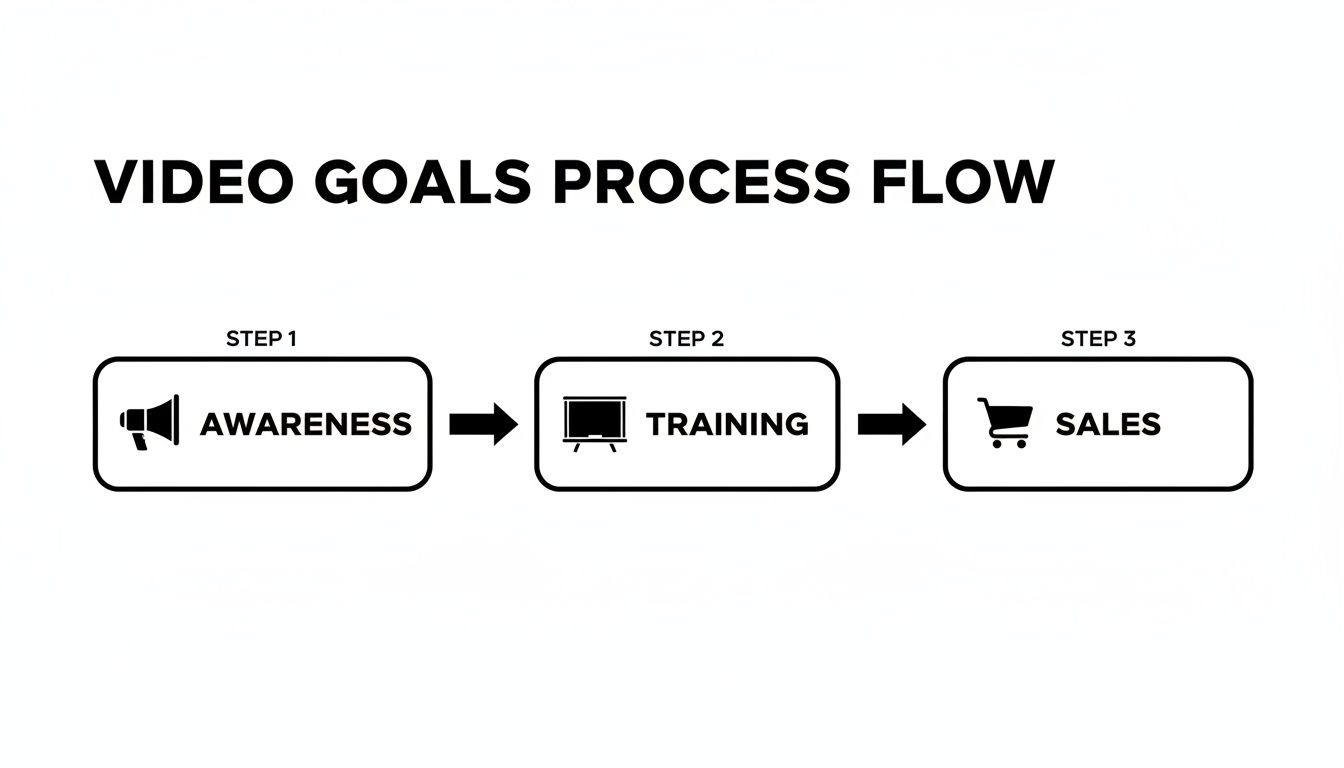
Each objective demands its own strategic approach, influencing everything from the script and visuals right down to the final call to action.
Phase 4: Post-Production, Assembling the Story
Once the shoot wraps, all the raw footage and audio files head into post-production. This is where the magic really happens and the story is brought to life. Our editor will meticulously sift through all the takes, weaving the best moments together into a cohesive and engaging narrative that follows the script and storyboard.
Post-production isn’t just one step; it’s a multi-layered craft:
- Video Editing: Assembling the footage, setting the pace, and structuring the narrative.
- Colour Grading: Artfully adjusting the colours to create a specific mood and give the video a polished, cinematic look.
- Sound Design and Mixing: Cleaning up the audio, adding a music score, and layering in sound effects to elevate the emotional impact.
- Motion Graphics and Animation: Adding animated text, logos, or visual effects to clarify complex ideas or reinforce your branding.
You’ll get to review a ‘rough cut’ and provide feedback for revisions, ensuring the final edit is a perfect match for the goals we set out in the beginning.
Phase 5: Distribution and Repurposing
A fantastic video is only effective if the right people see it. The final phase is all about getting your finished masterpiece in front of your intended audience—whether that’s on your website, social media channels, in an email campaign, or on a big screen at a trade show.
But it doesn’t have to end there. A single corporate video can be a goldmine of marketing content. Once your main video is launched, think about repurposing it. For example, there are tools that can help you efficiently transform long-form content into engaging short videos for social platforms. This small step can dramatically extend the life and reach of your investment, squeezing every last drop of value out of your new content.
How to Budget for Your Corporate Video Project
Let’s get right to it. For any business thinking about a creative project, two questions always pop up first: “How much will this cost?” and “How long is it going to take?”
The honest answer is always “it depends,” but that’s not very helpful, is it? A better way to think about it is that the budget and timeline for any corporate video production are shaped by specific, controllable factors.
It’s a bit like renovating a kitchen. You could spend a small amount on a fresh coat of paint and some new handles, or you could go all out with custom cabinets, high-end appliances, and a complete redesign. Both give you a “new kitchen,” but the scope, complexity, and cost are worlds apart. Video production works exactly the same way.
Key Factors That Shape Your Video Budget
Understanding where the money goes is the first step to building a realistic budget. A simple talking-head interview is a completely different beast from a cinematic brand film with professional actors and multiple locations. The final cost is simply the sum of your creative ambition and the logistics needed to make it happen.
These are the main drivers of your budget:
- Concept Complexity: A straightforward interview in one location needs far less planning and a smaller crew than a story-driven film shot across several places.
- Crew Size: The number of pros on set—from the director and camera operator to sound technicians and lighting experts—directly affects the daily cost.
- Production Days: Every single day of shooting adds costs for the crew, equipment hire, and location fees. Bigger ideas almost always need more time on set.
- Talent and Casting: Using professional actors, voiceover artists, or even specialist on-screen experts comes with its own set of fees.
- Locations: Filming in a controlled studio is often cheaper and easier than getting permits and managing the logistics for filming in public or private locations.
All these pieces are connected. A decision in one area will almost certainly have a knock-on effect on the others.
The single best way to manage your budget is to be crystal clear on your goals right from the start. A detailed brief that spells out your objectives, audience, and key message lets a production partner figure out the most cost-effective way to get the result you want.
Understanding Typical Production Timelines
Just as budgets vary, so does the time it takes to go from an idea to a finished video. A quick turnaround isn’t always the best option if it means cutting corners on quality. A well-managed timeline respects the creative process and gives each step the time it needs to produce a polished, professional video.
Here’s a rough guide to how long different types of videos can take:
- Simple Interview or Testimonial Video: Usually 2-4 weeks. This covers planning, a half-day shoot, and a straightforward edit.
- Animated Explainer Video: Often takes 4-8 weeks. The timeline here is driven by finalising the script, designing storyboards, creating the illustrations, and the animation work itself.
- In-Depth Brand Film: Can take 8-12 weeks or more. This allows for detailed pre-production, potentially several shoot days, and a more involved post-production phase with professional colour grading and sound design.
The Financial Landscape in Poland
The production scene in Poland has seen a huge amount of investment recently, which is a bit of a double-edged sword for corporate clients. In 2022, Polish producers reported that total budgets for film and TV production shot up by 70.2% to around €149 million.
While this growth means you get access to highly skilled crews and world-class facilities for your project, it also shines a light on the financing challenges in the industry. About 85% of producers say that getting access to capital is a major hurdle. In practice, this often means production companies rely on client pre-payments and deposits to manage their cash flow, which naturally influences contract terms and project schedules. You can explore more insights on the Polish film industry financing environment to get a fuller picture.
What this all means for you is that having transparent financial discussions and agreeing on a clear payment schedule with your production partner from day one is absolutely crucial. When you understand these factors, you can plan your resources properly, set realistic expectations, and build a strong partnership that respects both your budget and your creative vision.
Measuring the Success of Your Video Content
Creating a powerful corporate video is a huge milestone, but the work isn’t over once the final cut is approved. The real test begins now. A great video is only truly effective if it connects with the right audience and achieves its core purpose. This final stage is all about smart distribution and meticulous performance tracking.
Think of it like launching a rocket. The design and construction are vital, but without a precise launch plan and a good tracking system, it won’t hit its target or send back any useful data. In the same way, your video needs a strategic distribution plan to reach its intended viewers and clear metrics to prove it actually worked.
Aligning Distribution With Your Goals
Where you share your video is just as important as what’s inside it. The platform has to match the video’s objective and your audience’s viewing habits. A one-size-fits-all approach just doesn’t cut it; your distribution needs to be tailored for maximum impact.
For instance, a cinematic brand film belongs on your website’s homepage or playing on a big screen at an industry event to build brand prestige. On the other hand, a short, snappy product demo is built for targeted social media ads and email campaigns designed to drive immediate action.
Key Performance Indicators That Actually Matter
To prove your investment in corporate video production was worthwhile, you have to look past the surface-level numbers. While a high view count feels good, it doesn’t tell you the whole story. Real success is measured by how your video influenced behaviour and helped you hit your business goals.
A view is a vanity metric; a conversion is a business result. The goal is to connect your video investment to tangible outcomes, demonstrating a clear and compelling return on investment (ROI).
You need to focus on KPIs that tie directly back to the video’s original mission:
- Engagement Rate: This covers likes, comments, and shares, but the most important piece is average watch time. A high watch time is a clear signal that your message is compelling enough to hold people’s attention.
- Click-Through Rate (CTR): If your video includes a call to action (like “Visit our website”), the CTR shows you how many viewers actually took that next step. It’s a direct measure of interest.
- Conversion Rate: For any sales-focused video, this is the ultimate metric. It tracks how many viewers completed the action you wanted, whether that’s making a purchase, signing up for a demo, or downloading a guide.
Calculating Your Return on Investment
Measuring ROI is how you connect your video’s performance directly to your bottom line. The basic formula is straightforward: subtract the total cost of the video from the financial gain it generated, then divide that by the cost. A positive result means your video was a profitable venture.
Let’s say you spent €5,000 on a product video that directly resulted in €20,000 in new sales. Your ROI is a massive 300%. Tracking these numbers is absolutely essential for justifying your video marketing budgets in the future.
To really get a feel for how your corporate videos are performing, especially on major platforms, a deep dive into YouTube competitive analysis can be incredibly valuable. It helps you benchmark your own success against others in your industry. For more on connecting video to business results, check out our guide on marketing with video.
By focusing on the right metrics and a smart distribution plan, you can turn your corporate video from a creative project into a powerful business asset.
Your Corporate Video Production Questions Answered
Diving into the world of corporate video often kicks up a few questions. Whether this is your first project or you’re a seasoned pro looking to fine-tune your approach, getting straight answers is the best way to move forward with confidence. We’ve put together this section to tackle the most common queries we hear from our clients.
Think of it as a practical guide to help you sidestep common hurdles and make smart decisions. When you have a solid grasp of typical timelines, cost drivers, and your own role in the project, the entire collaboration becomes smoother, and the final video is far more likely to hit the mark.
How Long Does It Typically Take to Produce a Corporate Video?
The timeline for any video project is tied directly to its complexity. There’s no one-size-fits-all answer, as every video has its own unique demands, but we can offer a general guide to help you plan. For instance, a simple interview or testimonial video can often be turned around in just 2-4 weeks.
If you’re looking at a more involved animated explainer video, you’ll want to budget for 4-8 weeks. That extra time is crucial for nailing down the script, creating custom illustrations, and handling the meticulous animation work. For a full-blown cinematic brand film with multiple locations, professional actors, and advanced post-production, you should set aside 8-12 weeks or even longer.
Keep in mind that the pre-production stage is often where the timeline can fluctuate the most—thorough planning is absolutely essential for a successful shoot.
What Are the Key Factors That Determine the Cost of a Video?
Getting a handle on the main cost drivers is the first step to building a realistic budget for your video. The final price tag is really a combination of your creative ambition and the real-world resources required to make it happen.
Here are the primary factors that will influence the cost:
- Concept Complexity: A straightforward, single-location shoot is always going to be more budget-friendly than a complex, narrative-driven film with multiple intricate scenes.
- Shoot Duration: The number of filming days has a direct impact on costs for the crew, equipment hire, and location fees.
- Crew and Talent: The size of the production crew and the fees for any professional actors or voiceover artists are significant line items in any video budget.
- Post-Production Needs: Advanced work like custom animation, complex motion graphics, professional sound design, and detailed colour grading will add to the final cost.
A detailed creative brief is your best tool for managing the budget. When your goals, audience, and key message are clearly defined from the very beginning, your production partner can map out the most cost-effective way to get you the results you want.
What Is My Role as the Client During the Production Process?
Your involvement is not just helpful—it’s vital to the project’s success. You are the ultimate expert on your brand, your message, and your audience. Your most critical input will come during the initial strategy and pre-production phases.
This is the time when you’ll provide the core brief, sign off on the script and storyboard, and give feedback on key creative decisions. Getting your approval at these early stages is what keeps the project aligned with your goals and on track. During the shoot itself, it’s often a good idea to have a designated decision-maker on set to give immediate approval on things like performances or camera setups. Finally, once we move into post-production, your feedback on the edited cuts will guide us through the final revisions.
Can I Reuse Footage From Our Corporate Video for Other Marketing?
Absolutely—in fact, you should! Repurposing your video content is a smart, cost-effective way to maximise the return on your investment. A single video shoot can become a goldmine of assets for all your other marketing activities.
For example, you can easily pull shorter clips perfectly tailored for different social media platforms like LinkedIn, Instagram, or Facebook. High-quality stills from the video can be used on your website, in blog posts, or for digital ads. You can even incorporate segments of the main video into sales presentations or internal training materials. Just be sure to mention your repurposing goals to your production partner early on so they can shoot with these other uses in mind.
At Simple Frame, we partner with businesses in Poland and across Europe to create stunning visual content that achieves clear objectives. From initial concept to final delivery, we manage every single step of the corporate video production process.
Discover how our video and animation services can bring your vision to life.