
Your Guide to Film Production From Concept to Screen
Welcome to the world of film production, where a simple idea is carefully crafted into a compelling visual story. Far from being a chaotic burst of creativity, professional production is a structured, multi-stage journey that turns a raw concept into a polished final video, ready for its audience.
This process involves meticulous planning, coordinated execution, and detailed refinement to get professional results every single time.
What Is Film Production Really Like?
Think of making a film like building a house. You wouldn’t just start throwing up walls without a detailed architectural blueprint, and the same principle applies here. This guide is built for businesses, marketers, and creators who need video for anything from an ad campaign to a corporate training module or even a feature-length documentary. We’ll demystify the entire process, breaking it down into clear, manageable stages.
At its heart, production is a creative partnership between you (the client) and a production team. Your vision provides the “why,” while the production company brings the “how.” A successful project always comes down to clear communication, shared goals, and a mutual understanding of what needs to be achieved right from the start.
The Three-Act Structure of Production
Every project, big or small, follows a simple three-act structure. Getting your head around this framework is the first step toward bringing your vision to life on time and on budget.
- Pre-Production: This is the blueprint phase. It’s where all the planning happens, covering everything from scriptwriting and storyboarding to scouting locations, casting actors, and building a detailed schedule. A thorough pre-production stage is your best defence against costly mistakes down the line.
- Production: This is the build phase—the part everyone thinks of when they hear “filming.” It’s when the cameras are actually rolling. A skilled crew, led by a director, works to capture all the visual and audio elements that were mapped out in the plan.
- Post-Production: This is where the magic really comes together. All the raw footage and sound are meticulously edited, colour-graded, and enhanced with music, sound effects, and graphics to create the finished product.
Film production isn’t just about pointing a camera at something interesting; it’s a discipline of organised storytelling. Every single decision, from the choice of lens to the timing of an edit, is made to serve the core message and strategic goals of the video.
This methodical approach ensures that every creative choice is intentional and, most importantly, effective. For businesses, this means the final video doesn’t just look good—it gets results. If you’re exploring what kind of project might work for you, you can learn more about professional video and animation production to see what best fits your needs.
The Three Stages of Making a Film
Every professional film project, from a snappy 30-second commercial to a feature-length documentary, follows the same fundamental three-stage path. This methodical approach isn’t just about ticking boxes; it’s the framework that keeps a project on schedule, on budget, and true to its creative soul. Thinking of it this way helps demystify what can otherwise feel like a hugely complex process.
This visual guide breaks down that core journey, showing how we move from the initial blueprint to the final, polished film.
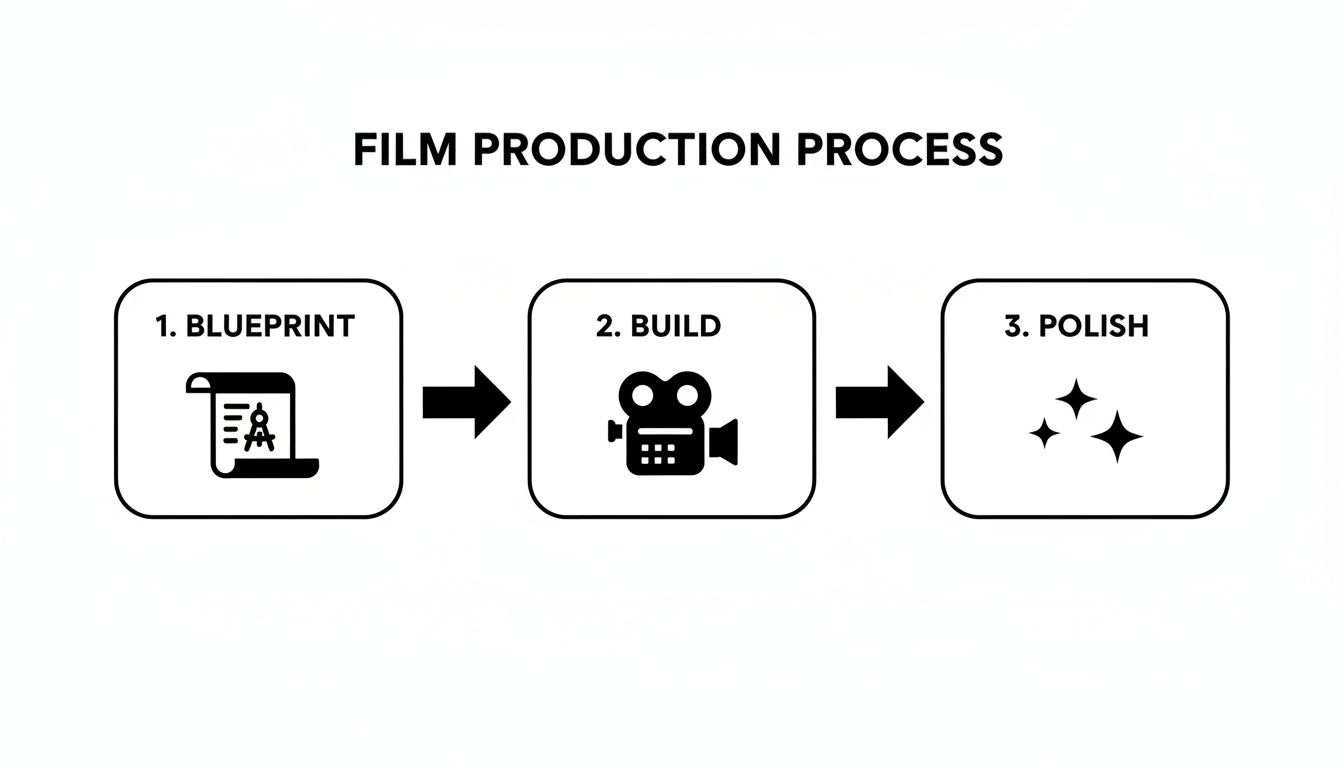
Each stage flows directly into the next, which is why getting the early steps right is so crucial for a great final product.
To get a clearer picture, let’s break down exactly what happens in each phase. This table gives you a quick overview of the key activities and goals.
A Quick Look at the Film Production Stages
| Stage | Key Activities | Primary Outcome |
|---|---|---|
| Pre-Production | Scripting, storyboarding, casting, location scouting, scheduling | A detailed, actionable plan for the entire project |
| Production | Filming scenes, capturing audio, lighting, directing talent | All the high-quality raw footage and audio needed for the edit |
| Post-Production | Editing, colour grading, sound design, visual effects, final review | The final, polished film, ready for delivery and distribution |
With this framework in mind, let’s dive into what each stage really involves.
Stage 1: Pre-Production – The Blueprint
This is where the magic really begins. Pre-production is the strategic planning phase where a project’s fate is sealed long before a camera starts rolling. Think of it as drawing up the architectural blueprint for a building; a rock-solid plan here prevents hugely expensive problems down the line. It’s no exaggeration to say that around 70% of a project’s critical decisions happen right here.
This foundational work involves several key activities:
- Scriptwriting and Storyboarding: Nailing down the narrative, dialogue, and shot-by-shot visual sequence of the film.
- Casting and Talent Acquisition: Finding the perfect actors, voice-over artists, or interview subjects who embody the brand’s message.
- Location Scouting: Sourcing and securing the ideal settings that bring the script to life.
- Crew Assembly: Bringing on board the director, cinematographer, sound engineers, and other key personnel.
- Scheduling and Logistics: Creating a meticulous shot list and daily schedule to make every moment on set count.
Meticulous pre-production is the single greatest investment you can make in your project. It’s what turns abstract ideas into a concrete, actionable plan that the entire team can rally behind, minimising surprises and keeping everything running smoothly.
For those exploring more modern workflows, it’s also worth noting the rise of AI content creation tools for script to video, which can help streamline some of these early planning steps.
Stage 2: Production – The Build
This is it—the part everyone pictures when they think of “making a film.” The production stage is all about execution, where the team takes the blueprint from pre-production and brings it to life. It’s a fast-paced, highly collaborative environment where the director’s vision is finally realised through the camera lens.
The main goal here is simple: capture all the high-quality raw audio and video needed for the story. This requires the perfectly synchronised efforts of the entire crew, from camera operators and lighting technicians to sound recordists and production assistants. The cinematographer, or director of photography, is central here, shaping the visual tone and style of every single shot according to the plan.
Stage 3: Post-Production – The Polish
Once the cameras stop rolling, the project moves into its final phase: post-production. This is where all the raw materials are painstakingly assembled, refined, and polished into a cohesive final film. If production was the build, post-production is the interior design, finishing touches, and final inspection. The story truly takes its final shape in the edit suite.
Here’s what’s happening during this critical final stage:
- Video Editing: The editor sifts through all the raw footage, selecting the best takes and piecing them together to create a compelling narrative flow and rhythm.
- Sound Design and Mixing: Audio is cleaned up, dialogue is balanced, and sound effects and music are woven in to create a rich, immersive soundscape.
- Colour Correction and Grading: The colourist meticulously adjusts the colour and tone of every shot to ensure visual consistency and evoke a specific mood.
- Visual Effects (VFX) and Motion Graphics: Any digital effects, animations, or on-screen text are created and seamlessly integrated into the footage.
- Final Review and Delivery: The client reviews drafts, provides feedback, and signs off on the final cut before it’s exported for distribution.
Budgeting Your Film and Planning Timelines
For any film production to succeed, you need a firm handle on two things: the money and the time. It doesn’t matter how brilliant your creative idea is; without a solid budget and a realistic schedule, things can go off the rails fast. Think of the budget as the fuel for your project and the timeline as your roadmap—you absolutely need both to get where you’re going.
Creating a budget is much more than just tallying up costs. It’s a strategic document that outlines the true scope and ambition of your film. It forces you to be deliberate about where you invest your resources to get the biggest impact, making sure every pound spent supports the story and your business goals.
Building Your Production Budget
A proper budget accounts for every single expense, from the major outlays down to the smallest details. Generally, these costs are broken down by the main stages of production to ensure nothing gets missed. While every project has its own unique needs, most budgets will share the same core categories.
Here are the main cost centres you’ll need to factor in:
- Crew and Talent: This covers salaries for everyone from the director and cinematographer to sound engineers, on-screen actors, and voice-over artists. The size of your crew and their level of experience will be a major driver of the budget.
- Equipment Rentals: Professional cameras, lenses, lighting rigs, and sound recording gear all come with a price tag. If you need specialised kit like drones or stabilisers, that will add to this line item.
- Location Fees and Logistics: This bucket holds all the costs for securing filming locations, getting the right permits, crew travel expenses, and accommodation if you’re shooting away from home.
- Post-Production Services: This is a huge part of any budget. It covers video editing, colour grading, sound design and mixing, visual effects (VFX), and motion graphics. The complexity of the work needed here can swing costs dramatically.
A well-built budget is an honest reflection of what your project needs. It’s not about finding the cheapest option for everything. It’s about allocating funds intelligently to protect the quality and integrity of the final film.
Mapping Out a Realistic Timeline
The timeline is every bit as important as the budget. How long a film takes to make can vary enormously depending on its scale. A simple corporate video might be done in a few weeks, while a detailed documentary could easily take a year or more. A common mistake is rushing the process, especially in pre-production, which almost always leads to a lower-quality result.
For a standard business video, a typical timeline might look something like this:
- Pre-Production (1–3 Weeks): This is where all the planning happens: scripting, storyboarding, casting, and logistics. This stage lays the foundation for everything to come.
- Production (1–5 Days): These are the actual filming days. The number of shoot days is one of the biggest variables affecting both your timeline and your budget.
- Post-Production (2–4 Weeks): Now it’s time for editing, adding graphics, mixing the sound, colour grading, and going through review cycles with the client. Multiple rounds of feedback can stretch this phase out.
Understanding these stages is vital, whether you’re putting together a small internal video or a major commercial. For a closer look at timelines for specific projects, our guide to corporate video production offers more detailed examples.
The Impact of Production Incentives
For larger-scale projects, it’s worth looking into how production incentives can affect your financing and choice of location. Many countries and regions offer financial rebates or tax credits to attract film productions, knowing how much economic value they bring. These incentives can make a location that seems too expensive suddenly become financially viable.
For instance, a KPMG analysis of productions backed by Poland’s Cash Rebate between 2019 and 2022 revealed that the average production pumped about PLN 26 million into the economy and created roughly 200 jobs. As you can see when you explore the full findings on Polish film funding, these programmes are a win-win: they help producers get their films made and give local economies a significant boost. It just goes to show how strategic financial planning can open up a world of new creative and logistical possibilities for your film.
Choosing Between Live-Action and Animation

One of the first, and most important, creative calls you’ll make in any production is choosing the right medium for your message. Will you be filming real people in real locations? Or will you build a world from the ground up using animation? The answer isn’t just about aesthetics; it shapes your budget, timeline, and the entire emotional feel of the finished film.
Live-action and animation are both powerful ways to tell a story, but they play in very different sandboxes. Making the right call means matching the medium to your core business goals, your brand’s personality, and the specific story you need to tell. It’s a strategic choice that sets the tone for the entire production from day one.
The Power of Human Connection
Live-action film production is all about authenticity. If you want to build trust, forge an emotional connection, or show genuine human stories, filming real people is almost always the most direct path. It grounds your message in a reality your audience can instantly relate to.
This approach is a natural fit for projects where relatability is everything:
- Customer Testimonials: Nothing builds social proof like hearing a real customer talk about their success in their own words.
- Brand Stories and Documentaries: Putting a human face to your company’s mission creates a connection that graphics alone can’t replicate.
- Interviews and “About Us” Videos: Live-action lets the personality of your team and leadership shine through in an authentic way.
The real strength of live-action lies in its ability to capture nuance—the subtle facial expressions, the unscripted moments, and the raw emotion that make a story feel real and trustworthy. It sends a clear message: “This is real, these are real people, and this story matters.”
The Freedom of Imagination
Animation, on the other hand, gives you total creative freedom. If you can dream it up, you can put it on screen. This makes animation the perfect choice when your concept is abstract, highly technical, or simply impossible to film with a camera. And it’s not just for cartoons; it’s a sophisticated tool for making complex ideas simple and visual.
Animation excels at explaining complicated concepts in a clear, engaging way. It can make the invisible visible, whether that’s showing how a piece of software works behind the scenes, visualising a delicate medical procedure, or bringing a brand mascot to life. Its versatility is its greatest asset, offering a massive spectrum of visual styles. To get a feel for just how diverse it can be, you can explore the different types of animation available for businesses, from clean 2D motion graphics to photorealistic 3D models.
Making the Right Strategic Choice
So, how do you actually decide? Your choice shouldn’t just be about which style you like more, but about what your film absolutely needs to accomplish. Start by asking yourself a few key questions.
- What’s the core message? If your story hinges on emotion and human connection, live-action is probably your best bet. If it’s about explaining a complex process or an abstract idea, animation is likely a better tool for the job.
- What’s your brand identity? Does your brand have a friendly, approachable mascot that would come to life in an animation? Or is your company built on a foundation of real-world expertise and authentic client relationships?
- What are the practical constraints? Sometimes, logistics make the decision for you. Filming in a secure data centre, for example, or showcasing a product that’s still just a prototype might make a live-action shoot impractical, pointing you towards animation.
Ultimately, the goal is to pick the medium that serves the story best. By thinking through these factors, you can make sure your final film doesn’t just look good, but that it hits its strategic goals and makes the biggest possible impact.
How to Choose the Right Production Partner
Picking the right production company is probably the most important decision you’ll make in this entire process. This isn’t just about hiring a supplier; you’re bringing on a creative collaborator, a project manager, and a strategic guide all in one. Finding a team that clicks with your vision, gets your business goals, and has the technical chops to pull it off is everything.
Making the right call means looking past a flashy showreel. You have to really dig into their portfolio, get a feel for their process, and make sure their communication style works for you. The best partnerships are built on trust, transparency, and a shared drive to create something amazing.
Evaluate Their Portfolio with a Critical Eye
The first port of call is always a company’s past work. But don’t just get wowed by their greatest hits compilation. Go deep into their full portfolio and hunt for specific examples that echo what you’re trying to do. A team might have an incredible reel of car commercials, but that doesn’t automatically make them the right choice for a complex medical animation.
As you review their work, ask yourself a few key questions:
- Does their style fit your brand? Look at the overall tone, the pacing, and the visual language. Does it feel like it could come from your company?
- Is the quality consistent? Are all their projects polished to a high sheen, or do you see some that look a bit rough around the edges? Pay close attention to details like lighting, sound mixing, and colour grading.
- Do they have experience in your industry? While not always a deal-breaker, a partner who already knows the lay of the land in your sector can get up to speed much, much faster.
This kind of careful review helps you narrow down the list to companies that don’t just make great videos, but make the right kind of videos for you.
Ask the Right Questions During Initial Calls
Once you have your shortlist, those first conversations are your chance to see how they really operate. This is where you get past the glossy finished product and get a feel for the people and their workflow. A good chat should feel more like a strategy session than a sales pitch. It’s also a good time to get a feel for the local industry. In 2022, Poland accounted for roughly 3.4% of EU audiovisual production sector revenues, with around 300 entities making films and series. Discover more insights about Poland’s role as an active production centre in Europe to understand the landscape.
A great production partner is interested in your business challenges first and your video second. They should be asking probing questions about your audience, your goals, and your measures of success to ensure the final film delivers real value.
Come to the call prepared with questions that go deeper than just “how much will it cost?”
- What does your creative process look like? You need to understand how they come up with ideas and how much they expect you to be involved at each step.
- How do you handle client feedback and revisions? A clear, well-defined feedback loop is crucial for keeping a project on track and on budget.
- Who will be my main point of contact? Knowing you have a dedicated project manager or producer means communication will be clear and consistent.
Demystify the Proposal and Budget
Finally, a detailed proposal is the hallmark of a professional and transparent partner. Steer clear of one-page quotes with just a single number at the bottom. A proper proposal should lay out the scope of work, the specific deliverables, a realistic timeline, and a transparent budget. Look for a clear breakdown of what’s included and, just as importantly, what might cost extra.
This document becomes the blueprint for your entire collaboration. For certain projects, like explainer videos, a rock-solid scope is absolutely essential. If you need a partner skilled in this specific area, you might want to look for an explainer video agency that lives and breathes this kind of work. A detailed proposal gives you peace of mind that there won’t be any nasty surprises down the road, paving the way for a smooth and successful production from start to finish.
Understanding Your Final Video Deliverables
Once the final cut gets your stamp of approval, the last step is getting the finished files into your hands. These are your video deliverables, and knowing exactly what you’re receiving is key to getting the most out of your investment. It’s never just a single file; it’s a whole package of different versions, each one built for a specific job.
A good way to think about it is like getting photos from a professional photographer. They’ll give you a massive, high-resolution original for printing a huge poster, but they’ll also provide smaller, web-ready JPEGs for your social media. Your video deliverables work just the same, making sure your film looks incredible no matter where it’s being watched.
The most important file in that package is the master file. This is the highest-quality, uncompressed version of your video—basically the digital equivalent of an original film negative. It’s far too large for day-to-day use, but it’s absolutely vital for your archives or for creating new versions down the road.
Decoding Technical Specifications
From that master file, your production partner will create a range of compressed versions designed for different platforms. Getting a handle on a few technical terms will help you have a much clearer conversation about what you need.
- File Format (Container): This is the “box” the video comes in. The most common you’ll see are .MP4, which is compatible with almost everything and perfect for the web, and .MOV, a high-quality format from Apple that editors often use.
- Resolution (Quality): This is all about sharpness, measured in pixels. Standard High Definition (HD) is 1920×1080 pixels. 4K (or Ultra HD) is 3840×2160, giving you four times the detail and a much crisper image.
- Aspect Ratio (Shape): This simply refers to the shape of the video frame itself. A cinematic film or a standard YouTube video uses a widescreen 16:9 ratio, while vertical videos for things like Instagram Reels or TikTok are flipped to 9:16.
These different specs make sure your video is formatted perfectly for its destination. A 16:9 4K video designed for a massive screen just won’t look right as a 9:16 story on social media, which is why having the right versions from the start is so important.
Aligning Deliverables With Your Distribution Strategy
Your distribution plan is the roadmap that tells you exactly which types of files you need. Are you aiming for a cinema screening, a TV broadcast, a social media blitz, or maybe all three? Each of these channels has its own unique technical demands.
Discussing your distribution strategy early in the film production process is vital. It allows your production partner to plan for and create every necessary deliverable, ensuring your content is perfectly optimised for every single platform from day one.
For instance, the Polish cinema landscape in 2022 included over 500 cinemas, with the big multiplexes drawing most of the audience. If your film is headed for a theatrical run, you’ll need a special file format called a Digital Cinema Package (DCP), which is a world away from a standard MP4.
Beyond the main film, you also need to think about how to optimize visual content for social media to get the most reach and engagement. When you align your deliverables with how your audience actually watches content, you guarantee they have a seamless, high-quality experience every single time.
Got Questions About Film Production? We’ve Got Answers.
Diving into professional film production for the first time can feel like learning a new language. You’re probably wondering about timelines, potential roadblocks, and how much you’ll need to be involved. It’s completely normal, and we’re here to demystify the process for you.
Think of this as your cheat sheet. We’ve pulled together the most common questions we hear from clients to help you step into your first project with confidence, knowing exactly what to expect.
How Long Does a Typical Corporate Video Take to Make?
This is the big one, and the honest answer is: it depends on the complexity. For a straightforward 2-3 minute corporate video, a realistic timeline is around 4-6 weeks from our first chat to the final file delivery. This gives everyone enough breathing room for proper planning and creative refinement without cutting corners.
A typical schedule breaks down something like this:
- Pre-production: 1-2 weeks for all the crucial upfront work – planning, scripting, and locking down logistics.
- Production: 1-2 days for the actual shoot. It’s the most intense part, but often the shortest.
- Post-production: 2-3 weeks for the magic to happen in the edit suite – editing, adding graphics, sound design, and handling revisions.
Of course, a more ambitious project with multiple filming locations, detailed animation, or complex visual effects could take a few months. The key to keeping things on track, no matter the scale, is clear communication and giving timely feedback.
What Is the Biggest Mistake to Avoid in Production?
Without a doubt, the most common and costly mistake we see is rushing the pre-production stage. When the planning phase is cut short, problems have a nasty habit of showing up on the filming day. This could be anything from missing equipment and scheduling clashes to a creative vision that’s still fuzzy. These issues almost always lead to expensive reshoots or, even worse, a final video that doesn’t hit the mark.
Your project’s best insurance policy is a rock-solid plan. Investing the right amount of time in scripting, storyboarding, and logistics is the single most effective way to guarantee a smooth production and a fantastic result.
How Much Involvement Is Needed from the Client?
As the client, your expertise is absolutely vital during pre-production. This is where we need your input on the script, the overall creative direction, and the strategic goals. You know your business best, and getting this alignment right from the start is essential. When it’s time to film, you might be on set to offer guidance, but you can trust the crew to handle the technical side of things.
Once we move into post-production, your main role is to review the different versions of the edit and provide clear, consolidated feedback. Any good production partner will set up key review points for your approval, making sure your vision comes to life without you having to manage the day-to-day grind.
Ready to bring your vision to life with a professional film production partner? Simple Frame specialises in creating high-quality video and animation that delivers results. Contact us today to start your project.