
Choosing an Animation Studio for Medical and Healthcare Videos
A specialised animation studio for medical and healthcare videos does more than just create pretty pictures; it translates dense, complex science into visual stories that are clear, engaging, and accurate. Unlike a generalist studio, these expert teams are a unique blend of artist and scientist, making them indispensable partners for explaining everything from drug mechanisms to intricate surgical techniques.
Why Medical Animation Is Essential for Healthcare Communication
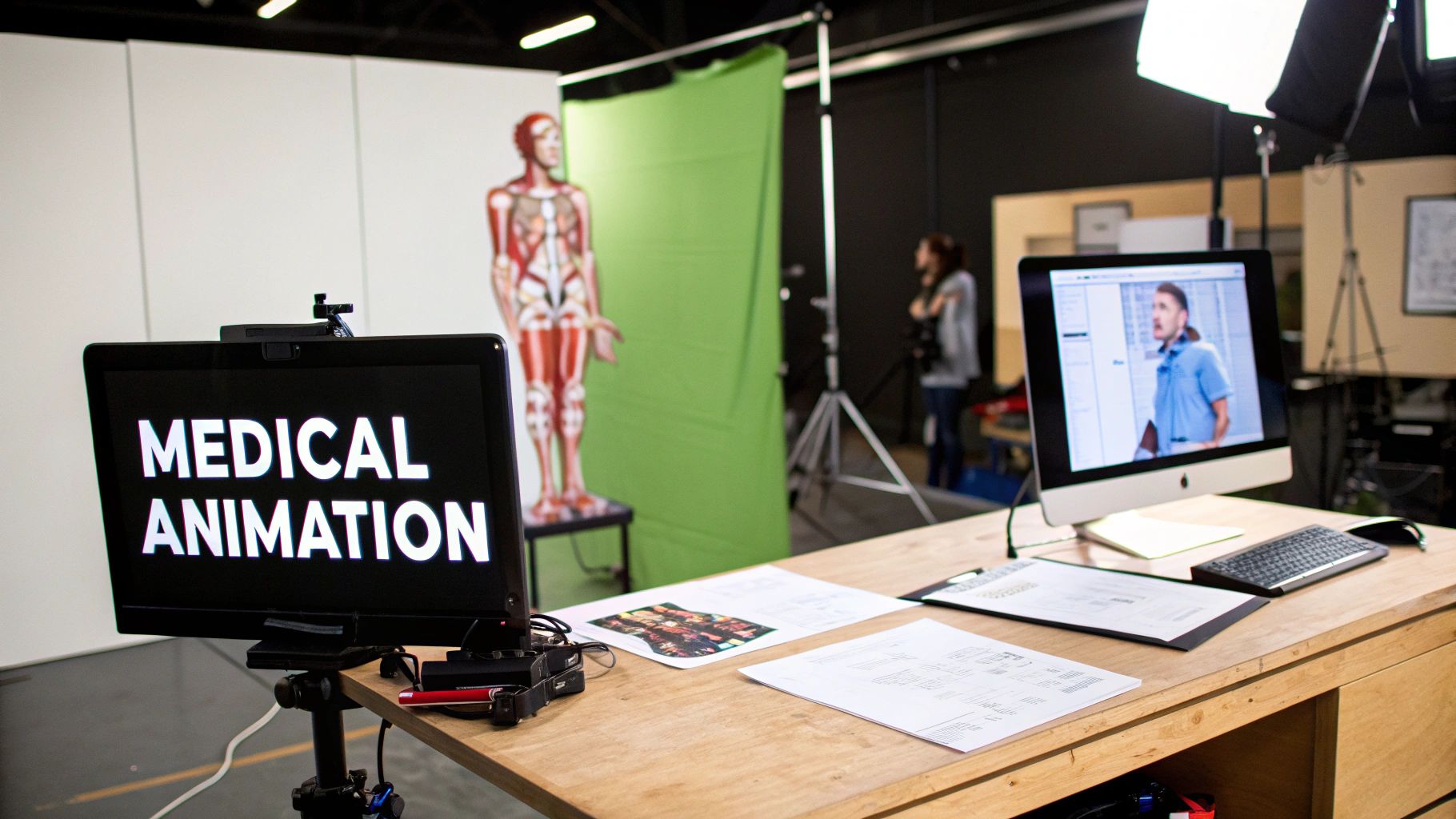
Trying to explain a new surgical method or how a drug works at the molecular level using words alone is often a losing battle. The human brain processes images an incredible 60,000 times faster than text, so it’s no wonder that crucial medical details get lost in translation when buried in dense reports or static diagrams. This is exactly the communication gap that medical animation is designed to fill.
It acts as a universal translator, turning abstract biological processes into tangible, memorable narratives. Whether it’s for educating patients, training professionals, or marketing pharmaceuticals, animation makes the invisible visible.
Bridging the Knowledge Gap
At its heart, medical animation is about making complex topics simple without dumbing them down. For a patient, a short animation can demystify a scary diagnosis or treatment plan, which helps reduce their anxiety and makes them more likely to follow their doctor’s advice. For medical professionals, it’s a powerful tool for training and continuous learning.
- Patient Education: An animation can clearly show how a medication targets specific cells, helping patients truly understand its benefits.
- Professional Training: Surgeons can walk through complex procedures in a 3D environment, rehearsing each step and exploring anatomical relationships long before they step into the operating theatre.
- Marketing and Sales: Medical device companies can showcase a product’s innovative features in a dynamic way that a printed brochure could never match.
Medical animation isn’t just about creating visuals; it’s about building understanding. It transforms dense data into intuitive stories, empowering audiences—from patients to physicians—to grasp complex concepts quickly and confidently.
This powerful capability is fuelling major growth in the creative production world. In Poland’s vibrant film and video industry, a staggering 10,851 businesses were active as of 2025, a number that reflects a strong 6.0% compound annual growth rate since 2020. This boom highlights the rising demand for specialised creators, including animation studios in Warsaw that excel in medical content. You can dig deeper into Polish production market trends over on ibisworld.com.
The Power of Different Animation Styles
Not all animation is created equal, and the right style depends entirely on your message, your audience, and what you want to achieve. A top-tier animation studio for medical and healthcare videos will have a whole toolkit of techniques to meet your specific communication goals. Gaining a basic grasp of educational animation is a great first step to seeing how these styles can be used.
To give you a better idea of what works where, here’s a quick breakdown:
Choosing the Right Animation for Your Healthcare Needs
| Animation Type | Best Used For | Core Advantage |
|---|---|---|
| 2D Animation | Explaining concepts, patient journeys, public health messages. | Friendly, approachable, and excellent for simplifying abstract ideas. |
| 3D Animation | Surgical procedures, medical device demonstrations, drug MOA. | Photorealistic detail and depth, perfect for showing complex structures. |
| Motion Graphics | Presenting statistics, clinical trial data, key takeaways. | Dynamic and engaging, makes data easy to digest and remember. |
Ultimately, choosing the right partner means you don’t have to be the expert. They’ll listen to your goals and guide you to the perfect style, ensuring your project doesn’t just look good but truly succeeds in its mission.
The Risks of Using a General Animation Studio
Hiring an animation studio for your healthcare project might seem simple enough, but choosing between a generalist and a specialist can make or break your entire project. It’s a bit like asking a brilliant graphic designer to draw up an engineering blueprint. They’ll certainly make it look good, but they don’t have the deep, foundational knowledge to ensure it’s accurate, functional, and safe. This same logic applies directly to creating medical content.
A general animation studio might produce breathtaking visuals for a new car commercial or an entertainment piece, but they’re playing in a completely different ballpark. The stakes in medical and healthcare communication are sky-high. One small mistake isn’t just a branding hiccup; it could lead to a patient misunderstanding their treatment, someone misusing a medical device, or a pharmaceutical company’s hard-won credibility going up in smoke.
At its core, the problem is a massive knowledge gap. A generalist team simply lacks the deep-seated scientific and medical literacy needed to turn complex biological processes into visually accurate stories.
Inaccuracy: The Silent Killer of Credibility
The single biggest risk of working with a non-specialised studio is factual inaccuracy. Medical content demands nothing less than absolute precision. There’s zero room for “artistic interpretation” when you’re showing how a new drug works or the delicate steps of a surgical procedure. A generalist animator might not grasp the subtle but critical difference between two cell types or the correct anatomical placement of a medical implant.
These seemingly small errors can unleash huge consequences:
- Misleading Patients: An inaccurate animation might give patients the wrong idea about their condition or treatment, creating unnecessary anxiety or false hope.
- Confusing Professionals: For medical training videos, even tiny mistakes can confuse healthcare professionals and completely undermine the educational value of the content.
- Damaging Brand Trust: The moment physicians or scientists spot errors in your content, your organisation’s reputation as a knowledgeable authority is instantly compromised.
When it comes to medical communication, accuracy isn’t just a feature—it’s the very foundation of trust. A single factual error can invalidate the entire message and erode the confidence of your audience, whether they’re patients, doctors, or regulators.
A specialist studio has a team vetted for scientific understanding, often including medical illustrators or expert consultants. They speak the same language as your subject matter experts, which makes the feedback process incredibly efficient and ensures every single frame is correct.
Navigating the Maze of Regulatory Compliance
Another major pitfall is the failure to understand and follow strict regulatory guidelines. The healthcare and pharmaceutical industries are heavily regulated, with firm rules about what can and cannot be shown in promotional and educational materials.
General studios are often completely in the dark about these constraints. They don’t know the specific requirements of regulatory bodies or the legal nuances of marketing medical products. This ignorance can lead them to create content that’s not just ineffective but also non-compliant, resulting in expensive revisions or even legal trouble. A specialist studio, on the other hand, builds its entire workflow around these regulations, ensuring the final product is both compelling and compliant right from the start.
The Problem of Generic Storytelling
Finally, generalist studios often struggle to tell a compelling story for a highly specialised audience. They might create a generic explainer video that looks slick but fails to connect with its intended viewers, whether they’re surgeons, lab technicians, or patients with a specific condition. For a deeper look into what makes a great explainer, our guide on choosing an explainer video agency offers some valuable insights.
A specialist studio understands the audience’s mindset. They know how to frame information differently for a physician versus a patient, using the right tone, level of detail, and visual language to make the message stick. They don’t just animate—they communicate with purpose and empathy, making sure your video achieves its strategic goals. Choosing a generalist means risking a final product that looks professional but ultimately fails to connect, educate, or persuade.
What to Expect from a Top-Tier Medical Animation Partner
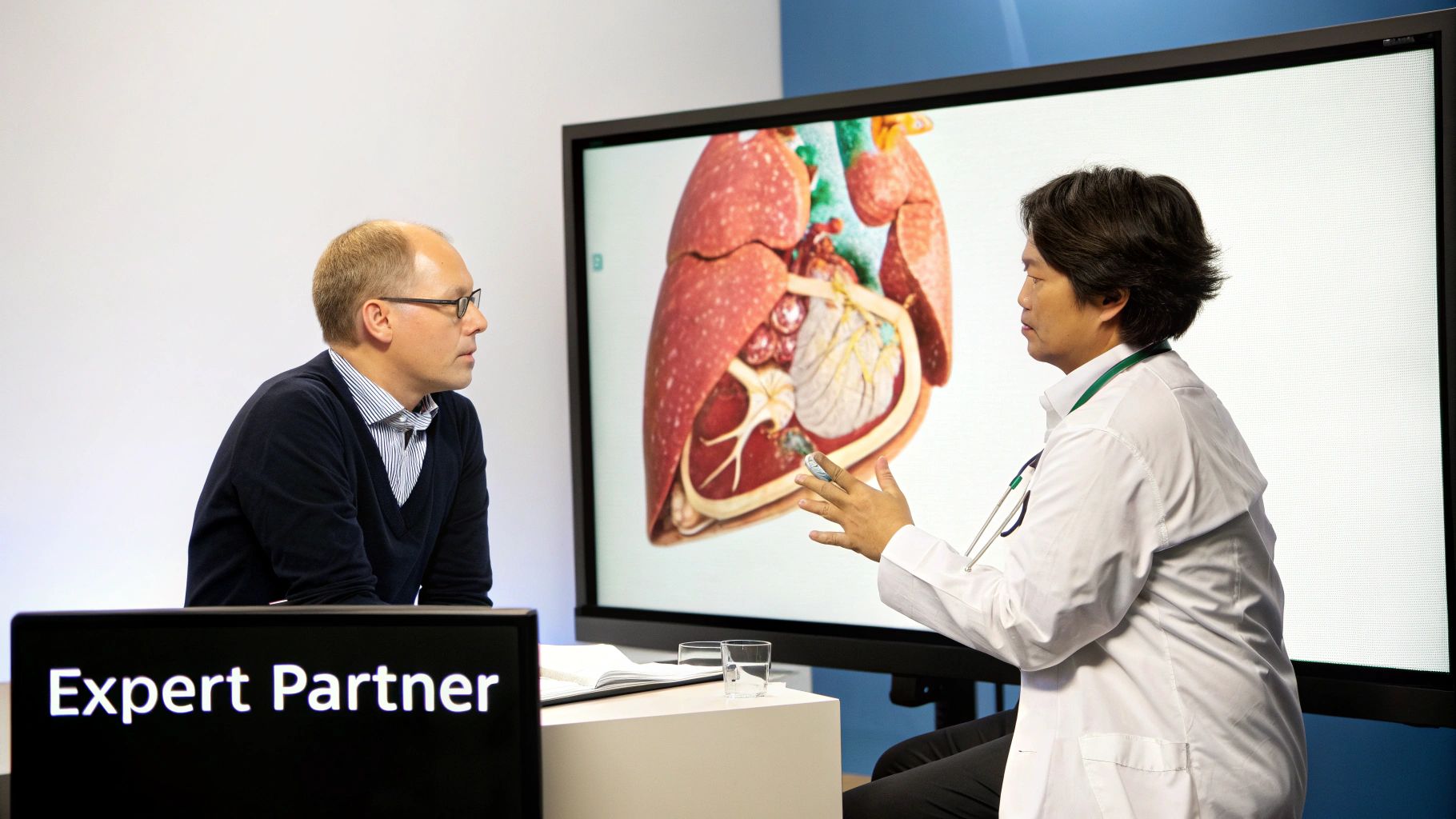
When you decide to work with a premier animation studio for medical and healthcare videos, you’re getting much more than just a team of artists. You’re bringing on a partner full of scientific storytellers. These are specialists who move beyond simple visuals, blending creative flair with a deep respect for scientific rigour and strategic communication. Their job is to take your dense, complex medical concepts and translate them into visual stories that are clear, compelling, and—above all—accurate.
This means they do more than just operate animation software. A truly top-tier partner has a working knowledge of anatomy, biology, and clinical procedures. They know the right questions to ask, making sure every single frame is true to the science and hits your communication goals.
The Power of a Multidisciplinary Team
The real magic of a specialised medical animation studio happens because of its diverse team. You should expect to collaborate with a group of experts whose skills cover every part of the project, from the initial brainstorming sessions right through to the final rendered video.
It’s a bit like a surgical team in an operating theatre. Every member has a specific, vital role, but they all work together seamlessly to achieve the same objective. Your animation team should be just as coordinated.
- Medical Illustrators and Scientific Consultants: These experts form the foundation of accuracy. They ensure every anatomical detail, cellular process, and procedural step is shown with absolute precision.
- Creative Directors and Scriptwriters: These are the storytellers. They craft the narrative to make sure the message is not just correct, but also engaging and understandable for your specific audience.
- Skilled 2D and 3D Animators: These are the technical wizards who bring the vision to life, creating fluid movement and realistic detail that makes the invisible, visible.
This mix of expertise is absolutely essential. It’s what separates a true medical specialist from a generalist animation studio and guarantees your final video is both scientifically sound and visually stunning.
A Spectrum of Animation Services
A leading studio will have a versatile range of animation styles in its toolbox, each suited for different communication challenges. They won’t try to sell you a one-size-fits-all solution. Instead, they’ll analyse your needs and recommend the best approach, whether you’re educating patients about a new treatment or training surgeons on a new device.
For instance, if you need to explain a complex cellular mechanism to patients, clean and approachable 2D animation is often the perfect choice to simplify abstract ideas. The style feels less intimidating and helps the viewer focus on the main message without getting bogged down in unnecessary detail.
On the other hand, demonstrating a new surgical instrument demands the photorealistic detail that only 3D animation can provide. This technique lets you showcase the device’s mechanics and its precise interaction with human anatomy from any angle, offering a level of insight that live-action video just can’t match. This is crucial for both marketing and training, and you can see how a detailed medical procedure animation is built to meet these exacting standards.
A top-tier studio doesn’t just offer different animation styles; it strategically deploys them. They match the technique to the message, ensuring 2D simplifies for clarity, 3D demonstrates with precision, and motion graphics highlight data with impact.
This strategic use of visuals is becoming more critical by the day. The Polish advertising market, for example, is a great indicator of this trend. Projections show that by 2025, out-of-home advertising will grow by 8.3% to 881.9 million PLN, while digital video advertising on short-form content is set to hit US$176.82 million. This surge fuels the demand for concise, powerful animated explainers perfect for social media and other digital channels.
A Collaborative and Transparent Process
Finally, any good partnership is built on clear communication and a structured workflow. A professional studio will walk you through a well-defined process, keeping you in the loop and involved at every important milestone.
This process usually looks something like this:
- Discovery and Strategy: Kicking things off with a deep dive to fully understand your goals, your audience, and the core scientific concepts.
- Scripting and Storyboarding: You’ll get to review the narrative and the visual plan before any animation work starts, giving you a chance to provide early feedback.
- Animation Production: This is the main creation phase where the storyboard comes to life, with regular check-ins to show progress.
- Review and Refinement: A dedicated feedback stage where your team and subject matter experts can request tweaks to ensure 100% accuracy.
An organised process like this takes the guesswork out of the equation and ensures the final animation perfectly matches your vision and scientific needs. It’s this powerful combination of specialised talent, versatile services, and a reliable workflow that defines a truly exceptional medical animation partner.
How to Evaluate and Select the Right Animation Studio
Picking the right partner for your project is a huge decision, one that goes way beyond just choosing a team with a flashy showreel. The ideal animation studio for medical and healthcare videos needs to be a rare mix: part creative artist, part technical wizard, and part scientific collaborator. You’re looking for a team that can turn your complex subject matter into a visual story that isn’t just beautiful, but also meticulously accurate, strategically smart, and compliant with all the necessary regulations.
Think of this less like hiring a vendor and more like bringing a specialist onto your communications team. You need a solid framework to check out their portfolio, grill them on their process, and really make sure they know their stuff.
Look Beyond the Surface of the Portfolio
Naturally, the first place you’ll look is the studio’s portfolio. But it’s critical to see past the initial “wow” factor of slick visuals. A gorgeous animation is useless if it gets the science wrong.
When you’re looking through their past work, ask yourself these questions:
- Is the science clear? Can you, as a non-expert, actually follow the biological process or medical procedure they’re showing? If the animation is confusing, it’s already failed.
- Is the storytelling effective? Does the video have a logical flow? A great medical animation isn’t just a collection of cool-looking images; it tells a story with a clear beginning, middle, and end that guides the viewer to a specific understanding.
- Does their work fit what you need? Hunt for examples in their portfolio that feel similar to your project in complexity, audience, and tone. If you need a photorealistic 3D surgical guide, a portfolio packed with friendly 2D patient explainers might not be the right match.
A strong portfolio shows off versatility and a real grasp of different medical communication challenges. Taking a look at a diverse range of projects, like the work showcased in the Simple Frame portfolio, can give you a solid benchmark for what excellence looks like across various styles and medical fields.
Verify Subject Matter Expertise and Technical Skill
Once you’re satisfied with their creative work, it’s time to dig into their technical chops and scientific literacy. A beautiful animation is completely worthless if it’s factually incorrect. This is where a specialised studio really proves its value over a generalist one.
You need to know they have a rock-solid process for ensuring scientific accuracy. Ask them directly about their team. Do they have in-house medical illustrators or scientific consultants on staff? If not, how do they work with subject matter experts to check every single detail? A studio that fumbles this question is a major red flag.
A studio’s commitment to accuracy is non-negotiable. Their process should involve multiple, rigorous review cycles with your own medical experts to guarantee that every frame, from cellular interactions to anatomical structures, is depicted with absolute precision.
On top of that, it’s important to make sure they follow established video production best practices. This ensures they have a professional handle on the entire project, from the first conversation to the final file delivery.
Understand Their Production Process and Communication Style
A successful project hinges on a process that’s transparent, collaborative, and well-managed. Before you sign anything, you need to have a perfectly clear picture of how the studio operates. A professional team will be more than happy to walk you through their entire workflow.
This process usually breaks down into a few key phases:
- Discovery and Scripting: This is where they dive deep into your goals and write the narrative.
- Storyboarding: A visual blueprint of the entire video is created for your approval.
- Animation and Production: The main creation phase where the magic happens.
- Review and Revisions: Structured loops for feedback to polish the animation.
Ask pointed questions about communication. Who will be your main contact? How often can you expect updates? A studio that prioritises clear, consistent communication and has a structured workflow is a studio that respects your time and investment. That makes them a much more reliable partner.
To help you get organised, we’ve put together a checklist you can use when you’re vetting potential studios.
Studio Vetting Checklist for Project Managers
This table is a handy tool for marketing and communications managers to keep track of the key evaluation points when speaking with different studios.
| Vetting Criteria | What to Look For | Potential Red Flags |
|---|---|---|
| Portfolio Review | Examples of work in a similar medical field or animation style. Clear storytelling and scientific accuracy. | Visually impressive but confusing content. A portfolio lacking relevant medical examples. |
| Subject Expertise | In-house medical illustrators or a clear process for working with external subject matter experts. | Vague answers about their accuracy validation process. No prior experience in your specific medical area. |
| Production Process | A transparent, multi-stage workflow (script, storyboard, animation, review). Clear communication protocols. | A disorganised or undefined process. Resistance to involving your experts in review stages. |
| Regulatory Knowledge | Familiarity with healthcare advertising standards and compliance requirements in your region. | Unaware of industry-specific regulations or dismissal of their importance. |
| Client References | Willingness to provide references from previous healthcare clients. Positive testimonials. | Hesitation to share references or a lack of testimonials from relevant industries. |
By using this structured approach, you can go beyond a gut feeling and confidently choose an animation studio for medical and healthcare videos that will be a true strategic partner—one capable of delivering content that’s not just visually stunning, but also scientifically sound and powerfully effective.
The Business Impact of High-Quality Medical Animation
Choosing a professional animation studio for medical and healthcare videos is much more than just a creative decision—it’s a serious business move that pays dividends. Forget fuzzy terms like “engagement.” The real value shows up in concrete results that directly impact your organisation’s bottom line.
For marketing teams, this means hitting tangible goals. A top-tier animation can massively improve the quality of your leads by making the value of a complex medical device or pharmaceutical easy to grasp. This clarity often shortens sales cycles because buyers “get it” faster. It also builds serious brand authority, positioning your company as an expert educator in a crowded field.
Driving Real-World Outcomes Across Sectors
And it’s not just about marketing. For healthcare providers, the benefits are woven directly into patient care and operational efficiency. A well-designed animation can dramatically improve how well patients understand their condition or treatment plan. Studies have shown this leads directly to better treatment adherence.
This approach also makes consultations far more effective. Doctors can use animations to explain tricky procedures, saving precious time and ensuring patients leave fully informed. That means fewer follow-up calls and higher patient satisfaction scores.
A well-executed medical animation isn’t a cost centre; it’s a strategic asset. It directly contributes to revenue growth, operational efficiency, and brand equity by transforming complex information into a powerful tool for persuasion, education, and trust-building.
For advertising agencies, the payoff is twofold. Delivering a scientifically accurate and visually stunning animation campaign makes their clients successful, which strengthens relationships and locks in future business. On top of that, it produces award-worthy creative that elevates the agency’s reputation, helping it land new, high-value clients in the competitive healthcare space.
This flowchart maps out the key decision points—from checking out a portfolio to understanding their process—that guide you toward a studio capable of delivering these kinds of business wins.
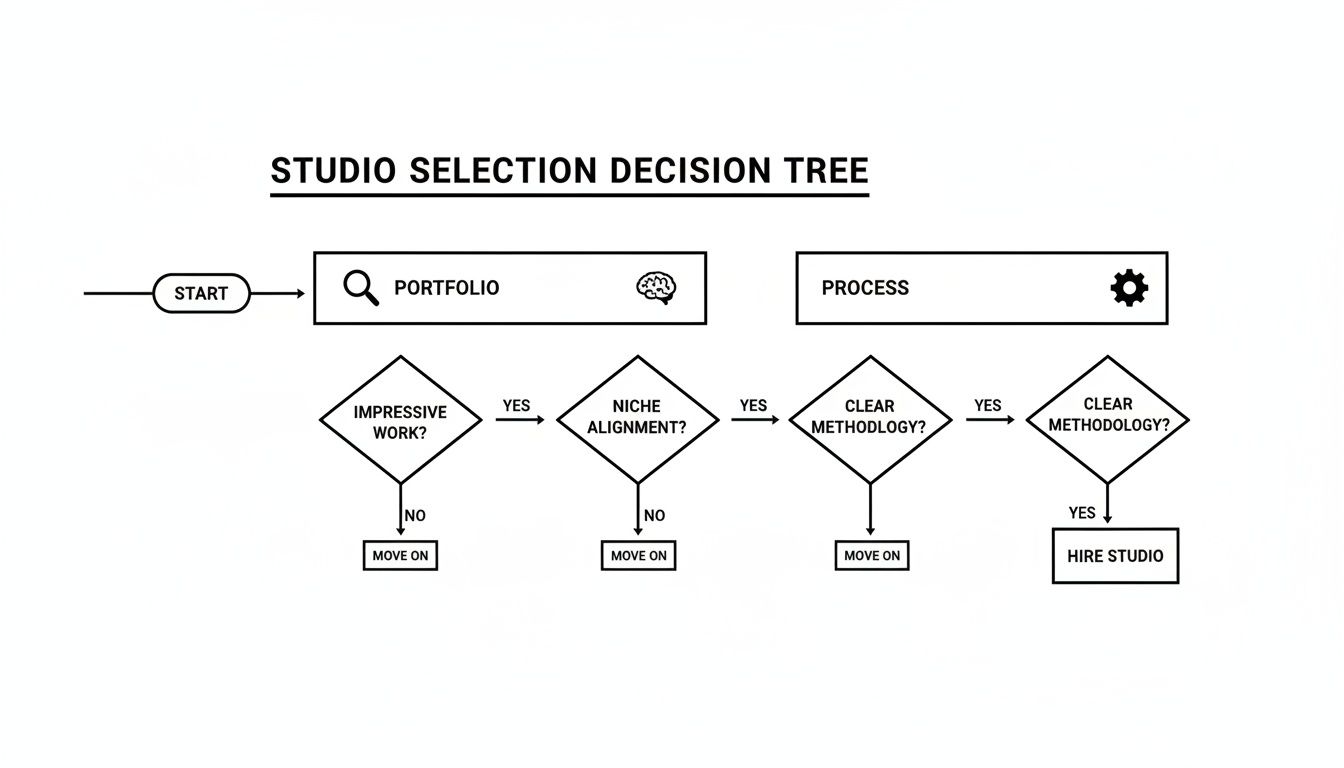
As the visual shows, a methodical selection process is your first step toward getting a real business return from your animation project.
Capitalising on a Hybrid Media Landscape
The sheer versatility of animated content is another huge advantage, especially today. Take Poland’s entertainment market, for example. It shows how different platforms can thrive side-by-side. In 2025, traditional Pay-TV is projected to command a massive 60% of market revenue, while streaming services are growing at 12% year-over-year. This hybrid landscape is the perfect environment for medical animations, which can be adapted to work brilliantly on both traditional broadcast and modern digital channels.
Efficiency as a Driver of ROI
Finally, how efficiently your chosen studio operates has a direct impact on your project’s budget and timeline. When you’re vetting a studio, it’s worth asking how they manage their internal workflow. Smart operational practices, like using dedicated tools for Time Tracking for Agencies to Boost Productivity & Profitability, are a good sign. This kind of internal discipline means they are better equipped to deliver projects on time and on budget, ensuring you get the most out of your investment.
Your Medical Animation Questions Answered
Diving into a project with a medical and healthcare animation studio naturally brings up a few questions. This field is a unique mix of creative art and hard science, so getting a handle on the practical side of things is the first step toward a great partnership. To clear things up, we’ve tackled some of the most common queries people have when they start this journey.
Getting straight answers helps you budget and plan, but more importantly, it builds trust that you’ve picked the right studio for the job. Let’s get into the details.
How Is the Cost of a Medical Animation Determined?
There’s no single price tag for a medical animation. The final investment is shaped by a handful of key factors that define the project’s size and complexity. Think of it like commissioning a custom piece of lab equipment—the final cost comes down to the specific materials and engineering required.
The main cost drivers are usually:
- Animation Style: A clean, illustrative 2D animation is typically less intensive to produce than a photorealistic 3D animation, which demands complex modelling, texturing, and lighting.
- Video Length: It’s simple maths—longer videos require more time and resources across the board, from scripting and storyboarding right through to the final animation and sound design.
- Scientific Complexity: There’s a world of difference between showing a simple patient journey and animating an intricate molecular mechanism of action. The more complex the science, the more expertise and time are needed to nail the accuracy.
Any professional studio worth its salt will give you a transparent, itemised quote based on your creative brief. This way, there are no nasty surprises, and you know exactly where your budget is going.
What Is a Realistic Timeline for a Healthcare Animation Project?
A solid timeline is the backbone of any well-run project. While every animation is different, a typical production process follows a structured path that usually takes between 6 to 10 weeks from start to finish.
This window isn’t just pulled out of thin air; it allows for a thorough, collaborative process that ensures quality at every turn.
A standard 6-10 week production cycle is a carefully planned process, not an arbitrary number. This timeframe is designed to accommodate essential client feedback loops, rigorous scientific accuracy checks, and the detailed creative work required to produce a high-calibre medical animation.
The whole process is broken down into clear milestones:
- Consultation and Scriptwriting (1-2 weeks): This is where we lock down the project goals and craft the story.
- Storyboarding (1-2 weeks): We create a visual blueprint for you to approve before a single frame is animated.
- Animation Production (3-6 weeks): The core creative phase where the magic happens. The timeline here depends heavily on the complexity.
- Post-Production and Revisions (1-2 weeks): Adding sound, finalising the visuals, and incorporating your feedback.
This organised approach keeps everyone on the same page and makes sure we hit our deadlines.
How Do Studios Guarantee Medical and Scientific Accuracy?
In medical communications, accuracy is everything. It’s non-negotiable. A specialised studio builds quality control into every single step of the production process. It all starts with grounding the project in credible medical sources and your detailed brief.
From there, it’s all about collaboration and review. The production pipeline has multiple checkpoints—script reviews, storyboard approvals, and final animation checks—where your team and subject matter experts can give critical feedback. This intense, back-and-forth process is what truly separates a specialist animation studio for medical and healthcare videos from a generalist one.
Can an Animation Be Updated if Medical Guidelines Change?
Absolutely. In fact, this is one of the biggest perks of animation over live-action video. Healthcare is always evolving—guidelines are refined, new drug information comes out, and surgical techniques improve. Animation is wonderfully adaptable.
Professional studios keep meticulous archives of all project files. That means if a guideline changes or new data comes to light, they can jump back into the original files and make the necessary updates efficiently. It’s far cheaper and faster than reshooting an entire live-action scene, ensuring your content stays current, compliant, and accurate for its entire lifespan.
At Simple Frame, we blend scientific precision with creative excellence to produce medical animations that clarify complex topics and achieve your strategic goals. Discover how our expert team in Warsaw can bring your next healthcare project to life by visiting us at https://simpleframe.com.