
Video Animation for Crowdfunding Platforms That Actually Converts
When it comes to crowdfunding, your video is your single most powerful tool for turning a casual browser into an enthusiastic backer. By weaving together a compelling story, clear visuals, and a touch of emotional magic, animated videos manage to simplify complex ideas and build instant trust with people all over the world. The numbers don't lie: a campaign with a great animated video is 50% more likely to smash its funding goal.
Why Animated Videos Win on Crowdfunding Platforms
In the fast-paced, high-stakes world of platforms like Kickstarter or Indiegogo, you have just a few seconds to grab someone's attention. Your project isn't just competing for money; it's fighting for focus against a sea of other ideas. Let's be honest, static images and long blocks of text just don't cut it anymore.
This is exactly where video animation gives you a massive advantage. While live-action shoots can get bogged down by finding the right location, actors, or a perfect physical prototype, animation offers total creative freedom. You can bring a concept to life before it's even built, show exactly how it works inside, or tell a brand story that’s bigger than reality itself.
Clarifying Complexity and Building Trust
So many groundbreaking products are genuinely hard to explain with words. Animation is a genius at breaking down complicated ideas into simple, easy-to-digest visuals. Imagine trying to describe a new type of software or a clever engineering trick. An animated video doesn't just tell—it shows it in action, making the value crystal clear to potential backers in an instant.
That clarity is what builds confidence. When a backer truly understands your product and your vision, they're far more likely to trust you with their support.
- Simplifies the Abstract: It makes intangible ideas, like a new app or service, feel concrete and real.
- Demonstrates Functionality: You can show your product working perfectly, even if the physical prototype is still a bit rough around the edges.
- Creates an Emotional Connection: By using characters and storytelling, you can build a genuine bond with your audience, turning them from passive viewers into active supporters who want to be part of your story.
A well-crafted animated video does more than just explain; it persuades. It transforms a complex idea into a compelling story that resonates with backers on an emotional level, making them feel like part of the journey.
A Cost-Effective and Accessible Option
Creating stunning visuals is no longer something only massive corporations can afford. In Poland's booming animation sector, for example, video animation has become a go-to strategy for crowdfunding campaigns. This is helped in a big way by support from organisations like the Polish Film Institute (PFI), which offers a 30% cash rebate on production costs. Incentives like these dramatically lower the barrier to entry, making professional-grade animation a realistic option even for startups on a tight budget.
For new companies trying to explain their big idea, custom explainer video animation services are a direct line to creating this crucial campaign asset. In the end, animation levels the playing field, allowing the most innovative ideas to shine, no matter the size of the creator's wallet.
Crafting Your Campaign Story and Script
Long before you even think about animation styles or colour palettes, your campaign’s fate is being decided. It's all in the story. A killer script is the blueprint for everything that follows, and it’s what separates a video that gets people clicking ‘Back This Project’ from one that gets scrolled past without a second thought.
This isn't just about listing off your product's features. It's about pulling people into a narrative that makes them genuinely care about your success.
The whole thing kicks off with one surprisingly simple question: Who is this for? Get specific. Give your ideal backer a name, a job, and a problem they can't stand. Are you talking to a busy city commuter who needs a smarter way to carry their gear, or a weekend artist who wants a tool to make their hobby easier? Nailing this down sets the tone, language, and emotional direction for your entire video.
Once you know who you’re talking to, you need to find your one core message. If a backer walks away remembering only one thing, what is it? This becomes your guiding light, keeping every line of the script on track.
Structuring a Script That Converts
A great crowdfunding video script isn't just creative—it’s a finely tuned machine built to generate pledges. Think of it as taking your viewer on a short but powerful journey, from idle curiosity to enthusiastic commitment.
Those first five to eight seconds are everything. You have to open with a hook that grabs them immediately. This could be a relatable problem, a shocking statistic, or a captivating visual that makes them ask, "What's that?" For instance, a campaign for a smart backpack could open with a frantic shot of someone dumping their entire bag on the floor just to find their keys. We’ve all been there.
With their attention caught, you then dive deeper into that problem. Really twist the knife a bit. Why is this issue so frustrating? This builds empathy and gets the viewer primed for a solution. Only then do you introduce your product as the hero. Show how it solves that problem—don't just tell them.
According to Indiegogo, campaigns with a pitch video raise a staggering four times more funds than those without one. Your script is the foundation of that video, so every single word needs to earn its spot.
Next, you’ll want to weave in some social proof. This could be a quick quote from an early beta tester, a nod from an industry expert, or some compelling survey data. It’s all about building trust and showing that others believe in your idea, too.
Writing for the Animated Medium
Writing a script for animation is a whole different ball game than writing for live-action. The language has to be sharp, concise, and work hand-in-glove with the visuals. Why waste words on a long-winded explanation when you can just show the concept in a beautifully animated sequence?
- Keep Sentences Short: You're aiming for a conversational, easy-to-digest voiceover. The best way to check this? Read your script out loud. You'll immediately spot any clunky or unnatural phrases.
- Think Visually: While writing, constantly ask yourself: "What's happening on screen right now?" Use your script to call out specific actions, visual gags, or transitions that an animator can bring to life.
- Focus on Benefits, Not Just Features: Don't just say, “It has a 5000mAh battery.” Instead, frame it as, “It’ll last you the entire weekend, so you can forget about hunting for a power outlet.” This connects a technical spec to a real human benefit.
As you build your narrative, looking at examples of effective branded content can spark some great ideas for storytelling that truly connects with an audience.
The final, crucial piece of your script is the call-to-action (CTA). Don't be vague and just say, “Back our project.” Create urgency and be specific. Point them directly to a reward tier: “Click the 'Back This Project' button now and claim your Early Bird discount before they’re all gone!”
Finally, get friendly with storyboarding. It doesn’t need to be a masterpiece—stick figures are perfectly fine. A storyboard is your bridge from script to screen, translating your words into a visual sequence. This ensures your entire team, especially your animation partner, is on the exact same page. This one simple step can save you a mountain of headaches and revision costs down the line. To dive deeper into this planning stage, you can find great resources on marketing visualisation that help align your script and visual strategy from the get-go.
Choosing an Animation Style That Fits Your Brand
With your script locked and loaded, it's time to decide how your video will actually look and feel. The animation style you land on is so much more than just a visual flourish; it’s the personality of your entire campaign. It’s the very first thing that signals your brand’s identity to potential backers.
Nail this, and you forge an instant connection. Get it wrong, and you risk confusing your audience or—even worse—coming across as unprofessional.
Picking the right style of video animation for crowdfunding platforms isn't about chasing trends. It's a strategic decision that has to balance your product's character, your brand’s voice, and, of course, your budget. A slick, high-tech gadget will just feel wrong with a whimsical, hand-drawn look, just as a heartfelt social cause might feel cold and corporate with sterile 3D models.
Decoding the Main Animation Styles
The world of animation is vast, but for most crowdfunding campaigns, the choice really boils down to three core styles: 2D animation, 3D animation, and motion graphics. Each brings something different to the table and is uniquely suited for different kinds of projects and stories.
-
2D Animation: This is the classic, character-driven style everyone knows. It’s incredibly versatile and absolutely perfect for telling stories, explaining complex processes, and building a genuine emotional connection with characters. Think of it as a digital storybook brought to life. It’s often more cost-effective than 3D and is a great fit for projects that need to feel relatable and accessible.
-
3D Animation: When you need to show off a physical product from every conceivable angle—demonstrating its form, texture, and function with photorealistic detail—3D is the undisputed king. It adds a sense of depth, substance, and premium quality that’s difficult to achieve otherwise. This makes it a fantastic choice for hardware startups, innovative gadgets, or any campaign where the physical product is the star of the show.
-
Motion Graphics: This style is all about animating text, shapes, logos, and data. It’s clean, modern, and absolutely brilliant for explaining abstract concepts, showcasing software interfaces, or presenting stats in a dynamic, engaging way. If your project is a service, an app, or a digital platform, motion graphics can make it feel sharp, efficient, and forward-thinking.
Your animation style is your campaign's visual handshake. A tech startup launching an app might use crisp motion graphics to feel modern and efficient, while a campaign for a new board game could use charming 2D characters to build a world of fun and adventure.
Comparing Animation Styles for Your Crowdfunding Video
To help you visualise the options, here’s a quick breakdown of the most common animation styles, their best use cases for crowdfunding, and how they stack up in terms of complexity and budget.
| Animation Style | Best For | Visual Feel | Relative Cost |
|---|---|---|---|
| 2D Animation | Storytelling, explainer videos, character-driven narratives | Friendly, artistic, versatile | $$ |
| 3D Animation | Product showcases, hardware demos, architectural visualisation | Realistic, premium, detailed | $$$ |
| Motion Graphics | App/software demos, data visualisation, abstract concepts | Modern, clean, professional | $ |
Each style offers a distinct way to communicate your message. The key is to match the visual language with your product's essence and your campaign's goals.
Aligning Style with Your Project and Budget
So, how do you actually choose the right one for you? Start with your product. A complex piece of machinery or a beautifully designed physical object is practically begging for a 3D animation to show it off in all its glory. A campaign for a new mobile app, on the other hand, would benefit immensely from sleek motion graphics that mimic the user experience.
Your brand's personality is the next piece of the puzzle. Are you playful and fun? 2D animation can capture that spirit perfectly. Are you sophisticated and professional? Clean motion graphics or a polished 3D render will align with that image. A powerful animated brand video builds on this consistency, making sure every visual element reinforces your core message.
Budget, naturally, is a huge factor. As a general rule, motion graphics can be the most budget-friendly option, followed by 2D animation. Full-scale, detailed 3D animation is typically the most significant investment due to its sheer technical complexity. It's always best to be upfront with potential animation partners about your budget so they can recommend a style that gives you the biggest bang for your buck.
Finally, finding the right production partner is absolutely non-negotiable. Don't just glance at their showreel; look for studios that have real experience with crowdfunding campaigns. They'll understand the unique pacing and conversion-focused messaging you need. When you’re reviewing portfolios, see if their style clicks with your vision. Ask for a detailed quote that breaks down the entire process, and make sure they value a collaborative approach. A good partner doesn't just animate—they become a strategic extension of your campaign team.
From Storyboard to Final Cut: The Production Process
Right, you've got a killer script and you know what style of animation you're going for. Now for the fun part: bringing it all to life. This is where the magic happens, turning those static ideas and storyboards into a moving, persuasive video that gets people to back your project.
Think of production as a series of building blocks. Each stage rests on the one before it, so getting each step signed off before moving on is crucial. It’s the best way to keep your project on track and, importantly, on budget. Trying to rush this part almost always leads to headaches and expensive revisions down the line.
This flowchart gives you a bird's-eye view of the typical workflow, starting from nailing your brand identity and choosing the right creative partner to work with.
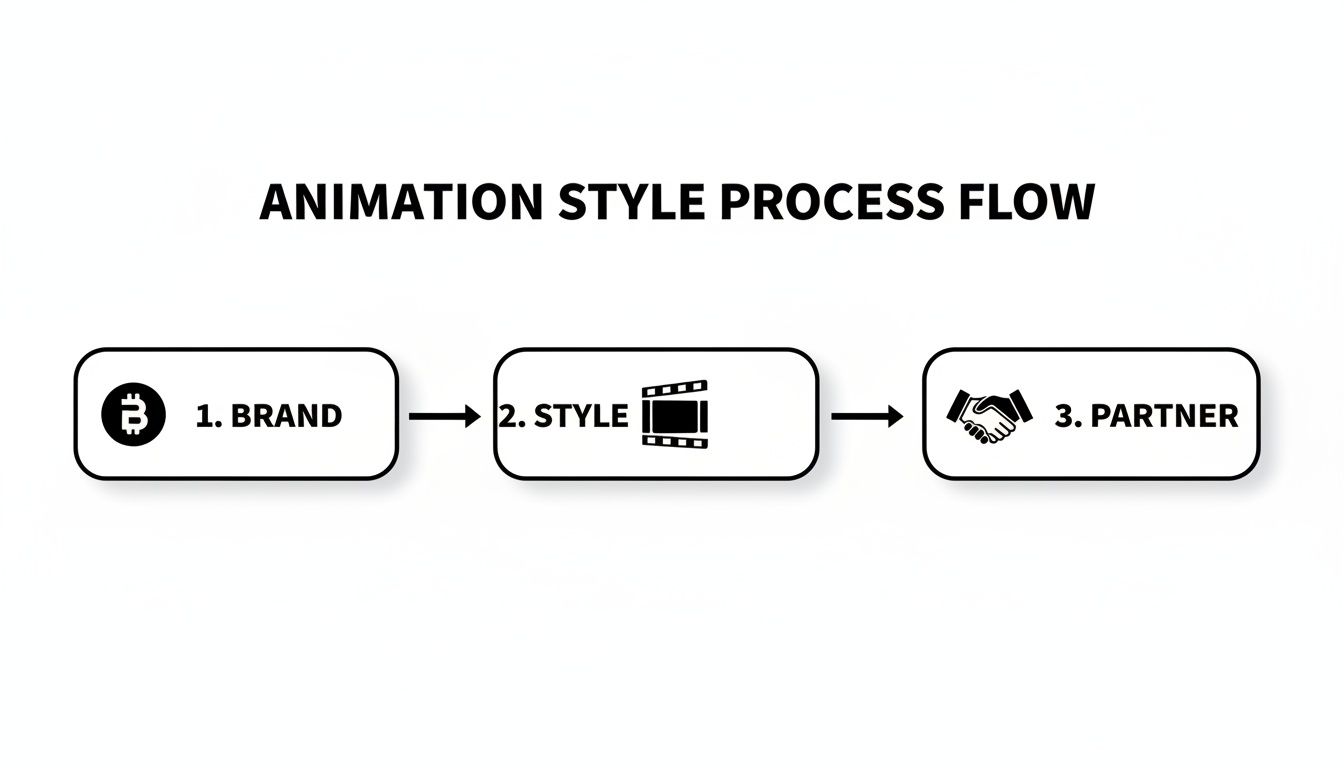
As you can see, a great video isn’t just about creative flair; it’s built on a solid, strategic foundation.
Bringing the Visuals to Life
The first big milestone after your storyboard is design. This is where your video’s unique look gets locked in. Animators will start creating key visuals—character designs, backgrounds, props, and any important objects—all based on the style you’ve chosen.
Your feedback at this stage is absolutely vital. Does everything feel true to your brand? Does the main character feel relatable? Do the colours and environments match the emotional tone of your script? Once you approve these designs, they become the visual blueprint for the entire video.
With the designs signed off, the animation itself can begin. This is often the most time-consuming part of the whole process, where artists meticulously bring every single frame to life. You’ll usually get drafts to review so you can see how the timing and motion are shaping up. Your focus here should be on the flow and pacing—does the action feel natural? Is the timing sharp and engaging?
The Magic of Post-Production
Once the core animation is done, the project heads into post-production. This is where a good video is polished into a great one. It’s all about adding those extra layers that create a professional, immersive experience for your backers.
A huge part of this is sound design. We're not just talking about background music here. Sound design covers every subtle noise that makes the world feel real: the click of a button, the whoosh of a transition, the low hum of a device. These tiny details add incredible texture and depth, making the animation far more believable and engaging.
Then there's the music. The soundtrack is what really sets the emotional tone of your video.
- An upbeat, energetic track can build excitement and urgency for a product launch.
- A thoughtful, softer score can create a sense of trust and sincerity.
- A clean, modern beat can give a tech product a fresh, innovative feel.
The music has to complement the voice-over, never overpower it. A professional explainer video agency can be a massive help here, sourcing properly licensed music that hits the perfect note for your campaign.
A professional voice-over isn't just about reading words off a page; it’s a performance. The right artist brings warmth, authority, and personality, turning your script into something people genuinely connect with and want to listen to.
Technical Polish and Global Reach
Before you pop the champagne, there are a few final technical checks to run. Your video needs to be perfectly optimised for the platforms where your backers will be watching it. Crowdfunding sites like Kickstarter and Indiegogo have their own specific technical requirements.
Kickstarter Technical Specifications
- Resolution: Stick to 1080p (1920×1080 pixels) for the best quality.
- Aspect Ratio: 16:9 is the standard.
- File Format: H.264 encoded MP4 is their preferred format.
- Audio: AAC codec, stereo, at 44.1kHz.
Indiegogo Technical Specifications
- Resolution: They support up to 4K, but 1080p is perfectly fine.
- Aspect Ratio: Again, 16:9 is what you want.
- File Format: MP4 is highly recommended.
- Video Hosting: Videos are embedded from YouTube or Vimeo, so you’ll need to meet their specs first.
Making sure your final video file meets these specs means every potential backer gets a smooth, high-quality viewing experience, free from frustrating buffering or weird formatting glitches.
Finally, think bigger. To really maximise your campaign’s reach, consider localisation. Adding subtitles in a few key languages is a surprisingly cost-effective way to open your project up to international backers. It's a simple step, but it shows you've thought about a wider audience, and that can significantly boost your funding potential by making your campaign more accessible and inclusive.
Launching Your Video for Maximum Impact

Creating a brilliant animated video is a huge step, but it’s really only half the battle. Think of it this way: a stunning video with no audience is like a party with no guests. Your launch strategy is what fills the room. It’s the engine that turns your beautifully crafted animation into a pledge-driving machine, building unstoppable momentum from the very first day.
This is much more than just hitting 'publish' and hoping people show up. A successful launch is a carefully coordinated effort that begins long before your campaign is even live. It's about priming your audience, optimising for discoverability, and executing a plan that ensures your video lands with maximum force.
Pre-Launch Preparation: Your Foundation for Success
Before anyone can even see your campaign page, your video needs a home where it can start gathering steam. Hosting on platforms like YouTube or Vimeo is standard, but simply uploading it won’t cut it. You need to get the metadata right so people can actually find it.
- A Title That Hooks: Don't just use your product name. Think about what your ideal backer is searching for. Instead of just "Aura Light," try something like "The Aura Smart Bike Light – A Revolution in Cycling Safety." It’s specific, benefit-driven, and packed with keywords.
- A Thumbnail That Pops: This is your video's first impression, so make it count. Use a bright, high-contrast image straight from your animation—a great shot of the product in action or a character’s expressive face works well. A little bit of text overlay can build intrigue, but avoid cluttered visuals at all costs.
- A Description That Sells: The first couple of lines are gold because they show up in search results. Start with a direct link to your crowdfunding page. Follow it with a punchy paragraph summarising your project and its core benefit. Use the rest of the space for specs, details, and links to your social channels.
Getting this groundwork done early means that when you finally go live, your video is already positioned to be found by the right people.
Building Buzz Before Day One
That quiet period before your campaign kicks off is a golden opportunity to build anticipation. This is where you run a pre-launch teaser campaign to get your core audience excited and ready to back you the moment you go live. Why is this so important? An early surge of pledges creates powerful social proof and pushes your campaign right up the platform's rankings.
One of the best ways to do this is by creating shorter, super-shareable clips from your main animation. These bite-sized assets are tailor-made for social media.
- 15-Second Teasers: Pull a single, exciting moment from your video. It could be the hero shot of your product or a funny character interaction. These are perfect for Instagram Stories or TikTok.
- Animated GIFs: Capture a quick, looping visual that shows off a key feature. GIFs are incredibly shareable and work brilliantly in emails and on Twitter.
- Character Spotlights: If your animation has a relatable character, create a short clip introducing them and the problem they’re facing. This helps build an emotional connection before anyone’s even seen the full video.
Your goal during the pre-launch phase is simple: make people feel like insiders. Give them a sneak peek and make them eager for the full reveal. This is how you turn followers into your first and most enthusiastic backers.
The potential audience in Poland is enormous. YouTube alone reaches 29.0 million users, which is 75.6% of the country's entire population. For a crowdfunding campaign, this means your video animation for crowdfunding platforms can connect with a massive, engaged viewer base right from the start.
Executing a Coordinated Launch Day Push
On launch day, everything should converge in one synchronised push. This is the moment you unleash your full video and funnel everyone to your campaign page. Your email list is your most powerful tool here—these are people who have already asked to hear from you. Send them a launch email with the video embedded, a personal message from the founder, and a crystal-clear call-to-action to back the project.
At the same time, go live across all your social media channels. Share the full video natively on platforms like Facebook and LinkedIn for better reach. On Instagram and TikTok, post your shorter clips with a clear "Link in Bio" to drive traffic. For more strategies on how to use video content to boost conversions, it's worth applying proven e-commerce techniques to your crowdfunding push. By coordinating all your outreach, you create a wave of traffic and pledges that can carry your campaign straight to its goal—and far beyond.
Answering Your Crowdfunding Animation Questions
Even with a solid plan, jumping into the world of animation can feel like a massive step. It’s completely normal for project creators to have questions about the process, how much it costs, and how long it all takes. Getting clear, straight answers is the only way to move forward feeling confident you're making a smart investment in your campaign.
Let's dive into some of the most common questions we hear about creating video animation for crowdfunding platforms. The idea here is to pull back the curtain on the process, helping you sidestep common mistakes and get the best possible video for your money.
How Long Should My Crowdfunding Video Be?
This is the big one, and for good reason—length has a direct line to how many people actually watch your video to the end. While there's no single magic number, we've found the sweet spot for a main campaign video is between two and three minutes.
That's just enough time to tell a compelling story, outline the problem, show off your solution, and hit them with a strong call to action. Anything shorter can feel rushed and might not build enough trust with potential backers. On the other hand, once you creep past the four-minute mark, you start to see a serious drop-off in viewership. People are busy, and your video has to respect their time.
A study of successful campaigns shows that a project with a video is 50% more likely to reach its funding goal. The trick is making every single second count by keeping it sharp and focused.
For social media teasers or ads, you need to think much, much shorter. Aim for punchy little clips of 15 to 30 seconds. Their only job is to grab attention and drive people back to your main campaign page to get the full story.
What’s a Realistic Budget for a Good Animation?
This is another huge consideration, and the honest answer is: it really depends. The price tag on an animated video is tied to a few key things:
- Animation Style: A clean, 2D motion graphics video is generally going to be more budget-friendly than a complex 3D product animation that needs a ton of detailed modelling and rendering time.
- Length and Complexity: It's simple maths—a 90-second video is less work than a three-minute one. Similarly, a video packed with multiple characters, detailed scenes, and complex movements will cost more than one that relies on simple icons and text.
- Who You Work With: Costs will naturally vary between freelancers, boutique studios, and larger agencies.
As a rough ballpark, a professionally made 60-90 second 2D animated video can run anywhere from a few thousand to over ten thousand pounds. I know it’s tempting to hunt for the cheapest option, but remember this video is your number one sales tool. High-quality animation sends a message of professionalism and trustworthiness, which directly influences a backer’s choice to hit that "pledge" button. Always insist on a detailed quote that breaks down every stage of the production.
How Far in Advance Should I Start Production?
Whatever timeline you have in your head, add a bit more. Creating a great animated video takes time and it’s a deeply collaborative process involving scripting, storyboarding, design, animating, and post-production. Rushing any of these steps almost always hurts the final quality.
A safe timeline to work with is six to eight weeks from the first kickoff meeting to having the final video file in your hands. This gives everyone enough breathing room for creative development, a few rounds of feedback, and revisions without creating a last-minute panic right before you launch. Starting early means your video will be a polished, powerful asset, not something you scrambled to finish.
Should I Show My Face in the Video?
Even though animation is the star of the show, having the creator's face pop up—even for a moment—can be a seriously powerful move. People on Kickstarter or Indiegogo aren't just funding a product; they're backing the people and the vision behind it.
Splicing in a short, live-action clip of you or your team talking passionately about the project adds a layer of authenticity and trust that animation sometimes can't capture on its own. It proves there are real, dedicated humans behind the campaign. A great formula is to open with slick animation to hook the viewer, then cut to a personal message from the founder, and then transition back to animation to close with a powerful call to action.
At Simple Frame, we specialise in creating compelling animated videos that help crowdfunding campaigns stand out and smash their funding goals. Our Warsaw-based team works with you from the initial concept to the final cut, telling your story in a way that truly connects with backers. Learn more about our animation services and see how we can bring your vision to life.
 English
  Polish
  German