
Your Guide to Product Explainer Video Production
Think of a product explainer video as your most effective salesperson, one that works around the clock to deliver the perfect pitch every single time. It’s a short, compelling video that takes a complex idea, product, or service and boils it down into a simple story that truly connects with your audience and encourages them to take the next step.
Your Digital Storyteller for Driving Conversions
Imagine trying to describe a sophisticated software feature or a multi-step industrial process using just text and a few static pictures. It’s a tough sell. This is where a product explainer video comes in, cutting through the clutter to act as a powerful digital storyteller. It closes the gap between what your product does and why your customer should care.
Instead of just rattling off a list of features, these videos position your product as the hero in your customer’s own story. They typically follow a classic narrative structure: introduce a problem the viewer instantly recognises, present your product as the clear solution, and then showcase how it leads to a better outcome. This method doesn’t just inform people; it forges a genuine emotional connection.
How an Explainer Video Works
A great explainer video makes complicated things feel simple without dumbing them down. It translates technical jargon into relatable benefits, making your unique value proposition crystal clear in about 60 to 90 seconds. That kind of clarity is absolutely crucial for generating quality leads and boosting conversion rates.
This approach is particularly powerful in B2B marketing, a space where Polish explainer video companies are making a real name for themselves. The numbers back it up: 73% of video marketers now view explainer videos as their number one format for product demos. In creative hubs like Warsaw, firms are seeing animated explainers drive significantly stronger results for corporate clients, which aligns with the broader finding that 94% of marketers believe video improves product understanding. You can discover more insights about these video marketing trends here.
It’s this proven impact that has businesses—from fresh-faced tech startups to established corporate giants—relying on them.
An explainer video isn’t just another marketing asset; it’s a communication tool that streamlines the entire sales process. It educates prospects before they ever hop on a call, meaning they come to the conversation better informed and much closer to making a decision.
To help you visualise the direct impact, we’ve put together a table summarising the key advantages of using an explainer video.
Table: Key Benefits of Using a Product Explainer Video
| Benefit | Impact on Business Goals | Ideal for Which Audience |
|---|---|---|
| Increased Conversions | Turns passive viewers into active leads or customers by clearly showing value. | Audiences on landing pages or product pages. |
| Enhanced Understanding | Simplifies complex products, reducing confusion and support queries. | New users, potential B2B clients, and internal teams. |
| Improved Engagement | Captures and holds attention far better than text alone, keeping users on-site longer. | Top-of-funnel audiences on social media and homepages. |
| Boosted SEO | Videos on your site can significantly improve your search engine rankings. | Anyone searching for solutions your product provides. |
| Sales Team Enablement | Arms your sales team with a consistent, perfect pitch they can share with prospects. | Leads in the consideration phase of the sales cycle. |
As you can see, the benefits are tangible and tied directly to core business objectives, making these videos a smart investment across the board.
The Creative Forms an Explainer Video Can Take
One of the best things about product explainer videos is their sheer versatility. They can be adapted to match any brand voice, message, or industry through a variety of creative styles. This flexibility is key to making sure your story is told in the most impactful way possible.
Here are the main styles you’ll come across:
- 2D Animation: A hugely popular and flexible option. It’s perfect for explaining abstract concepts or software services in a way that’s visually engaging and budget-friendly.
- 3D Animation: The go-to style for showing off physical products, creating detailed technical visualisations, or producing medical animations with photorealistic depth.
- Live-Action: Builds authenticity and a human touch by featuring real people and locations. This makes it a fantastic choice for customer testimonials or service-based businesses.
- Motion Graphics: Uses animated text, logos, and dynamic shapes to present data and information in a clean, modern, and professional style.
Each style offers a distinct way to get your message across. As we’ll get into later in this guide, choosing the right one is fundamental to creating a video that doesn’t just explain but truly converts.
Exploring Different Explainer Video Styles
Picking the right visual style for your product explainer video is a bit like choosing the perfect instrument for a song. Each one sets a different mood and tells your story in a completely unique way. This isn’t just about aesthetics; it’s a strategic decision that directly impacts how your message is received, understood, and ultimately remembered by your audience.
The goal is to find that perfect sweet spot where the visual execution lines up with your brand identity, the complexity of your product, and what you want to achieve with your marketing. A fun, vibrant style might be perfect for a new consumer app, whereas a sleek, technical approach would feel right at home for sophisticated industrial machinery.
Let’s break down the most popular and effective explainer video styles to help you find the perfect match for your project.
The Versatility of 2D Animation
There’s a good reason 2D animation is one of the most popular choices out there. It’s incredibly versatile and has a unique ability to bring abstract concepts to life with engaging characters and fluid movement. Think of it as a digital storybook that can simplify even the most complex software-as-a-service (SaaS) platform into a narrative that’s easy to follow.
This style is fantastic for creating a friendly, approachable brand personality. Because you aren’t tied to the rules of reality, 2D animation can use clever metaphors and creative visuals to explain features and benefits in a way that truly sticks with the viewer. It’s an effective and often cost-efficient solution for businesses needing to get their ideas across clearly and creatively.
The real power of 2D animation lies in its ability to focus the viewer’s attention. By stripping away real-world distractions, you can guide your audience’s eyes exactly where you want them, making sure your core message is impossible to miss.
The Detail and Depth of 3D Animation
When you need to show off a physical product with absolute precision and realism, 3D animation is the undisputed champion. This style adds depth, texture, and a tangible sense of space, which makes it ideal for demonstrating how a product works from every conceivable angle. It lets you take viewers right inside a complex machine or showcase an architectural design before a single brick has been laid.
Industrial companies, medical device manufacturers, and tech hardware firms often lean on 3D animation to highlight intricate details and functional advantages. For instance, a detailed 3D product animation can give a clear, compelling view of an engine’s inner workings that would be impossible to film with a real camera. For more examples, you can learn more about how product animation videos bring technical products to life in our detailed guide.
The Clarity of Motion Graphics
Motion graphics videos are the masters of presenting information with style and clarity. This approach uses animated text, icons, charts, and abstract shapes to create a clean, modern, and highly professional feel. If your goal is to present data, explain a service-based workflow, or highlight key statistics, motion graphics are an excellent choice.
They are less about character-driven stories and more about making information digestible and visually appealing. This makes them a perfect fit for corporate presentations, financial service explanations, or any scenario where clear communication is the absolute top priority.
The Authenticity of Live-Action Video
Sometimes, the most powerful way to connect with an audience is to simply show them real people, real places, and real emotions. Live-action explainer videos build trust and authenticity by putting a human face to your brand. They are perfect for customer testimonials, company culture videos, or demonstrating a service that relies heavily on human interaction.
However, live-action isn’t the only way to build an authentic connection. When exploring different explainer video styles, you might find valuable resources on UGC video creation, which offers a unique and genuine approach by using content made by actual customers. This adds another layer of credibility to your marketing efforts.
Ultimately, you can even combine styles to create a powerful hybrid video. For example, you could overlay motion graphics on top of live-action footage to highlight key features while a person is using your product. The creative possibilities are vast, allowing you to craft a product explainer video that is perfectly suited to your brand’s unique story.
The Production Process from Start to Finish
Creating a product explainer video isn’t about just pointing a camera or opening some software. It’s a carefully structured journey, a real partnership that turns an idea into a powerful business tool. When you understand the workflow, the whole experience becomes less of a mystery and more of an exciting collaboration.
Think of it like building with Lego blocks. Each phase builds on the one before it, and your input at every step ensures the final video is exactly what you envisioned. From the first chat about strategy to the final touches in editing, having a clear roadmap means everything runs smoothly and the end result truly connects with your audience.
So, let’s break down the six core phases of bringing your explainer video to life.
Phase 1: Discovery and Strategy
This is the foundation. A project’s success is almost always decided right here. We start by diving deep into your business, your product, and what you’re trying to achieve. We don’t just ask what you want to make; we need to understand why.
During this phase, we’ll nail down the essentials:
- Who are we talking to? We need to get inside the head of your target audience. What are their biggest problems, what motivates them, and what do they already know about solutions like yours?
- What’s the one key message? If a viewer only remembers one thing from the video, what should it be?
- What’s the goal? Are we aiming for more leads, better conversion rates, fewer support tickets, or simply helping new users get started?
- What’s the vibe? We’ll establish the right tone and style—professional, witty, empathetic, or technical—to make sure it perfectly matches your brand’s personality.
Phase 2: Scriptwriting
With a solid strategy locked in, it’s time to build the narrative. The script is the blueprint for everything that follows, dictating the story, the rhythm, and the final call-to-action. A great script doesn’t just list features; it tells a compelling story about the problem your product solves.
This part is highly collaborative. You’ll get to review early drafts to make sure the message is spot-on, the language feels right for your brand, and the story flows perfectly. Once approved, this script becomes the guide for the voiceover artist, the designers, and the animators.
Phase 3: Storyboarding and Visual Concept
This is where your story starts to become visible. A storyboard is basically a comic book version of your video. It’s a sequence of drawings that maps out every scene, showing the on-screen action, character movements, and key visuals alongside the corresponding lines from the script.
At the same time, we’ll develop “style frames.” These are beautiful, fully designed still images that set the final look and feel for the animation or live-action shots. This step is crucial for getting everyone aligned on the visual direction before the heavy lifting of animation or filming begins, which saves a ton of time and avoids costly changes down the line.
The diagram below shows how the production path splits depending on the style you choose.
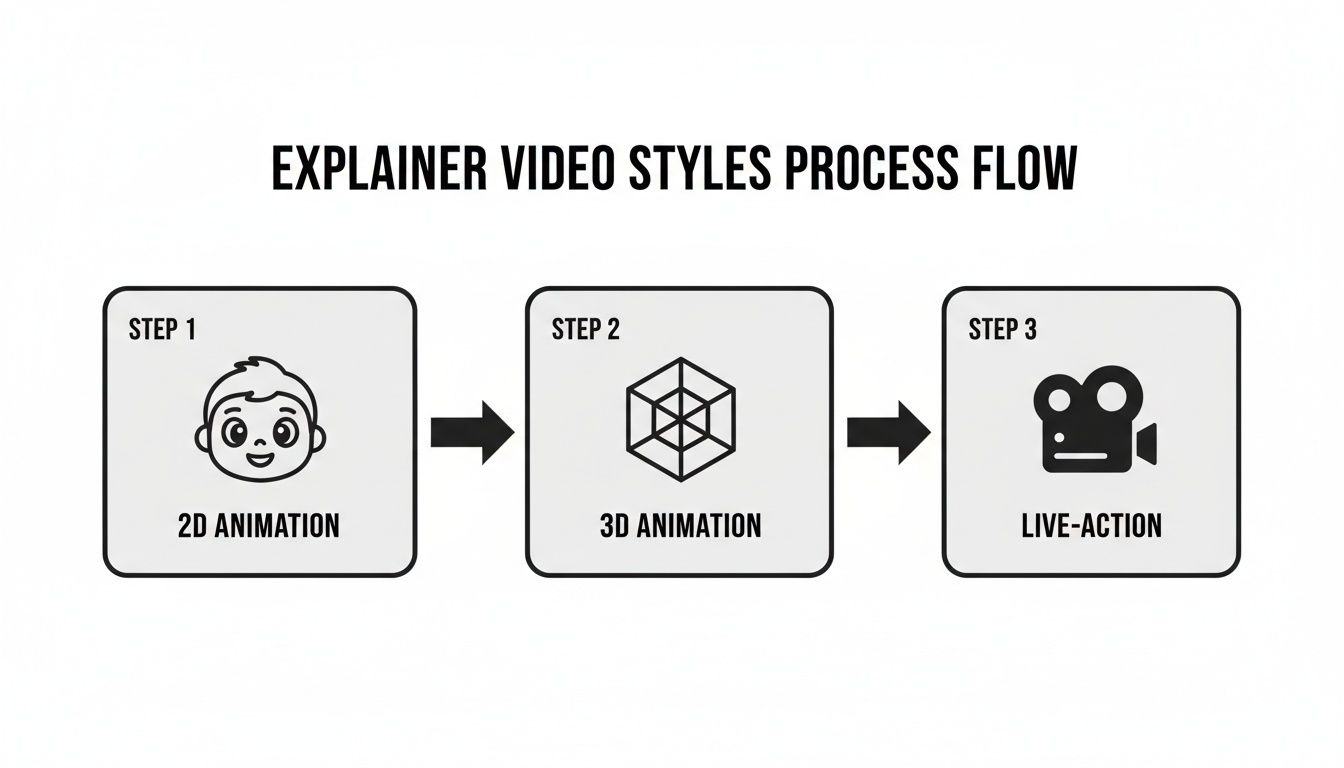
As you can see, styles like 2D animation, 3D animation, and live-action each follow a unique workflow, requiring their own specialised skills and tools.
A typical production timeline for a 60-90 second animated video gives you a clearer picture of how these phases fit together.
Explainer Video Production Timeline and Key Milestones
| Production Phase | Typical Duration | Key Client Deliverable/Milestone |
|---|---|---|
| Discovery & Strategy | 1-2 weeks | Project Kickoff, Creative Brief Approval |
| Scriptwriting | 1-2 weeks | Final Script Approval |
| Storyboard & Style Frames | 1-2 weeks | Storyboard & Visual Style Approval |
| Voiceover & Sound Design | 1 week | Voiceover Artist Selection & Recording Approval |
| Animation/Production | 2-4 weeks | First Draft of Animated Video (Animatic) |
| Post-Production & Revisions | 1-2 weeks | Final Video Approval & Delivery |
| Total Estimated Time | 6-12 weeks | – |
This timeline helps set clear expectations and ensures everyone knows what milestones to look for as the project moves forward.
Phase 4: Voiceover and Sound Design
With the visual plan in place, we focus on the audio. A professional voiceover artist is chosen based on the tone we’re going for—whether that’s warm and friendly or authoritative and confident. Their performance breathes life into the script, giving your video a real personality.
Next comes sound design. This is where we add background music, custom sound effects, and professional audio mixing to create a truly immersive experience. The right audio can stir emotion, build excitement, and keep your viewer hooked from the first second to the last.
Phase 5: Animation or Filming
Now for the fun part. Guided by the storyboard and script, our animators start bringing the motion graphics to life, or our film crew gets ready for the live-action shoot. This is usually the most time-intensive phase of the entire project. Following general video production best practices is absolutely essential here to guarantee a high-quality video that hits the mark.
Phase 6: Post-Production and Final Delivery
This is the home stretch, where all the individual pieces are assembled into a seamless whole. Our editors put together the animated scenes or raw footage, sync it perfectly with the voiceover and sound, and add any final visual effects or colour correction. This is where the video gets its final polish.
Post-production is so much more than just editing. It’s the final stage of storytelling where we perfect the pacing, fine-tune the emotional impact, and get the video ready for the world to see.
You’ll get a chance to review the edited video and provide feedback before we render the final version. If you’re curious about what goes on behind the scenes, you can learn more about the crucial work a postproduction studio does to complete a project. Once you give the final thumbs-up, we deliver all the files you need, perfectly formatted for your website, social media, and other marketing channels.
How Much Does a Product Explainer Video Cost?
Figuring out the budget for a product explainer video can feel a bit like guesswork. The honest answer is, there’s no fixed price. Costs are a mix of creative choices and technical details, with the final price tag reflecting what your specific project needs to succeed.
Think of it like commissioning a painting. A simple pencil sketch and a detailed oil portrait are going to have very different costs. It’s the same with video; a basic animated piece will be much friendlier on the wallet than a complex 3D visualisation with custom-designed characters and rich environments. The trick is to understand what drives the costs so you can put your money where it will make the most difference.
Key Factors Influencing Video Production Costs
A few core elements will always shape the final quote you get from a production partner. Getting a handle on these variables helps you make smarter decisions about where to invest your budget for the best possible impact.
It really boils down to three main factors:
- Video Style and Complexity: A straightforward 2D motion graphics video is generally the most budget-friendly option. As you move into photorealistic 3D animation, the price goes up. The more detailed the character design, the environments, and any special effects, the more time and specialised skill it takes, which naturally adds to the cost.
- Video Length: This seems obvious, but a longer video isn’t just about adding a few more seconds of work. It means more scriptwriting, more storyboarding, more time in the voiceover booth, and a lot more time spent animating or editing. Every single second has a cost attached.
- Turnaround Time: Need your video yesterday? A tight deadline usually means the production team has to work overtime or shuffle other projects around. That kind of urgency almost always comes at a premium.
A common mistake is getting fixated on the lowest price. A much better approach is to focus on value. An effective, high-quality video that actually achieves your business goals will deliver a much greater return than a cheaper one that just doesn’t connect with your audience.
Realistic Price Ranges in Poland
So, what should you really expect to pay? The good news is that the Polish video production market offers incredible value, giving you access to world-class quality at a fraction of what you might pay in the US or Western Europe.
Explainer videos have become incredibly popular in Poland’s dynamic video production scene, with 72 dedicated companies now specialising in this format. The average cost for a 60-second explainer video in Europe is around $5,662.50, which is already much lower than the US average of $12,667.65. This makes Poland a real hotspot for cost-effective, high-quality production. You can discover more insights about Poland’s video production market here.
Here’s a rough breakdown of what you can expect for a 60-second animated product explainer video made in Poland:
- Basic Tier (€1,500 – €3,000): This budget typically gets you simpler 2D animations that might use template assets or straightforward motion graphics. It’s a solid starting point for new companies or businesses working with a modest budget.
- Professional Tier (€3,000 – €7,000): This is the sweet spot for most businesses. It unlocks custom 2D animation, unique character design, a professional voiceover, and custom sound design. You end up with a polished and completely unique video.
- Premium Tier (€7,000+): If you’re looking for high-end 3D animation, complex visual effects, or really intricate character work, this is the budget you’ll need. This tier is for ambitious projects designed to make a huge impact, similar to the detailed work you’d see in high-end corporate video production.
At the end of the day, investing in a product explainer video is an investment in communicating clearly with your customers. By understanding these cost factors, you can budget with confidence for a powerful tool that will help your business grow.
Real-World Examples of Explainer Videos
Theory is one thing, but seeing a product explainer video out in the wild is where you really grasp its power. These aren’t just flashy marketing assets; they’re problem-solving tools used by businesses in every sector imaginable.
Looking at real examples helps you picture how this format could work for your own brand. Let’s walk through a few mini-case studies to see how different industries use explainer videos to get real, tangible results. It’s the easiest way to see the direct line between a business problem and a creative video solution.
The Tech Startup Launching a New App
The tech world moves at lightning speed. For a new startup, just getting noticed is a huge battle. The biggest hurdle is often explaining what your app or software does in a way that’s quick, engaging, and doesn’t drown people in technical jargon.
- The Business Challenge: A FinTech startup built a budgeting app with a really clever algorithm for tracking spending. Their website had plenty of screenshots and text, but feedback showed that potential users were confused. They couldn’t see how it was any different from the apps already on their phones, and sign-up numbers were low.
- The Video Solution: The startup invested in a 90-second 2D animated video. It followed a relatable character struggling to get their finances in order, then introduced the app as the simple fix. Clean, clear motion graphics showed exactly how the algorithm worked and the ultimate payoff: financial peace of mind.
- The Impact: They put the video right at the top of their landing page and pushed it out in social media ads. The change was almost instant. Demo requests shot up by 45%, and the conversion rate from website visitor to new user more than doubled. The video finally gave them the clarity they needed to cut through the market noise.
The Medical Company Explaining a Complex Device
In healthcare, clarity isn’t just a bonus—it’s everything. Explaining a new medical device or procedure to doctors or patients demands absolute precision. Dense manuals and static diagrams can easily create confusion when you can’t afford any.
A well-crafted explainer video can bridge the knowledge gap for highly technical products. It builds confidence by demonstrating functionality with a level of detail that static content simply cannot match, making it an essential tool for B2B sales and training.
- The Business Challenge: A medical device company created an advanced handheld diagnostic tool for specialists. It had a ton of innovative features, but its complexity made it tough for the sales team to demo it properly in short client meetings. They needed a way to standardise their pitch and make the benefits crystal clear every single time.
- The Video Solution: A high-quality 3D animation was the perfect answer. This let them build a photorealistic model of the device, peel back the layers to show its internal workings, and even demonstrate its use on a virtual patient. The 3D video broke the whole process down into a simple, easy-to-follow visual guide.
- The Impact: The sales team started using the video in their presentations, which helped shorten the average sales cycle by a massive 30%. The video was also a huge asset for training new staff on how to use the device correctly and safely.
The Industrial Firm Showcasing a Manufacturing Process
Industrial and manufacturing businesses often deal with massive, complex machinery in environments that aren’t exactly easy to visit. Trying to show a potential client how your custom solution works from halfway across the world is a serious logistical headache.
- The Business Challenge: An engineering firm that designs bespoke automated assembly lines needed a way to show off their work to international clients without flying them to a factory floor. They wanted to convey the precision, speed, and safety of their systems in a powerful way.
- The Video Solution: They went with a hybrid video, mixing real-world, live-action footage with slick 3D animated overlays. The video showed their actual machinery in motion while 3D graphics popped up to highlight key performance stats and safety features in real-time. This blend of reality and data gave a complete and seriously impressive overview.
- The Impact: This explainer video quickly became their number one digital sales tool, used in online meetings and at trade shows. It directly helped them land three major international contracts in just the first six months. The market for this type of content is booming in Poland, with the global industry expected to reach $45.6 billion by 2025. With 93% of marketers seeing a positive ROI from video, the value is clear. For industrial firms, these animations build trust—91% of consumers say video quality directly impacts their perception of a brand’s reliability. Discover more insights about the explainer video market on BetterVideoContent.com.
Choosing the Right Production Partner
Picking a production partner for your product explainer video is a massive decision. You aren’t just hiring a vendor; you’re bringing on a creative ally who needs to get your vision and turn it into a genuine asset for your business. The right team will guide you, offer strategic thinking, and act like a natural extension of your own team.
Your first move should be to dive headfirst into their portfolio. Look past the slick animation or polished cinematography. Ask yourself: do they have real experience in my industry? A team that already understands the ins and outs of tech, medical, or industrial products will get up to speed much faster and produce something far more effective.
Evaluating Potential Partners
Once you’ve got a shortlist, it’s time to dig deeper. Look for proof of a solid, collaborative process. Do they have detailed case studies or client testimonials that talk about their workflow and how they communicate? A good partner is an open book about how they work, from the first discovery call all the way to final delivery.
Don’t forget to check out their creative range. A varied portfolio showing off different styles—from 2D and 3D animation to motion graphics—is a fantastic sign. It tells you they have the creative chops to recommend the best style for your goals, not just the one trick they know how to do.
Choosing a production partner is about trust and alignment. The best fit will be a team that not only has the technical skills but also shares a genuine enthusiasm for your product and its story.
Key Questions to Ask
Before you sign on the dotted line, you need to have a proper conversation. This is your moment to make sure they’re the right fit. Get a list of questions ready so you can cover all your bases.
Here are a few essential questions to throw at any potential production partner:
- Who will be my main point of contact? Knowing who will be running your project day-to-day is absolutely critical for keeping communication smooth.
- What does your revision process look like? Find out how many rounds of feedback are baked in at each stage (script, storyboard, animation) to avoid any surprise costs down the line.
- Can you describe your ideal client collaboration? This question is great for revealing how they see the client’s role and helps set expectations for how involved you’ll need to be.
- How do you measure the success of a video? A strategic partner will think beyond just making a pretty video. They’ll be focused on how it’s going to hit your business goals.
Finding the right creative crew is the final, make-or-break step in this whole journey. A strong partner, like a skilled explainer video agency, will make sure your investment pays off with a product explainer video that actually gets results.
Common Questions Answered
Stepping into the world of video production can feel like learning a new language. To help you feel more comfortable and ready to go, we’ve put together a few of the most common questions we get about creating a product explainer video. This section gives you clear, simple answers to get you started on the right foot.
Think of these as quick insights to back up what you’ve learned and offer some practical advice. Let’s get into the details that truly matter as you start planning your project.
How Long Should a Product Explainer Video Be?
For most product explainer videos, the sweet spot is somewhere between 60 and 90 seconds. Extensive research points to this length as being ideal for holding your audience’s attention while still getting your main message across. It gives you just enough runway to set up a problem, present your product as the hero, and tell viewers what to do next.
Sure, some really complex products or services might need a video that stretches to two or even three minutes, but for top-of-funnel marketing, shorter is almost always better. The real goal is to make a powerful case before your viewer’s mind has a chance to wander off.
Keep it tight. We live in a world of shrinking attention spans, and a punchy 75-second video will beat a rambling three-minute one every single time. Your focus should be on creating the biggest impact in the shortest amount of time.
What Information Should I Include in a Creative Brief?
A solid, detailed creative brief is probably the single most critical document you’ll create for your project. It’s the map your production partner will use to navigate from your initial idea to the final video.
At a minimum, your brief must include these key points:
- Target Audience: Who are you actually talking to? Get specific.
- Primary Goal: What is the one thing you want viewers to do after watching?
- Key Messages: What are the non-negotiable takeaways?
- Brand Guidelines: Lay out your brand’s personality, colours, fonts, and overall style.
- Inspiration: Show them videos you love and, just as importantly, some you don’t.
The more detail you can provide about what you want to achieve, your budget, and your timeline, the better your creative team can get inside your head and bring your vision to life without any guesswork.
Can Explainer Videos Be Used for More Than Marketing?
Absolutely! While they are an absolute powerhouse for marketing, product explainer videos are surprisingly versatile. Their core strength is making complicated stuff simple, and that’s a valuable skill across your entire business.
Don’t just think about your website’s landing page. These videos are fantastic for:
- Employee Onboarding: Getting new hires up to speed on internal software or company processes.
- Customer Support: Creating visual answers to the questions your support team gets all the time.
- Sales Enablement: Arming your sales team with a perfect, consistent pitch they can use anywhere.
Finding new ways to use your video in different departments is a brilliant strategy to get more mileage out of your investment and see a much bigger return.
Ready to finally tell your product’s story with an explainer video that truly connects? The team at Simple Frame are experts in creating high-quality animations that get people’s attention and drive real results. Visit simpleframe.com to see our portfolio and start your project today.
 English
  Polish
  German