
Medical Training Video Production: A Practical Guide for Effective Training
Medical training video production is a specialised craft. It’s all about creating clear, accurate, and genuinely engaging video content to teach healthcare professionals everything from new procedures and devices to complex protocols. It’s where clinical expertise meets professional filmmaking and animation, all with the goal of delivering learning that actually sticks and improves patient care.
Building Your Strategic Foundation for Effective Medical Videos
Just pointing a camera at a surgeon and hitting record won’t cut it. A medical training video that truly resonates and teaches effectively needs a solid strategic framework from the very beginning. Every visual, every word spoken, has to serve a clear educational purpose.
We need to move past vague goals like “creating a training video.” The first, most critical step is to define sharp, measurable learning objectives that meet demanding medical standards. What, exactly, should a surgeon be able to do after watching? What critical diagnostic sign must a medical student be able to spot? These answers form the blueprint for the entire project, guiding everything from the script to the final edit.
Pinpoint Your Audience and Their Needs
You absolutely have to know who you’re talking to. A video for seasoned cardiologists learning a new valve replacement technique will look and feel completely different from one made for first-year nursing students mastering sterile field protocols. The complexity, tone, and pacing are worlds apart.
To get this right, you need to dig into a proper audience analysis:
- Assess Current Knowledge: What’s their baseline understanding? You don’t want to bury them in jargon they won’t recognise, but you also can’t oversimplify concepts they mastered years ago.
- Identify the Learning Gap: What specific knowledge or skill are they missing that this video will provide? This gap is your video’s entire reason for being.
- Consider the Viewing Context: Will they be watching on a phone between shifts, in a formal lecture hall, or as part of an online learning module? This directly impacts the ideal video length and format.
Answering these questions ensures your content is relevant, engaging, and respects your viewers’ time and expertise.
Assemble Your Specialist Project Team
Putting together a great medical training video is a team sport. It’s a careful blend of clinical authority and creative execution. A common mistake is relying only on your in-house medical experts or, just as bad, hiring a generalist video crew who doesn’t get the nuances of healthcare.
The dream team is a hybrid, combining your internal knowledge with external production skill.
Your core team should always include:
- In-house Subject Matter Experts (SMEs): These are your clinical champions—the surgeons, nurses, or researchers who own the medical information and can validate its accuracy.
- Instructional Designer: This role is often overlooked but is absolutely crucial. They are the experts in structuring content for optimal learning and retention, translating dense medical concepts into a logical, educational flow.
- Specialist Production Partner: You need a production studio with a portfolio in healthcare. They understand the unique challenges, from navigating sterile environments to creating clinically perfect 3D animations.
This flow diagram shows how these foundational pieces fit together. It all starts with the objectives, which inform your understanding of the audience, and that, in turn, helps you build the right team.
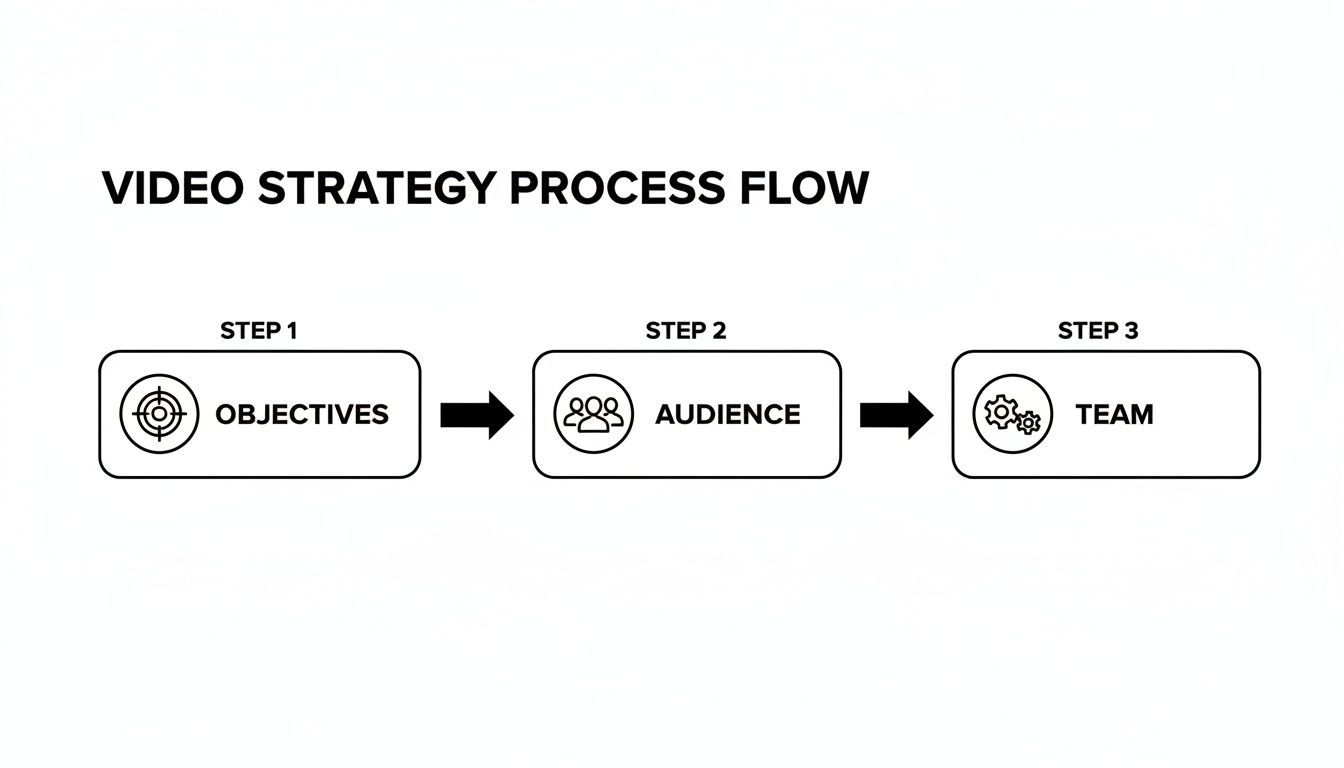
It’s a clear, sequential strategy where each step builds on the last. Get this right, and you’re halfway there.
A well-defined strategy is the single most important factor in medical video production. It transforms a simple recording into a powerful educational tool that can standardise training, reduce errors, and ultimately improve patient safety. Without it, you’re just filming.
This strategic alignment is a core part of any high-quality corporate video production but is especially vital in the high-stakes medical field. By laying this groundwork first, you create a clear path forward, ensuring the final video isn’t just visually polished, but is educationally powerful, clinically sound, and ready to make a real impact.
Scripting for Accuracy and Nailing Clinical Validation
In the world of medical training videos, the script is everything. It’s not just dialogue; it’s the clinical and educational blueprint for the entire project. This is where we take dense medical data, intricate procedures, and non-negotiable safety protocols and weave them into a story that’s clear, engaging, and instructionally sound. Let’s be frank: in this field, a tiny mistake isn’t just a slip-up. It can have serious consequences.
The first step is always to translate your core learning objectives into a narrative. Instead of just rattling off a list of facts, a powerful script tells a story or walks the learner through a real-world problem-and-solution scenario. This isn’t just for dramatic effect—it’s a proven way to boost learner retention. People simply remember stories better than a jumble of disconnected information. A script demonstrating a new surgical device, for example, is far more effective if it follows a surgeon’s entire workflow, from pre-op checks right through to post-operative care. It creates a logical, memorable journey.
Turning Clinical Jargon into Clear Communication
One of the biggest hurdles we consistently face is simplifying complex medical terminology without sacrificing an ounce of accuracy. The aim is to be precise but completely accessible to your specific audience. You’re not “dumbing down” the content; you’re making it crystal clear.
Here’s how we do it:
- Lean on Analogies: Comparing a complex biological process to something familiar can be a game-changer. For instance, describing the sodium-potassium pump as a cellular “gatekeeper” makes the concept click instantly.
- Define Your Terms: When a technical term is absolutely necessary, define it clearly the first time it appears, either in the narration or with a quick on-screen text overlay.
- Keep it Active: Use direct, action-oriented language. Don’t say, “the scalpel should be held.” Say, “hold the scalpel.” It’s clearer, more confident, and just works better for instruction.
The script also needs to be packed with detailed visual cues. These are the specific instructions for the camera crew or the animation team, describing exactly what needs to be on screen at any given moment.
For example, a line in the script might look something like this:
NARRATOR: “Insert the guidewire carefully through the catheter hub.”
VISUAL CUE: Tight close-up shot. We see the surgeon’s gloved hands steadily advancing the tip of the guidewire into the port. An on-screen graphic highlights the entry point.
This level of detail is crucial. It ensures the visual story aligns perfectly with the educational content, leaving zero room for misinterpretation. Once the script is locked, creating effective storyboards is the next vital step to visually map out these critical shots before you even think about filming.
The Clinical Validation Gauntlet: A Non-Negotiable Step
With a draft script in hand, we enter the most critical phase of all: clinical validation. This is a multi-stage review process where Subject Matter Experts (SMEs)—be they surgeons, specialist nurses, or other medical professionals—meticulously scrutinise every single word and visual cue for accuracy. There are no shortcuts here.
This isn’t a quick once-over and a sign-off. The process nearly always involves several rounds of feedback. An initial review might catch a slightly outdated term, while a later review of the storyboard could flag an incorrectly placed instrument. Every piece of feedback is carefully documented and implemented, and the revised version goes back for final approval.
Think of this iterative review cycle as your project’s ultimate quality control. It’s what guarantees the final video isn’t just polished, but is clinically irrefutable, safe, and truly ready for a professional medical setting.
This intense validation process extends well beyond the script. For projects involving animation, particularly those showing internal biological processes, it’s absolutely paramount. When we develop a sophisticated medical procedure animation, every anatomical structure, every cellular interaction, and every device mechanism has to be checked and re-checked by experts to ensure it mirrors reality with absolute precision. Rushing this stage is a recipe for creating inaccurate, and therefore dangerous, training material. It’s the very foundation of credible medical content.
Executing Flawless Production in Clinical Environments
This is where the rubber meets the road. Moving from a clinically validated script to the actual production floor—whether that’s a sterile operating theatre or a digital animation suite—is the moment theory becomes practice. It’s a phase that absolutely demands precision, flexibility, and a deep respect for the clinical environment you’re working in.
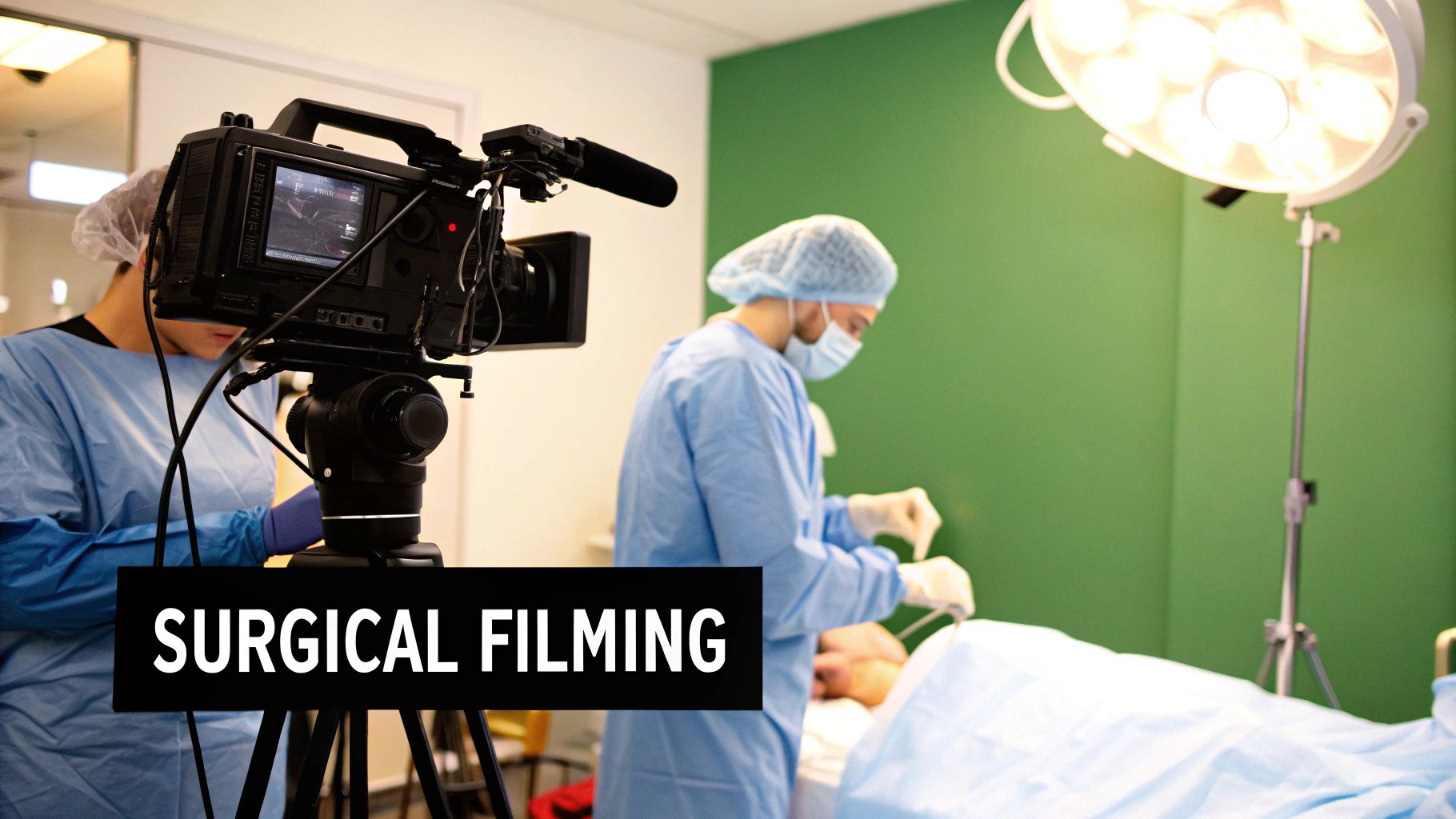
Live-action shoots, in particular, come with a unique minefield of logistical challenges. You aren’t just running a film set; you’re a guest in a tightly controlled healthcare facility where patient care is, and always will be, the top priority.
Success here is all about obsessive pre-production. That means getting every single permission squared away, coordinating closely with hospital admin, and building a shoot schedule that causes the least possible disruption to clinical routines. Every tiny detail, from where the crew can enter to where you’ll plug in the lights, has to be planned well in advance.
Mastering the Sterile Environment
Stepping into an operating room or a cleanroom with a film crew is a whole different ball game. It requires a complete shift in mindset. Your crew needs to be properly trained on sterile protocols, and every piece of gear that crosses the threshold must be sterilised according to strict hospital guidelines.
To pull this off without a hitch, we stick to some hard-and-fast rules:
- Minimal Crew Footprint: Only the absolute essential crew members are on set. A smaller, nimbler team drastically cuts down the risk of contamination and disruption.
- Equipment Prep: All cameras, lights, and sound equipment get a thorough wipe-down with approved disinfectants. We tape down cables and manage them carefully to eliminate any trip hazards.
- Follow the Leader: The crew wears the right Personal Protective Equipment (PPE) from start to finish and follows every instruction from the clinical staff without question. They lead, we follow.
The choice of camera and lighting is also make-or-break. You need to capture the procedure with perfect clarity without getting in the way. Using long lenses lets the camera keep a respectful distance, while modern LED lights give you bright, clean illumination without throwing off excess heat that could mess with sensitive equipment or affect patient comfort. Every shot has a purpose, capturing the key steps with the kind of precision medical education requires.
The Power of 2D and 3D Medical Animation
While live-action is brilliant for showing human interaction and how to handle a device, some things are just impossible to film. This is where 2D and 3D animation become absolutely essential tools for creating top-tier medical training.
Animation lets us travel inside the human body. We can show microscopic biological processes or demonstrate the mechanism of action for a new drug. It can break down the complex steps of a surgical procedure from angles a camera could never hope to capture, giving viewers a kind of “superman view” that makes every detail crystal clear. This is especially important for anything related to our work in technical video production, where showing internal mechanics is the whole point.
The real magic of medical animation is its ability to make the invisible visible. It turns abstract scientific ideas into solid, understandable visuals that massively boost learning retention and understanding for healthcare professionals.
This unique capability is fuelling major growth in the industry. Here in Poland, the demand for specialised video is backed by a robust TV and video market that’s projected to hit US$5.22 billion by 2025. It’s a great environment for expert producers creating medical animations for a booming pharma and medical device sector—a sector that was worth €2.5 billion as of late 2023 and is expected to grow another 5.9% in 2025. All that innovation creates a huge need for training videos. You can find out more about the media consumption trends in Poland on Statista.com.
The animation process itself is highly structured. We move from the clinically approved storyboard to 3D modelling, texturing, and rigging (which is like creating a digital skeleton for movement), before finally animating the scene. At every single stage, medical experts review our work to ensure every last anatomical detail is perfect. It’s this methodical approach that guarantees the final animation isn’t just visually stunning, but a clinically accurate and powerful teaching tool.
Navigating the Complex World of Medical Compliance
Creating medical video content isn’t like shooting a typical corporate film; you’re stepping into a minefield of legal and ethical rules. This isn’t just about making a great video. It’s about creating something legally sound that puts patient privacy first. One misstep can lead to severe legal trouble and shatter your organisation’s reputation.
The absolute bedrock of medical compliance, particularly when filming procedures, is informed patient consent. This is so much more than just getting a signature on a form. Genuine informed consent means the patient has a crystal-clear understanding of how their image and data will be used, who gets to see it, and why. They must know if the final video is for internal training, public education, or marketing.
Every part of this process needs to be documented with painstaking detail to comply with data privacy laws like GDPR. The consent has to be specific, given without pressure, and easy for the patient to withdraw at any time. Don’t forget, a patient agreeing to a medical procedure is not the same as them agreeing to have it filmed.
Educational Vs Promotional Content
The rulebook looks very different depending on whether your video is for education or promotion. This is a critical distinction, especially when you’re dealing with medical devices and pharmaceuticals. The path you follow is dictated entirely by your video’s purpose and its audience.
- Educational Content: This is for the experts—the healthcare professionals (HCPs). It’s where you can get technical, detailed, and show specific steps or how a device works. The whole point is to train and improve skills.
- Promotional Content: This material is usually for the public, designed to advertise a product or service. The regulations clamp down hard here to stop misleading claims and protect patients.
Think of it this way: a video demonstrating a new surgical robot to an audience of surgeons can show every intricate detail. But if you create a public-facing video about that same robot, you have to be incredibly careful. You can’t make claims that could be interpreted as direct-to-consumer advertising, which is heavily restricted in many parts of the world.
The core principle is simple: if your video is training a professional, you can be direct and technical. If it’s informing the public or promoting a product, you must navigate a much stricter set of advertising standards.
The Nuances of Device and Pharma Regulations
Things get even more granular when you get into the specific regulations for devices and pharmaceuticals. This is precisely where having a production partner with deep experience in the Polish and EU markets is a game-changer. Local regulations, like the Polish Medical Devices Act, put tight controls on public advertising while actively encouraging the development of professional training materials.
Poland’s medical technology market, which is on track to hit US$4.77 billion in 2025, perfectly illustrates this landscape. Medical devices are driving that growth, creating a massive need for high-quality training videos to get HCPs up to speed on advanced equipment. In 2024 alone, Poland’s regulatory office handed out 757 Free Sales Certificates for MedTech exports. Each one of those likely represents a product that needs clear video instructions to be used safely and effectively. You can discover more about the Polish MedTech market.
If your video content or any related documents touch on sensitive patient information, choosing HIPAA compliant transcription services is another essential layer of protection for everyone involved. You have to look at every single step of the production process through a compliance lens. Ignoring these detailed rules isn’t just risking a fine; it’s risking the trust that is the absolute foundation of the entire healthcare field.
Mastering Post-Production and Strategic Distribution
Once filming wraps, you’re left with hours of raw footage or a mountain of animation files. This is where the real magic happens. Post-production is the craft of shaping those raw assets into a polished, powerful educational tool. It’s so much more than just splicing clips together; it’s about building a narrative, sharpening clarity, and making sure every single second serves a learning objective.
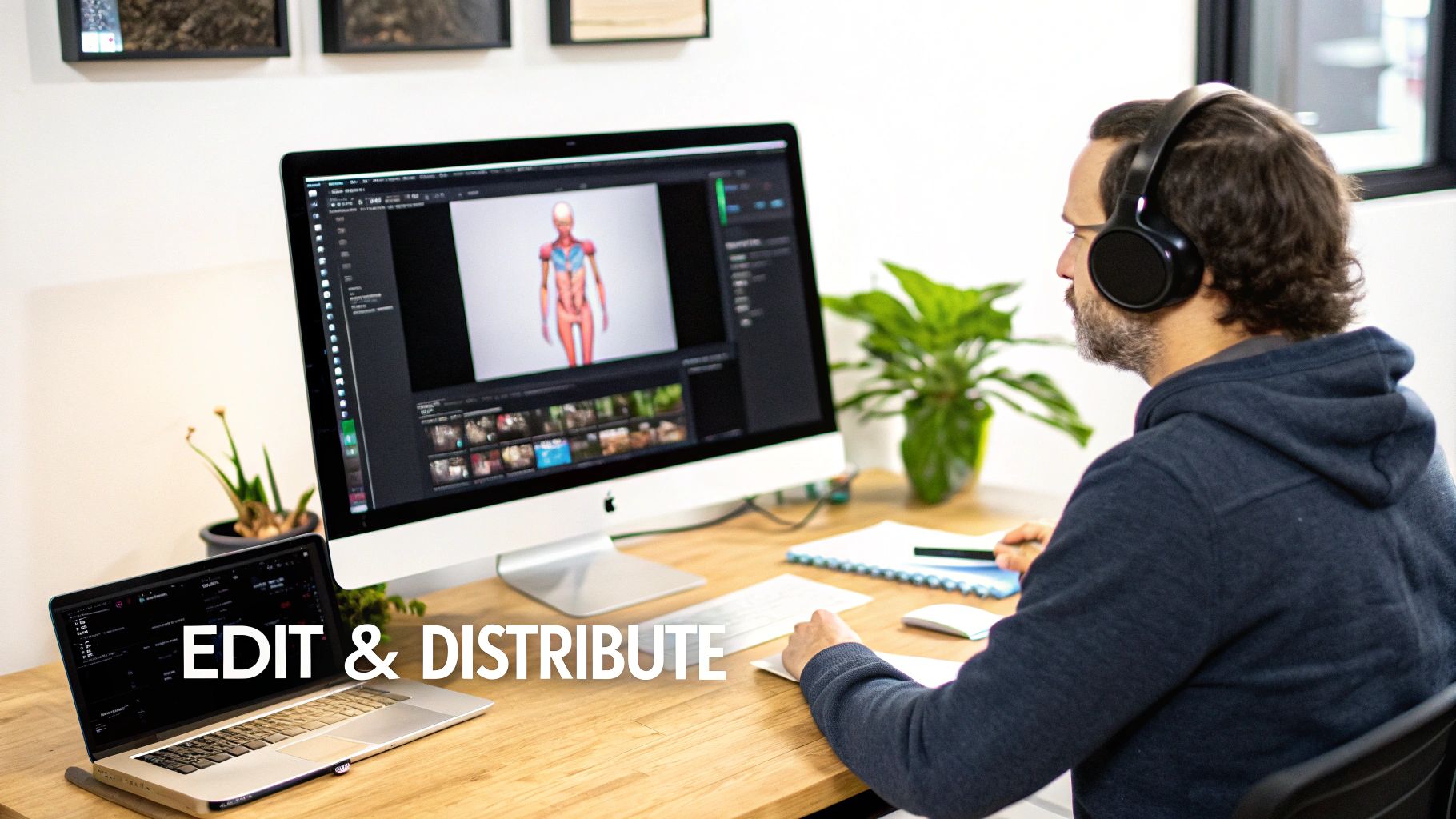
The process kicks off with the edit, where pacing is everything. A surgical procedure shown in real-time could be too slow to keep learners engaged, so a good editor will skilfully condense the timeline while using visual cues to show time passing. On the flip side, a very quick or complex action might need to be slowed right down, giving learners a chance to absorb every critical detail. It’s all about finding that perfect rhythm that holds attention and aids understanding.
Elevating Visuals and Audio for Maximum Impact
Beyond the basic assembly, post-production layers on a level of polish that dramatically boosts the video’s effectiveness. These aren’t just cosmetic touches—they are functional tools that guide the learner’s focus and reinforce key takeaways. A professional touch here can be the difference between a video that’s just watched and one that’s truly understood.
Key enhancements often include:
- Motion Graphics and Text Overlays: Clean, simple graphics can label anatomical parts, highlight the correct instrument, or display critical dosage information right on the screen. This kind of visual reinforcement is proven to improve how well people retain information.
- Colour Correction and Grading: Professional colour grading gives the video a consistent, clean, and clinical look. It can also be used tactically to draw attention to specific areas, like making a vein more prominent or enhancing the contrast on a diagnostic scan.
- Sound Design and Mixing: Clear audio is completely non-negotiable. This means stripping out background noise from live footage, adding subtle sound effects to animation to make actions feel more real, and professionally mixing narration so the instructor’s voice is always crisp and clear.
These details are best handled by a dedicated team. For a closer look at what this stage involves, you can explore the complete workflow of a professional postproduction studio.
From Final Cut to First Viewer Distribution Strategy
Creating an outstanding medical training video is only half the battle. If you don’t have a smart distribution strategy, your valuable content might never reach the people who need it. How you roll out your video really depends on your audience and what you want them to learn.
For internal training inside a hospital or for a medical device company, a Learning Management System (LMS) is usually the way to go. An LMS gives you a secure, controlled space to track learner progress, run quizzes, and certify completion. It wraps the video inside a structured curriculum.
When you’re picking a distribution platform, security and accessibility have to be your top priorities. Whether it’s an internal LMS or a global medical platform, the system must protect sensitive content while giving authorised users a smooth viewing experience.
For broader professional education, platforms like MedTube or even dedicated corporate YouTube channels can connect you with a global audience of healthcare professionals. This is a great approach for demonstrating new techniques or sharing industry-wide best practices.
Reaching a Global Audience with Localisation
Medical knowledge doesn’t have borders, and neither should your training content. Localisation is the process of adapting your video for different languages and cultures—a critical step for any organisation with a global presence.
This goes far beyond simple translation. Key localisation tactics include:
- Professional Subtitling: This is the most direct method, adding translated text to the screen. It’s cost-effective and a must-have for accessibility.
- Voice-over Narration: For a more polished experience, a professional voice artist records the script in the target language. This is often the preferred choice for complex instructional content.
- Graphic Localisation: Any text you have on-screen, like labels or titles, also needs to be translated and redesigned to fit the new language, ensuring all visual cues are fully understood.
This focus on global reach is backed by a growing local production industry. In Poland, the film and video production sector is now home to 10,851 businesses as of 2025, and it has been growing at a healthy 6.0% each year since 2020. This dynamic environment has cultivated specialists in medical training video production, ready to meet the high demand from both local and international clients. With global platforms like MedTube reaching 8.5 million users, the need for professionally produced and localised medical content has never been clearer.
Your Medical Video Production Questions, Answered
Stepping into the world of medical video production naturally brings up a lot of questions. We get it. You’re thinking about timelines, budgets, and whether you really need a specialist. To help you plan better and set the right expectations, we’ve put together straightforward answers to the most common questions we hear.
Getting clarity on these points from the outset helps demystify the entire journey. It ensures everyone, from your key stakeholders to the subject matter experts, is on the same page right from day one.
How Much Should I Budget for a Medical Training Video?
This is usually the first question on everyone’s mind, and the most honest answer is: it really depends. The final price tag is a direct reflection of your project’s complexity and what it takes to hit your learning objectives with absolute clinical precision.
For instance, a straightforward, single-camera shoot showing a basic procedure might start in the low thousands of pounds. Think minimal crew, a simple setup, and basic editing. But the costs can climb quickly as the requirements get more sophisticated.
Several factors will heavily influence your budget:
- Animation Complexity: A project needing detailed 3D medical animation to show what’s happening at a microscopic level will cost significantly more than one that uses simpler 2D graphics.
- Clinical Environment Shoots: Filming inside a working hospital or a sterile operating theatre is a major logistical undertaking. It requires specialised gear and strict adherence to protocols, which adds a layer of cost.
- Expert Involvement: The number of medical professionals you need to validate scripts, appear on camera, or take part in review cycles will also shape the final budget.
We always find that the only way to get a true picture of the investment is through a detailed consultation. A custom proposal built around your specific goals will give you a realistic and accurate quote.
What’s a Realistic Timeline for a Medical Video Project?
Your project timeline is tied directly to its complexity. The biggest variables are almost always the level of animation involved and the thoroughness of the clinical review process. In the medical world, accuracy is everything, so rushing the process is never a good idea.
For a more direct live-action video, like an expert interview or a simple device demonstration, you can often expect a timeline of 4 to 6 weeks from the initial kickoff to final delivery. This gives enough breathing room for proper planning, the shoot itself, editing, and a couple of feedback rounds.
However, if your project involves intricate 3D animation, you need to plan for a longer schedule. A realistic timeframe here is closer to 8 to 16 weeks, and sometimes even longer for highly complex visualisations. The animation process alone is incredibly detailed, covering everything from modelling and texturing to rigging and final rendering.
The clinical review cycle is the most critical and often the most time-consuming phase. You absolutely must build in enough time for medical professionals to meticulously check scripts, storyboards, and the final visuals. This is non-negotiable for ensuring the final product is accurate and credible.
A clear project plan with defined milestones is the key to managing expectations and keeping everything moving smoothly.
Why Partner with a Specialist Medical Video Agency?
Choosing an agency that lives and breathes medical video, rather than a generalist company, gives you a decisive edge. It directly impacts the quality, accuracy, and ultimate effectiveness of your training content. While lots of agencies can produce a polished video, a specialist brings a deep understanding of the healthcare sector that is simply irreplaceable.
A dedicated medical video production team knows the unique world you work in. They’re already familiar with navigating patient privacy regulations like GDPR and have proven, established workflows for collaborating with busy medical experts. This experience helps you sidestep common mistakes and makes the whole production process feel much smoother.
More importantly, they have the niche technical skills needed for high-fidelity medical animation. Visualising complex biological functions or the mechanics of a new surgical tool requires a unique blend of artistic skill and anatomical knowledge that a generalist agency just won’t have. This expertise is your guarantee that the final video isn’t just engaging, but clinically sound, credible, and perfectly suited for its professional audience.
At Simple Frame, we specialise in creating clinically accurate and visually compelling medical training videos that educate and engage healthcare professionals. Learn how our expertise can bring your next project to life.
 English
  Polish
  German