
A Guide to Medical 3D Animation Explaining Procedures
Trying to grasp a complex medical procedure from a flat diagram or a wall of text can feel like navigating a new city with a badly drawn map. You lose the crucial details, there’s no sense of scale, and the bigger picture just stays fuzzy. This is exactly where medical 3D animation changes the game in healthcare communication.
Bringing Medical Procedures to Life with 3D Animation
Medical 3D animation is a powerful visual tool that takes complicated surgical or physiological processes and turns them into crystal-clear videos. Forget static drawings; these animations are like a guided tour inside the human body. They show exactly how a procedure unfolds, how a new medical device works, or how a disease progresses with incredible clarity and precision.
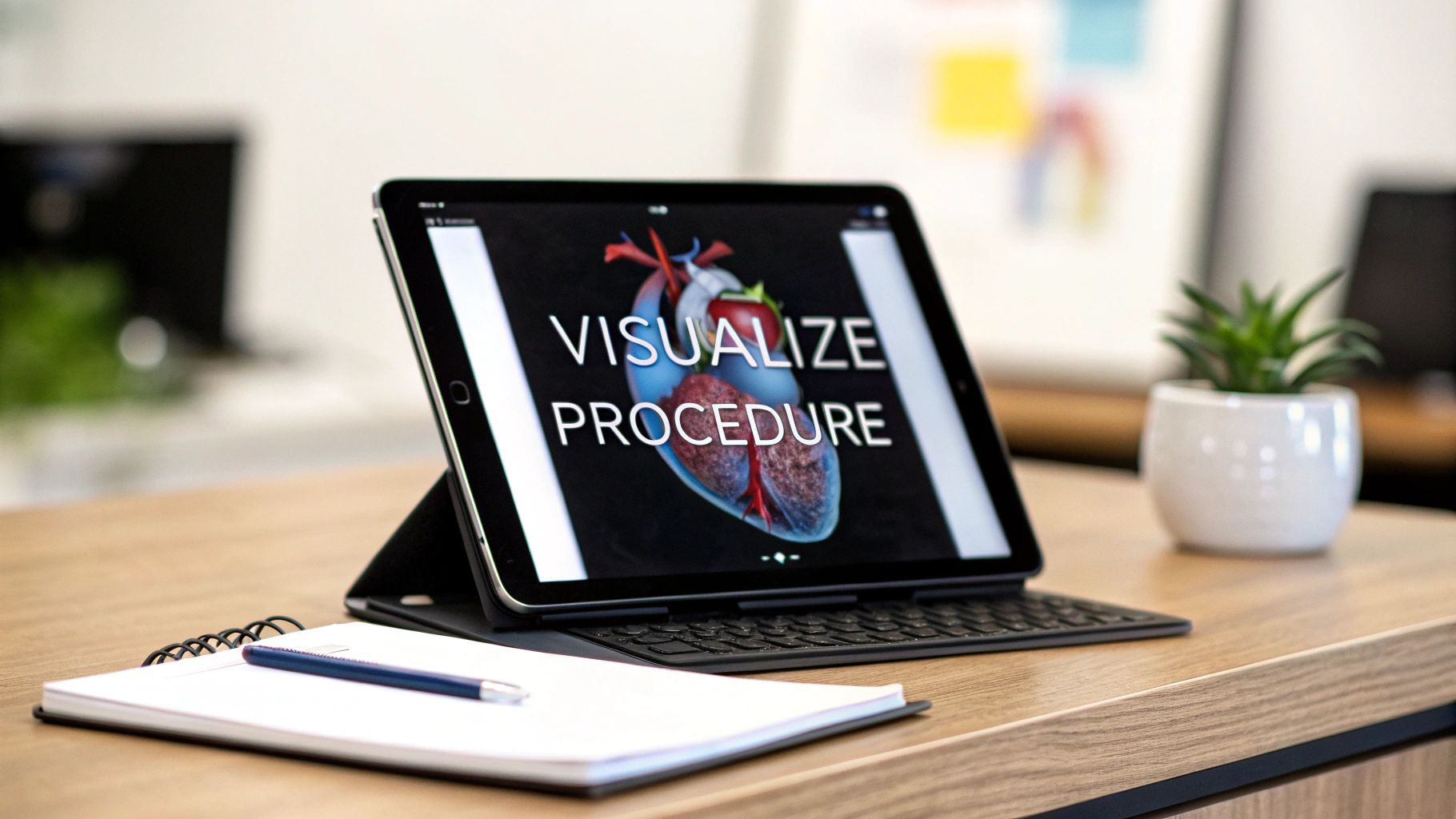
From Confusion to Clarity
Think of a standard medical illustration as a single photo of a complex engine. It’s helpful, sure, but it can’t show you how the gears turn, how the parts connect, or what happens when you turn it on. A medical 3D animation explaining procedures is like having a fully interactive, transparent model of that same engine. You can spin it around, watch it work in slow motion, and understand the purpose of every single component.
This dynamic way of explaining things is absolutely vital in healthcare, where a simple misunderstanding can have serious consequences. It closes the knowledge gap between medical experts and their audiences—whether they're patients, students, or other professionals.
By translating intricate medical information into a compelling visual story, 3D animation empowers viewers, builds trust, and fosters a deeper level of understanding that text alone can never achieve.
Core Applications in Healthcare
Medical animation is used across the healthcare and MedTech sectors, delivering unique benefits in each area. This visual medium is invaluable for explaining complex details in a way everyone can understand. To see how these animations work in the real world, you can explore our portfolio of medical and technical animations.
Here are a few key areas where medical animation really shines:
- Patient Education: Demystifying an upcoming surgery or treatment plan helps improve informed consent and significantly reduces patient anxiety. Imagine clearly seeing how a stent is placed inside a blocked artery.
- Professional Training and Surgical Simulation: This allows surgeons and medical students to visualise and mentally rehearse complex procedures, like a minimally invasive robotic surgery, long before they step into the operating theatre.
- Medical Device Marketing: Demonstrating how a new device, such as an advanced insulin pump or an orthopaedic implant, actually functions inside the body is the best way to communicate its value to clinicians and buyers.
- Pharmaceutical Mechanism of Action (MoA): These animations can illustrate how a drug interacts with cells and biological pathways at a molecular level, providing absolute clarity for researchers, investors, and regulatory bodies.
The table below breaks down these advantages, showing how 3D animation directly impacts patients, professionals, and the institutions they work for.
Key Benefits of Medical 3D Animation
| Area of Impact | Benefit for Patients | Benefit for Professionals & Institutions |
|---|---|---|
| Education & Consent | Reduces anxiety and empowers them to make informed decisions about their care. | Improves informed consent processes, potentially lowering malpractice risk. |
| Training & Skill Development | Benefits indirectly from better-trained, more confident healthcare providers. | Provides a safe, repeatable, and scalable environment for surgical training and skill refinement. |
| Marketing & Communication | Gains a clearer understanding of the benefits of new medical devices and treatments. | Increases market adoption and clearly communicates the value of innovative technologies. |
| Scientific Visualisation | Helps patients understand the science behind their condition or treatment. | Accelerates research, secures funding, and simplifies complex data for regulatory submissions. |
Ultimately, whether it's for training, marketing, or patient care, these animations all serve a single, powerful purpose: to make the invisible visible and the complex simple.
Why Visual Learning Transforms Healthcare Communication
Our brains are hardwired for visuals. It’s no surprise that studies show we process images 60,000 times faster than plain text, with a massive 90% of information sent to the brain being visual. This is precisely why a well-crafted medical 3D animation explaining procedures cuts through the noise far better than dense clinical documents or static diagrams.
Think about explaining a coronary angioplasty. You could describe it, but an animation shows it. A patient can follow the catheter's journey, see the balloon inflate to clear a blockage, and watch as a stent is placed to restore normal blood flow. What was once an abstract, scary concept becomes a clear and manageable process.
Bridging the Knowledge Gap
For medical institutions, this kind of clarity isn't just about patient comfort—it's a core part of managing risk. When a patient truly grasps what a procedure involves, the informed consent they give is far more meaningful. This simple step minimises misunderstandings, often improves patient compliance, and seriously reduces the risk of legal issues down the line.
The same idea applies to training professionals. Surgeons use these animations to walk through new techniques or get a feel for an innovative medical device. It's like a digital rehearsal, letting them anticipate challenges and perfect their approach before they even step into the operating theatre. This makes animation an essential pillar of modern medical education.
A visual explanation bypasses the jargon and complex terminology that can create barriers. It speaks a universal language, turning complex medical science into a story that anyone can follow and understand.
Why Animation Outperforms Traditional Methods
Compared to old-school text-based materials or even live-action video, medical animation has some clear advantages. Let’s be honest, live footage of surgery can be graphic and deeply unsettling for a patient. Animation delivers the same critical information in a clean, clinical, and much less intimidating way.
Here are a few reasons why animations just work better:
- Simplification of Complexity: They neatly break down complex, multi-step procedures into a visual story that is easy to follow.
- Focus on Key Details: Animators can make tissues transparent or highlight a specific instrument, directing the viewer’s eye exactly where it needs to go.
- Long-Term Value: An animation doesn’t get old because of dated clothing, hospital decor, or staff changes. It remains a relevant, evergreen asset for years.
Medical 3D animation is a standout tool among other effective patient education resources precisely because it makes difficult topics so accessible.
Building a Strong Business Case
Investing in medical animation provides a real, measurable return. For medical device companies, a sharp animation can shorten the sales cycle by helping clinicians immediately see a product's value. For hospitals, better patient understanding leads to improved outcomes and higher satisfaction scores.
Ultimately, these animations do more than just explain; they build trust. When a patient feels informed and empowered, they become a true partner in their own healthcare. This is fundamental to modern, patient-centred care. To see how this powerful visual medium can work for you, find out more about our approach to creating powerful educational animation that delivers results. It's a strategic investment in clear communication that pays for itself across training, marketing, and patient care.
Medical Animation in Poland: A Perfect Match for a Digital-First Healthcare System
While the power of clear visual communication is universal, its potential in Poland's healthcare sector is amplified by the country's incredibly advanced digital infrastructure. The nation's swift and successful digitisation has created the perfect environment for sophisticated tools like medical 3D animation explaining procedures. This isn't some far-off trend; it's an opportunity available today, driven by a population that's already highly comfortable managing its health online.
This widespread digital adoption is a massive strategic advantage. The Polish Ministry of Development and Technology notes that an incredible 86% of Polish citizens can access their medical data digitally, putting the country ahead of many others in Europe. This digital-first mindset means Polish hospitals, private clinics, and MedTech firms are perfectly set up to weave multimedia content into the platforms patients already use, from patient portals to e-consultations. You can dig deeper into Poland's healthcare landscape and investment opportunities in this comprehensive overview.
Making the Most of Digital Maturity
The common use of digital health records and telehealth platforms has completely reshaped what patients expect. People in Poland are used to getting information instantly and are looking for clearer, simpler explanations about their health. The old way of doing things—static pamphlets and dense consent forms—just doesn't cut it anymore.
This is exactly where 3D animation gives healthcare providers a clear upper hand. It’s a powerful way to significantly improve the patient experience.
- Smarter Consultations: Animations can walk a patient through a standard procedure before a consultation. This frees up the doctor's time to focus on the patient's specific questions instead of repeating the basics.
- Truly Informed Consent: Embedding a clear procedural video into a digital consent form ensures patients genuinely understand what they're agreeing to. This simple step can slash misunderstandings and the risks that come with them.
- Telemedicine That Works: For remote appointments, an animation is an essential visual aid. It helps bridge the communication gap when a doctor can't physically point to a diagram or model.
In a digitally savvy healthcare system like Poland's, high-quality visual aids aren't a luxury. They're a fundamental part of modern, effective patient communication. They meet patients right where they are—online.
A Powerful Tool for Polish MedTech
The opportunity goes far beyond patient care. For Poland's booming medical device and MedTech industry, 3D animation is an indispensable tool for both local and international marketing. It allows companies to demonstrate the mechanics and benefits of their innovative products with a clarity that words and photos could never match.
A single, well-crafted animation can serve multiple strategic goals. It can be the star of a product launch at a major industry conference, a critical training asset for surgeons learning a new device, or a persuasive sales tool for explaining a product's unique value to hospital decision-makers.
Seen this way, investing in medical 3D animation explaining procedures is more than a marketing choice. It's a strategic move that aligns perfectly with the digital direction of Poland's entire healthcare ecosystem. It offers a clear path to better patient outcomes, a stronger market position, and a real return on investment. The infrastructure is already here, and the audience is more than ready.
Your Step-by-Step Medical Animation Production Guide
Turning a complex medical procedure into a clear, engaging, and precise 3D animation isn't magic; it's a structured and collaborative journey. Think of it as a partnership—we bring the storytelling and visual skills, you bring the medical expertise. Understanding the workflow helps ensure the final video hits every one of your objectives.
Every step builds on the last, from the first conversation about your idea to the final sound mix. Each phase is designed to guarantee accuracy, clarity, and visual impact.
The infographic below shows a typical path in Poland's digital healthcare space. It starts with adopting digital records and leads to using powerful visual tools to improve patient care.
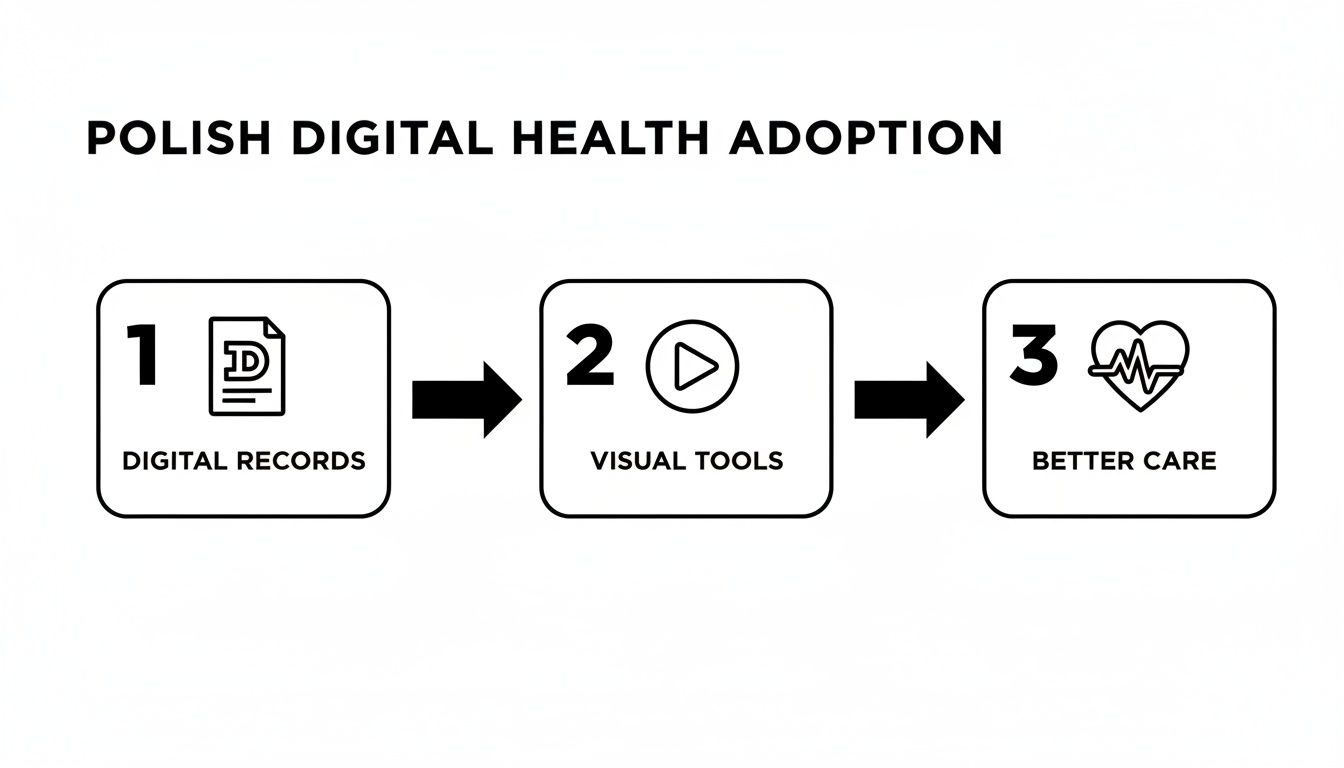
This process highlights how digital records lay the perfect groundwork for tools like 3D animations, which are now becoming key to delivering better health outcomes.
Phase 1: Initial Strategy and Scripting
Every great animation starts not with visuals, but with a solid plan. The first step is a discovery call or briefing session. Here, we pin down the project's core purpose. What procedure are we explaining? Who are we talking to—patients, surgeons, or investors? And most importantly, what's the one thing they absolutely must remember?
From that brief, we craft the script. This is the narrative backbone of the entire project. A great script for a medical 3D animation explaining procedures breaks down dense information into a simple, logical story. It sets the tone and pace, making sure the message is easy to follow.
A well-structured script is the blueprint for the entire project. It ensures that the visual story is not only beautiful but also medically precise and educationally effective.
Once the script gets your approval, we move to the storyboard. This is a sequence of sketches, like a comic book, that maps out every scene. The storyboard defines camera angles, on-screen text, and the flow of the action, giving you the first real glimpse of what the final animation will look like.
Phase 2: Design and 3D Asset Creation
With the storyboard signed off, the real technical work begins. This is where we build the digital world of the procedure from the ground up.
- 3D Modelling: Our artists create detailed digital models of everything needed—anatomical structures, surgical instruments, medical devices, you name it. Accuracy is everything, and we often work from reference materials like CT scans or CAD files to get it perfect.
- Texturing and Shading: Next, we give these models colour, texture, and surface properties. This is what makes an organ look realistic, a bone appear solid, and a metallic instrument gleam under the lights.
These early stages lay the entire visual foundation. The quality and accuracy of the models and textures created here are non-negotiable for a professional result.
Phase 3: Bringing the Procedure to Life
Now it's time to add movement. This is where static models come alive and the procedure starts to unfold on screen. It’s a multi-layered process that demands both technical precision and an artistic touch.
- Rigging: Before an object can move, it needs a digital "skeleton," or rig. This framework allows animators to manipulate the models in a realistic, controlled way.
- Animation: Animators meticulously bring each scene to life, frame by frame. They animate the instruments, the response of tissues, and the flow of fluids, all guided by the storyboard and script.
- Lighting and Rendering: We then place digital lights in the scene to create mood, direct focus, and enhance realism. The final step is rendering, an intensive process where the computer calculates every frame, combining all the models, textures, lighting, and movement into a final image sequence.
This is arguably the most complex part of the production. To learn more about the intricate details, feel free to explore our guide to the professional animation production pipeline.
Phase 4: Post-Production and Final Delivery
Once the visuals are rendered, the project moves into post-production for the final polish. This is where we bring all the elements together into a cohesive and impactful video.
Key activities include professional editing, colour correction for visual consistency, and adding on-screen text, labels, or other graphic overlays. Sound is also critical; a professional voice-over adds authority, while carefully chosen sound design and music boost engagement.
Finally, after a thorough review process with your team and medical experts, the animation is exported into the formats you need—whether it’s for a website, a conference, or an internal training platform.
We've put together a sample timeline to give you a clearer idea of how long a typical project takes. Keep in mind, this is just an estimate; the complexity of the procedure and the level of detail can shift these timings.
Medical 3D Animation Production Timeline
| Production Phase | Typical Duration | Key Activities & Deliverables |
|---|---|---|
| Phase 1: Strategy & Scripting | 1-2 weeks | Discovery call, scriptwriting, medical review, storyboarding. |
| Phase 2: Design & Asset Creation | 2-3 weeks | 3D modelling of anatomy/devices, texturing, look development. |
| Phase 3: Animation & Rendering | 3-5 weeks | Rigging, animation of the procedure, lighting, rendering image sequences. |
| Phase 4: Post-Production | 1-2 weeks | Editing, voice-over recording, sound design, colour grading, final delivery. |
This timeline for a standard 2-3 minute animation adds up to roughly 7-12 weeks from start to finish. Proper planning and clear communication are the best ways to keep the project on track and ensure the final product exceeds your expectations.
Best Practices for Effective Medical Storytelling
A technically perfect animation can still completely miss the mark if its story doesn't resonate. A strong narrative is the heart of it all—it's what turns cold, clinical data into a message that’s clear, relatable, and easy to grasp. Getting this right is the secret to creating a medical 3D animation explaining procedures that genuinely informs and reassures.
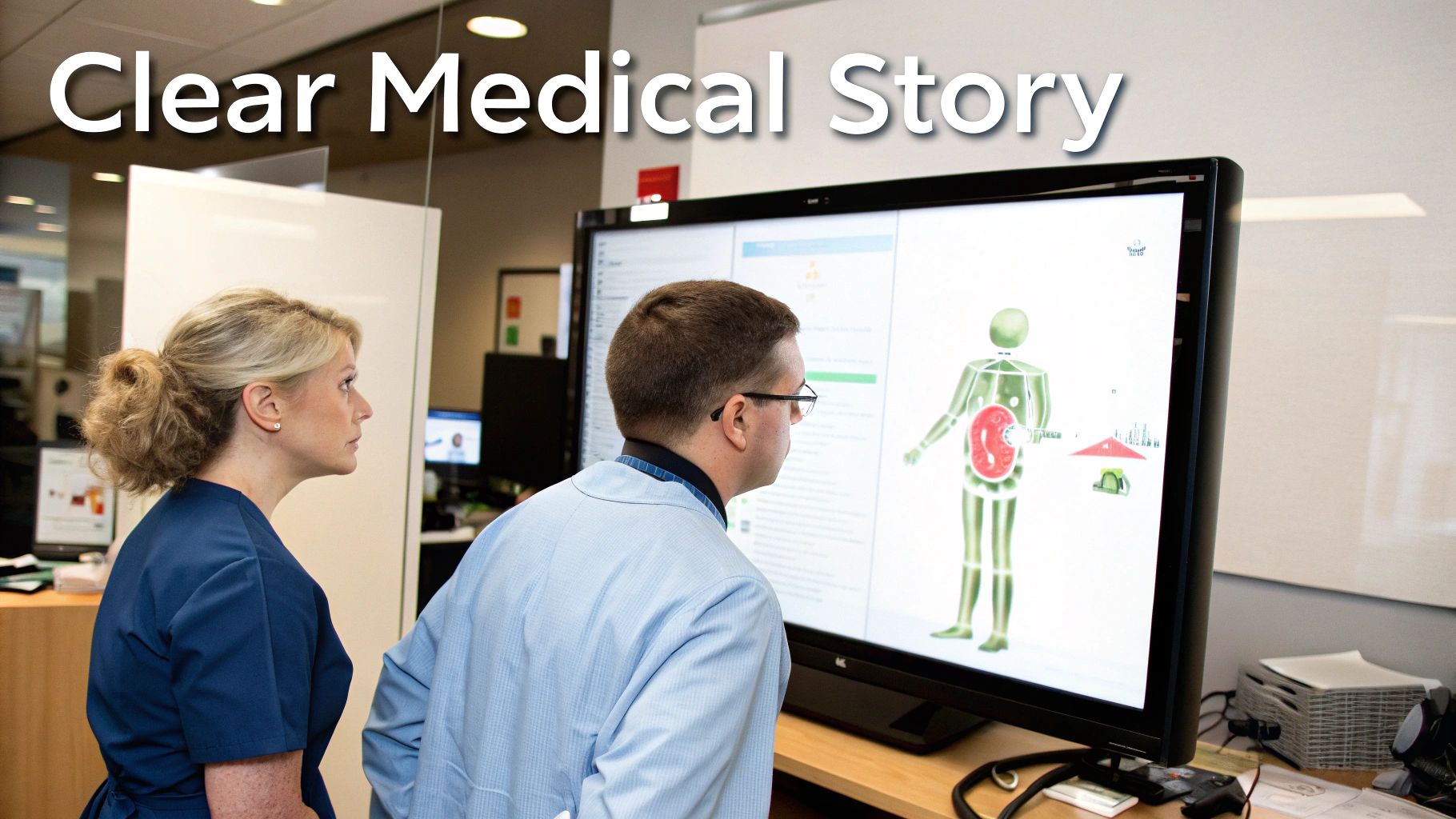
We're not talking about adding Hollywood drama here. Effective medical storytelling is about building a logical, empathetic bridge between highly complex information and the person watching. It transforms a dry list of steps into a journey—with a clear beginning, middle, and end—making everything far easier to process and remember.
Striking the Right Informational Balance
One of the toughest parts of the job is hitting that sweet spot between clinical accuracy and making the information accessible. Bombarding a patient with technical jargon will only create confusion and anxiety. On the flip side, oversimplifying for a surgeon can make the animation feel less credible. The key is to tailor the level of detail specifically to who is watching.
For patient-facing animations, the goals are always clarity and reassurance.
- Lean on Analogies: Compare complex biological functions to everyday things. A blocked artery is like a clogged pipe—it's an instant, understandable mental picture.
- Focus on the "Why": Don't just show what is happening. Explain why each step is vital for a good outcome. This builds trust and gives the procedure context.
- Keep a Reassuring Tone: The script, the voice-over, the music—every element should work in harmony to create a calm, supportive, and professional feeling.
But for professional audiences, like surgeons or medical device engineers, the story shifts completely. Here, the narrative must be packed with precise terminology and zoom in on the specific nuances of a technique or device.
The most effective medical animations speak the viewer's language. They anticipate questions, address concerns, and deliver information at a pace and depth that feels perfectly suited to their level of expertise.
Pacing and Visual Cues for Optimal Learning
How you present the information visually is just as critical as the script itself. A well-paced animation guides the eye, ensuring the viewer absorbs key details without feeling rushed or overwhelmed. That's where strategic visual design comes in, directing focus and making sure the message lands.
It’s the small details that can make a massive difference in how the story is understood.
- Colour Coding: Use distinct colours to highlight specific anatomical parts, show the difference between healthy and diseased tissue, or trace the path of a surgical instrument.
- Strategic Lighting: Use light to pull focus to the most critical area of action in a scene, letting less important details fade slightly into the background.
- Controlled Pacing: Slow things down. Use slow-motion to break down quick or intricate movements, giving the viewer time to really see what’s going on. A time-lapse, on the other hand, is great for showing gradual processes like healing over time.
These visual tricks work together to create a clear information hierarchy. They tell the viewer what to look at and when, turning a potentially confusing scene into a structured, easy-to-follow lesson.
Navigating Compliance and Ethical Reviews
Beyond the creative work, every medical 3D animation explaining procedures has to clear a series of regulatory and ethical hurdles. This is non-negotiable, especially for content used in marketing or to get informed consent from a patient. Accuracy isn't just a goal; it's a legal and ethical must.
Before any animation is signed off, it needs to be ready for some serious scrutiny.
- Medical Accuracy Review: The animation must be thoroughly checked by subject matter experts to confirm every single detail is precise and current.
- Advertising Standards: If it's for promotional use, the content can't make unproven claims and must stick to all relevant advertising rules for medical products and services.
- Ethics Board Submission: For animations used in clinical settings or for research, they may need a stamp of approval from an institutional review board (IRB) or medical ethics committee to ensure the information is communicated responsibly and without bias.
Building these review stages into the production timeline right from the start is absolutely essential. It ensures the final product isn't just visually engaging and educational, but also credible, compliant, and ready for its intended purpose. This diligence protects everyone—patients, practitioners, and the organisation that commissioned the work.
How to Commission Your Medical Animation Project
Starting a medical animation project is a straightforward, structured process. With a bit of prep work, you can make sure your vision comes to life efficiently and just how you imagined it. This final step is all about turning your needs into a detailed brief that an animation studio can use to build your procedure from the ground up.
First things first, get crystal clear on your core objective. Are you trying to walk patients through a surgical technique, train medical staff on a new device, or show investors why your product is a game-changer? Your main goal will steer every decision that follows, from the script's tone to the level of anatomical detail we'll need to create.
Next, you need to know exactly who you're talking to. An animation for a patient about to have surgery should be reassuring, using simple, calm language. On the other hand, a training video for seasoned surgeons has to be technically precise, packed with clinical terminology. Knowing your viewer is the key to creating something that truly connects.
Preparing Your Project Brief
A solid brief is the bedrock of a successful project. Think of it as the roadmap for the production team, making sure everyone is on the same page from day one. Before you even reach out to a studio, it’s a good idea to gather the essential materials and information they'll need.
Here’s a quick checklist of what to prepare:
- Key Objectives and Message: A single sentence summing up what the animation needs to do. For example, "To clearly show patients how a minimally invasive knee replacement is performed."
- Target Audience Profile: Describe who will be watching. What’s their level of medical knowledge? What are their biggest concerns or questions?
- Procedural Information: Pull together all the relevant documents you have. This could be surgical guides, product CAD files, medical illustrations, or even video footage of the actual procedure.
- Visual and Tonal References: If you've seen other animations or visual styles you like, share them. This gives us a great starting point for the look and feel.
A well-prepared brief gets rid of the guesswork. It lets the animation studio give you an accurate quote and timeline and sets the stage for a smooth, collaborative production process.
Understanding Scope, Budget, and Timelines
The scope of your medical 3D animation explaining procedures is the biggest factor in its cost and how long it takes to create. A snappy 30-second animation showing a single mechanism will be much faster and more affordable to produce than a five-minute, highly detailed surgical simulation. The main things that affect the project's complexity are the animation's length, the number of unique 3D models we need to build, and how intricate the movements are.
To make sure your project delivers real value, it should fit into a holistic digital marketing strategy for healthcare, one that’s focused on building patient trust and driving growth. Your animation is a powerful asset, and planning how you'll share it is just as important as producing it.
Planning for Distribution
Think about where your animation is going to be seen. Will it be up on a giant screen at a medical conference, embedded on your clinic's website, or shared as a short clip on social media? Each platform has different technical specs. Talking about your distribution plan early on means we can optimise the final video for every channel, making sure it has the biggest reach and impact possible.
The Polish medical devices market is valued at around USD 4.5 billion, thanks to big leaps in technology like diagnostic imaging and minimally invasive devices. For Warsaw-based studios, this means there's a clear demand for creating animated surgical guides for conferences in Kraków or Poznań and developing multilingual procedure explainers for Polish exports.
With your goals defined and your materials ready, you’re all set to find a professional partner. To chat about your project and see how we can help, learn more about our work as an animation studio for medical and healthcare videos. Taking these few preparatory steps will help you commission your project with total confidence and clarity.
Frequently Asked Questions
When you're thinking about creating a medical 3D animation, especially for the first time, a few questions are bound to pop up. We’ve put together answers to some of the most common queries to give you a clearer picture of the process, costs, and timings.
How Much Does a Medical 3D Animation Cost?
The investment needed for a medical 3D animation that explains a procedure can really vary. It all comes down to the complexity, the final length of the video, and just how deep into the anatomical detail we need to go. A straightforward animation could start at a few thousand pounds, whereas a highly detailed surgical simulation meant for professional training will naturally require a more significant budget.
The best approach is always to request a custom quote based on a solid project brief. That way, the estimate you get will line up perfectly with what you need to achieve.
How Long Does Production Take?
For a typical 2-3 minute medical animation, you can expect the production process to take anywhere from 6 to 12 weeks. This timeframe covers everything from the initial brainstorming and scriptwriting, through storyboarding, and all the way to the final rendering, sound design, and handling any revisions you have.
The biggest factor that shapes this timeline is the complexity of the medical procedure itself. More intricate processes simply need more time for detailed modelling, precise animation, and thorough reviews by experts.
Who Supplies the Medical Information?
All the medical expertise comes directly from you, the client. You'll need to provide all the crucial information, like the detailed steps of the procedure, any anatomical reference images you have (such as CT scans or diagrams), and give us access to your subject matter experts so we can get every detail right.
Our job at the animation studio is to take that specialist knowledge and translate it into a clear, accurate, and visually engaging story that your target audience can easily grasp.
Can the Animation Be Used on Multiple Platforms?
Of course. Medical animations are incredibly flexible. We can render them in different formats and resolutions, making them a perfect fit for all sorts of uses:
- Your website and patient portals
- Presentations at medical conferences
- Social media campaigns to raise awareness
- Internal training modules for staff
- Mobile apps designed for patient education
Just make sure to mention all the places you plan to use the animation during our initial chat. This lets us optimise the final files for maximum impact across every single platform.
Ready to bring your medical procedure to life with stunning clarity? The team at Simple Frame specialises in creating medically accurate and visually engaging animations that educate, inform, and build trust. Contact us today to discuss your project.
 English
  Polish
  German