
Your Ultimate Guide to Marketing With Video for Business Growth
Let’s be honest, marketing with video isn’t some optional extra anymore. It’s the very core of a serious business strategy. It’s simply the best way to grab someone’s attention, explain a complex idea, and build a real connection with your audience. To put it bluntly, if you’re not using video, you’re getting left behind.
Why Marketing With Video Is a Non-Negotiable Strategy
In a marketplace that’s more crowded than ever, attention is the only currency that matters. Let’s face it, static images and blocks of text just can’t hold a candle to the dynamic, multi-sensory experience of a good video.
It’s the difference between showing someone a blueprint and giving them a virtual tour of their future home. One informs, the other inspires them to take action.
This immersive quality is what makes video an absolute powerhouse for building brand recall. When your customers can see and hear your message, it creates a much stronger neurological imprint than text ever could. This deeper connection builds trust and makes your brand the first one they think of when it’s time to buy.
The Tangible Business Impact of Video
Beyond just grabbing attention, a well-thought-out video strategy drives real, measurable results through every step of the customer journey. Video is exceptionally good at making complex products or services easy to understand, which is a massive advantage for B2B and technology companies.
Instead of a dense whitepaper nobody will read, a sharp, two-minute animated explainer can make your value proposition crystal clear in an instant. For a closer look at how video can untangle complex corporate messaging, check out the insights from this corporate video highlighting PSE’s 2024 achievements.
Video also has a direct line to conversions and revenue. Weaving video content into your strategy gives a significant boost to key business metrics because it gives buyers the context and confidence they need to make a decision.
Video is not just a marketing tactic; it’s a fundamental business tool. It accelerates the sales cycle, enhances customer support, and builds a loyal community around your brand by humanising your message and making complex information digestible.
The explosive growth of video marketing is easy to see when you look at regional trends. In Poland’s online advertising market, for example, over 88 billion display and video ad impressions were served in a single month.
This sheer volume shows just how central video has become, especially when you realise it reaches an astonishing 87% of the online population. You can explore further insights into the Polish online advertising market to understand just how dominant it is.
Ultimately, marketing with video isn’t about creating flashy ads. It’s about communicating more effectively, building stronger relationships, and driving sustainable business growth in a world that overwhelmingly prefers to watch rather than read.
Building a Goal-Oriented Video Marketing Framework
Shooting video without a clear strategy is like setting sail without a map. It’s a costly creative exercise with no guarantee you’ll end up anywhere useful. Truly effective video marketing isn’t a shot in the dark; it’s a calculated effort built on a solid strategic foundation that turns video into a reliable engine for business growth.
The whole framework starts with one simple but critical question: “What do we want this video to achieve?” The answer to that question drives everything that follows, from the creative concept to the channels you use to share it. Every single video you produce needs a specific job, whether that’s grabbing attention, explaining a complex product, or sealing the deal.
Thinking this way prevents wasted time and money, ensuring every piece of content serves a distinct purpose in your wider marketing plan.
Mapping Your Videos to the Marketing Funnel
The marketing funnel gives us the perfect blueprint for lining up your video content with your customer’s journey. Your audience has different needs and asks different questions depending on where they are in their decision-making process. Your video strategy has to reflect that reality, delivering the right message at exactly the right time.
Think of it like a real conversation. You wouldn’t walk up to a stranger and immediately ask for a big commitment. You’d introduce yourself, build some rapport, and then gently guide them toward the next step. Your videos need to follow that same natural progression.
This visual shows how video builds on the core pillars of attention and connection to drive real business results.
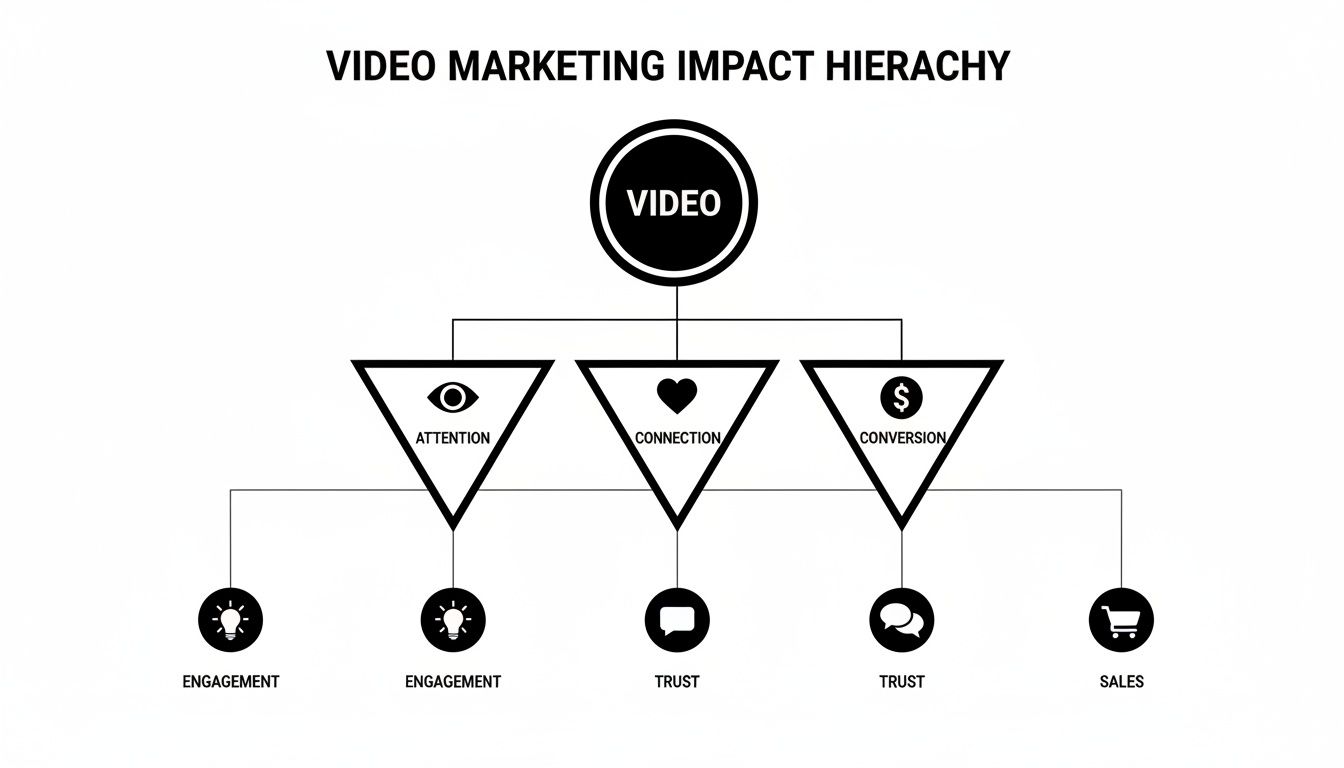
This hierarchy isn’t just a concept; it’s a process. Successful video marketing guides viewers from that first moment of awareness all the way to a profitable outcome for your business.
Matching Video Types to Marketing Funnel Stages
Knowing which type of video to use at each stage of the funnel is key to keeping your message relevant and moving your audience smoothly to the next phase. The following table breaks down how to align your video production with specific goals and stages in the customer journey.
| Funnel Stage | Primary Goal | Effective Video Types | Key Performance Indicator (KPI) |
|---|---|---|---|
| Top (Awareness) | Attract attention, introduce the brand, generate buzz | Brand films, social media clips, educational content, high-level explainers | Views, reach, social shares, website traffic |
| Middle (Consideration) | Build trust, demonstrate expertise, showcase solutions | In-depth product demos, customer testimonials, case studies, webinars | Watch time, click-through rate (CTR), lead magnet downloads |
| Bottom (Decision) | Overcome final objections, inspire action, close the deal | Personalised videos, FAQ videos, implementation guides, company culture videos | Conversion rate, demo requests, sales, lead quality |
By strategically mapping your videos to the funnel, you’re not just making content; you’re building a cohesive journey. Each video becomes a stepping stone, logically guiding a potential customer from asking “Who are you?” to saying “Where do I sign up?”
Defining Success with Clear KPIs
You absolutely have to set clear Key Performance Indicators (KPIs) before you even think about production. Vague goals like “increase engagement” are useless because you can’t measure them effectively. Instead, get specific with measurable objectives like “boost landing page conversion by 15%” or “increase qualified demo requests by 20%.”
These precise targets are what allow you to actually measure your return on investment (ROI) and justify your video marketing budget. And as your video library grows, a solid system for digital asset management for video becomes essential for keeping everything organised and accessible. A clear framework, mapped to the funnel and measured by sharp KPIs, is the definitive blueprint for winning with video.
Choosing the Right Video Format for Your Business Goals
Once you’ve got your strategy locked in, the next big question is: what kind of video will actually get the job done? Think of all the video formats out there as a set of specialist tools. You wouldn’t bring a sledgehammer to hang a picture frame, right? In the same way, you can’t expect a quick social media clip to explain a complex medical device.
Picking the right format is everything. It’s about making a genuine connection with your audience and hitting the specific goals you’ve set.
The secret to successful marketing with video is matching the video type to both your message and where your customer is in their journey. A cinematic brand film is brilliant for grabbing attention and building awareness, while a detailed product demo is built to convince people who are already weighing up their options. Getting this right ensures your investment pays off, moving viewers smoothly toward becoming customers.
Brand and Product Videos
Brand and product videos are the bread and butter of most video marketing plans. They do different jobs but work together perfectly—one builds an emotional connection, and the other shows how your product is the logical solution.
- Brand Videos: These are all about feeling and identity. They aren’t selling a specific feature; they’re selling the idea of your company. They tell your story, show what you stand for, and create the kind of loyalty that lasts. Their main job is to make your audience feel something and remember your name.
- Product Videos: This is where you switch from the “why” to the “what.” These videos zoom in on a single product or service, showing off its features and—most importantly—the benefits. A great product video doesn’t just give you a list of specs; it shows people exactly how it solves their biggest headache and makes their life better.
A smart strategy uses brand videos to capture attention and build trust early on, then follows up with targeted product videos to educate and persuade people as they get closer to a decision.
Explainer and Animated Videos
What if your product is a complex service, a piece of software, or an idea that isn’t easy to see? This is where explainer and animated videos come in. They are masters at turning complicated, abstract concepts into simple and memorable visual stories.
Animated explainer videos are incredibly powerful because they make things easy to understand. Using clean visuals, simple language, and a friendly tone, they can make even the most technical B2B service feel approachable. They are perfect for your homepage, landing pages, or email campaigns where you only have a minute or two to prove your value.
An animated explainer is like having your best salesperson on call 24/7, delivering a perfect pitch every single time. It cuts through the complexity, hooks the viewer, and clearly shows why you’re the best choice—all in under 90 seconds.
The sheer versatility of animation is a huge plus. It lets you show abstract ideas, internal workflows, and software interfaces in a way that just isn’t possible with a live-action camera. This clarity helps potential customers feel more confident and can even shorten the sales cycle by answering their biggest questions right away.
Technical and Medical Animation
For businesses in highly specialised fields—think engineering, manufacturing, or healthcare—your average video just won’t cut it. When you need to demonstrate an intricate mechanical process or a complex biological interaction, technical and medical animations aren’t just a nice-to-have; they’re essential.
These specialised animations offer a level of clarity that nothing else can. A technical animation can take viewers right inside a piece of machinery to show exactly how every component works. In the same way, a medical animation can illustrate a surgical technique or how a new drug works inside the body with incredible detail. For a deeper dive, you can learn more about empowering your marketing with 3D animations, which are especially powerful for these kinds of visualisations.
This kind of precision builds enormous credibility and trust, especially with sophisticated B2B buyers and professionals. It shows them you truly understand their world and gives them the hard proof they need to make high-stakes decisions. These animations are powerhouse assets for sales meetings, trade shows, investor pitches, and professional training.
Navigating the Video Production Process and Budget
Dipping your toes into the world of video production can feel like a massive undertaking, but it really boils down to a logical, three-part workflow. Once you understand the flow, the mystery disappears, and you’re empowered to have clear, productive conversations with a production partner or even manage your own in-house projects with confidence. It turns an intimidating task into a straightforward project with predictable stages.
The entire journey, from that first spark of an idea to the final polished video, is organised into distinct phases. Each step builds on the last, with its own focus, deliverables, and costs, all working together to bring your vision to life. Getting a handle on this flow is fundamental to effective marketing with video.
The Three Core Stages of Video Production
You can think of creating a video a bit like building a house. You wouldn’t start laying bricks without a solid blueprint, and you wouldn’t move in before the decorating and furnishing is done. Video production follows a very similar path.
- Pre-Production (The Blueprint): This is, without a doubt, the most crucial phase. It’s where all the strategic planning happens—from fleshing out the core concept and writing the script to storyboarding every shot, casting talent, and scouting locations. A rock-solid pre-production stage is your best defence against costly mistakes and delays down the line.
- Production (The Build): This is the “lights, camera, action!” part of the process. For live-action video, it involves the crew, cameras, lighting, and sound engineers all working together on set. For animation, this is the stage where designers create the visual assets and animators start bringing the storyboard to life, frame by frame.
- Post-Production (The Polish): Once all the raw footage is captured or the animation scenes are rendered, everything moves into post-production. This is where the magic happens: video editing, colour correction, sound design, adding the perfect music track, creating motion graphics, and integrating any visual effects to create the final, polished product.
Decoding the Costs of Video Production
One of the first questions we always hear is, “So, how much does a video actually cost?” And the honest-to-goodness answer is: it depends. A video’s budget isn’t just a number pulled from thin air; it’s a direct reflection of the resources, time, and talent needed to achieve a specific look and feel.
A video’s budget is a direct function of its complexity and the resources needed to execute the creative vision. Higher production value—achieved through experienced crews, advanced equipment, and detailed post-production—requires a larger investment but yields a more professional and impactful final asset.
Understanding what drives the cost helps you make smart decisions. Several key factors have a major impact on the final price tag:
- Crew Size and Experience: A large, seasoned crew with a director, cinematographer, and sound engineer will naturally cost more than a small, nimble two-person team.
- Equipment: Specialised gear like high-end cameras, specific lenses, professional lighting rigs, and audio equipment all factor into the budget.
- Locations and Talent: Shooting in multiple locations, renting out a studio, or hiring professional actors and voice-over artists will add to the overall cost.
- Animation Complexity: A simple 2D animated explainer video will be far less expensive than a photorealistic 3D technical animation that requires complex physics simulations.
- Post-Production Scope: The amount of time spent on editing, the intricacy of visual effects, and the creation of custom motion graphics can significantly influence the final investment.
For businesses curious about modern techniques, AI is becoming a bigger player in production. To navigate this well, it’s worth checking out a practical guide on how to create AI videos to see what it can really do. Whether you’re making a simple testimonial or a broadcast-quality commercial, understanding these cost levers helps you align your creative dreams with your financial reality. And for those ready to invest in compelling visuals, learning more about professional promotional video production will bring clarity to hitting your specific marketing goals.
Developing a Winning Video Distribution Strategy
Let’s be honest. Creating a brilliant video is only half the battle. A stunning piece of visual storytelling that nobody ever sees is a monumental waste of time, budget, and creative energy. The second, equally crucial, part of the equation is distribution—the strategic process of getting your video in front of the right eyeballs at just the right moment.
Without a smart plan, even the most compelling content will simply fade into the digital noise.
Think of it this way: your video is a high-performance race car, but your distribution strategy is the racetrack, the fuel, and the skilled driver all in one. To win, you need every single component working together in perfect harmony. This means ditching the old “upload and pray” approach and starting to think like a multi-channel strategist, treating each platform as a unique opportunity to connect with a specific slice of your audience.
Matching the Platform to the Purpose
Every social and video platform has its own algorithm, its own audience expectations, and its own unique content format. A one-size-fits-all approach to marketing with video is doomed from the start. A winning strategy involves carefully picking the right channels based on your business goals and, most importantly, where your ideal customers actually spend their time.
Here’s a quick look at the major players and their strategic strengths:
- YouTube: The SEO Powerhouse. As the world’s second-largest search engine, YouTube is unbeatable for long-term value. Videos here should be optimised with keywords to answer specific questions, solve problems, or provide in-depth tutorials. This is where you build a library of evergreen content that can pull in qualified leads for years to come.
- LinkedIn: The B2B Authority Builder. For corporate and B2B marketing, LinkedIn is the premier destination. Videos on this platform should be professional, insightful, and focused on industry trends, expert interviews, or company culture. It’s the perfect place to establish thought leadership and engage directly with professional decision-makers.
- Instagram & TikTok: The Attention Grabbers. These platforms thrive on short, visually engaging, and often entertaining content. Use them for quick brand stories, behind-the-scenes glimpses, and trend-based videos that capture attention in a heartbeat. Their strength lies in building brand personality and reaching a broad audience, fast.
The Art of Repurposing Content
The most efficient video distribution strategies are built on a simple principle: “create once, distribute forever.” A single, high-value “pillar” video—like an in-depth product demo or a powerful customer case study—can be sliced, diced, and repurposed into dozens of smaller assets, each one perfectly tailored for a different channel.
This approach dramatically boosts the ROI on your initial production investment.
A single five-minute corporate video can be transformed into a 60-second trailer for LinkedIn, a series of 15-second feature highlights for Instagram Stories, a key quote turned into a graphic for Twitter, and a detailed transcript that becomes a blog post.
This kind of strategic repurposing ensures your core message reaches audiences in the format they prefer, on the platform they use most. You maximise your reach without having to constantly create entirely new content from the ground up.
Combining Organic and Paid Strategies
A truly complete distribution plan uses both organic reach and paid advertising to hit its goals. Organic tactics are fantastic for building a loyal, long-term audience, while paid campaigns give you the targeted, predictable reach needed to accelerate your results.
Organic tactics include:
- Video SEO: Optimising your titles, descriptions, and tags on YouTube to rank in search results.
- Community Engagement: Sharing your videos in relevant online groups and forums where your audience gathers.
- Website Integration: Embedding videos on your homepage, landing pages, and blog posts to increase dwell time and drive conversions.
Paid tactics involve:
- Targeted Social Ads: Using platforms like Facebook, Instagram, and LinkedIn to put your video right in front of highly specific demographics and professional roles.
- YouTube Pre-Roll Ads: Capturing attention just before other relevant videos in your niche.
- Retargeting Campaigns: Showing specific follow-up videos to users who have already visited your website or engaged with your content.
This blended approach is powerfully effective. In the competitive Polish market, for example, Lidl achieved a staggering 76.69% reach among internet users aged 16-49 with its video ads. This shows just how deeply a well-funded, cross-media strategy can penetrate a market, especially in a country where online ad spending is surging past 7.8 billion PLN.
You can read more about video advertising effectiveness in Poland to see how leading brands are winning. By combining smart organic placement with targeted paid amplification, you ensure your video marketing efforts deliver the maximum possible impact.
Measuring Your Video Marketing ROI Like a Pro
Making a great video is one thing, but proving its worth is the real game. If you want to show your video marketing is working, you have to look past the easy, feel-good numbers like view counts. The numbers that really matter—the ones that get attention in the boardroom—are those that show a real impact on the business.
A view is just a glance. Engagement is what tells you the message is actually hitting home. Tracking the right metrics is the only way to build a solid, data-driven case for your video strategy. It helps you justify the budget, show off your wins, and get smarter about what to do next.
Moving Beyond Vanity Metrics
The first step to measuring your return on investment (ROI) is to stop obsessing over views and start focusing on what truly matters. A big view count is nice, but it tells you nothing about whether people actually paid attention or did anything afterwards.
To get the real story, you need to dig into engagement metrics:
- Watch Time and Audience Retention: This is your truth-teller. It shows you exactly how long people stick around and precisely where they lose interest. A high retention rate means your content is genuinely connecting with your audience.
- Click-Through Rate (CTR): If you’ve put a call-to-action (CTA) in your video, the CTR shows you what percentage of viewers actually clicked it. This is a direct line from your video to a lead-generating activity, like signing up for a webinar or downloading a guide.
- Conversion Rate: This is the ultimate goal. It tracks how many viewers took the final step you wanted them to, whether that’s buying a product or booking a demo call right after watching.
Understanding Viewability and Platform Analytics
Another concept you need to get your head around is viewability. This isn’t just about a video loading on a page; it measures whether a decent chunk of your video was actually on someone’s screen for a meaningful amount of time. It’s the difference between a fleeting impression and real, focused attention.
Measuring video marketing is about connecting the dots between someone watching your video and your business making money. It’s all about answering one question: “Did our investment in this video bring in more leads, better prospects, and ultimately, more revenue?”
This is especially critical in crowded markets. For instance, recent data from Poland shows that by September 2025, video ads hit an impressive viewability rate of 61.55%, leaving standard display ads in the dust. This just goes to show how powerful video is at capturing genuine attention. You can discover more insights about the Polish advertising market to see how these metrics are shaping local strategies.
Every platform, whether it’s YouTube or LinkedIn, gives you a dashboard packed with analytics. You need to dive into this data to understand who’s watching, where they’re coming from, and what devices they’re using. By analysing these reports, you can draw a straight line from video views to website traffic, leads, and sales. This is how your marketing with video stops being a creative cost and starts being a measurable engine for business growth.
Frequently Asked Questions About Marketing With Video
Even with a solid plan, stepping into the world of professional video production can bring up a few practical questions. Let’s tackle the most common queries we hear from businesses just starting out with video marketing, giving you the clear answers you need to move forward.
Think of this as a quick-reference guide to clear up any lingering hurdles, reinforcing the core ideas we’ve covered and making sure you’re fully equipped for a successful launch.
How Much Does a Professional Marketing Video Cost?
Honestly, there’s no single price tag. A marketing video’s cost can range from a few thousand for a straightforward animated explainer to tens of thousands for a large-scale brand commercial.
The final budget really comes down to a few key variables: the video’s length, the complexity of the animation or live-action shoot, crew size, and filming locations. The best approach is always to start with your business goal, then work with a production partner to build a scope that fits your budget while still hitting that all-important goal.
What Is the Ideal Length for a Marketing Video?
The perfect video length is all about context—it depends entirely on the platform and what you’re trying to achieve. You have to match the length to what the audience expects to see on that specific channel.
- Social Media Feeds: For catching the eye of scrolling users on Instagram or LinkedIn, you’ll want to keep it under 60 seconds.
- Website Explainers: A more in-depth product demo on your website or YouTube channel often hits the sweet spot at 2-5 minutes.
- Top-of-Funnel Ads: These need to be short and punchy. Think 15-30 seconds to grab that initial flicker of attention.
- Educational Content: Webinars or detailed tutorials can be much longer, simply because the audience has already set aside the time to sit down and learn.
Can We Just Use a Smartphone to Create Videos?
Absolutely—for certain kinds of content. Smartphones are fantastic tools for capturing that authentic, behind-the-scenes feel, creating quick social media stories, or gathering genuine user testimonials. They have their place.
But when it comes to your core brand assets—like the video on your homepage or a polished product demo—professional production is non-negotiable. That investment is what gets you the high-quality audio, lighting, and editing needed to build credibility and establish real trust with your audience.
How Long Does It Take to Produce a Marketing Video?
The production timeline really hinges on the project’s complexity. A slick, well-planned animated video can often be turned around in 3-4 weeks from the moment the script is approved.
On the other hand, a more involved live-action project with multiple stakeholders, locations, and edits could easily take 6-10 weeks or even longer. The single most important factor for keeping everything on track? A rock-solid pre-production phase. It sets the foundation for a smooth and efficient workflow from start to finish.
Ready to transform your marketing strategy with video that actually gets results? The team at Simple Frame specialises in creating high-quality animation and video that connects with your audience and smashes your business goals. Start your project with us today.
Article created using Outrank
 English
  Polish
  German