
How to Choose the Right Animation Studio for Your Brand
Before you even think about looking at studio portfolios, you need to get your own house in order. Picking the right creative partner starts with some serious internal alignment. Without it, you're just throwing ideas at a wall and hoping something sticks.
There are really three things you have to nail down first: defining your core objective, setting a realistic budget, and writing a clear creative brief. Get these fundamentals right, and you'll attract studios that are a perfect match for what you're trying to achieve.
Laying the Groundwork for Your Animation Project
Jumping into the selection process without a solid plan is a classic mistake. It almost always leads to miscommunication, last-minute changes, and a final video that just doesn't hit the mark. Think of this initial planning phase as building the foundation of a house—it’s not the exciting part, but it’s what keeps everything from falling apart later.
Define Your Project's Purpose
First things first, ask the big question: "What is this animation for?" The answer to this changes everything, from the art style to where you'll eventually post the video. A vague goal like "we need a cool video" is useless. You need a specific, measurable business objective.
What are you actually trying to accomplish?
- Boost sales conversions by showing off a product's best features.
- Explain a complicated service to cut down customer support tickets by 25%.
- Build brand awareness with a story that people will remember.
- Train employees on a new safety procedure or internal tool.
When you know your "why," you can communicate the project's value to potential studios. For instance, telling them your goal is to simplify a complex concept frames the project as a strategic tool. This is exactly what an experienced explainer video agency is built to handle. It lets them pitch a solution, not just a pretty animation.
Pinpoint Your Target Audience
Who are you trying to talk to? An animation for C-suite executives needs a completely different vibe than one for Gen Z on TikTok. Get as specific as you can about your audience. Think about their demographics, what keeps them up at night, and where they spend their time online. This info is gold for the creative team—it guides the tone, style, and script.
A studio can create a stunning animation, but if it doesn't connect with your specific audience, it's an expensive failure. Your audience insights are the creative team's North Star.
Establish a Realistic Budget
Money talk can be awkward, but you have to be upfront. The cost of animation is all over the map, depending on the style, complexity, and length. A simple 2D motion graphics piece is going to be worlds cheaper than a photorealistic 3D product animation.
Do a bit of research on industry averages and be honest about what you can afford. A clear budget helps studios give you a realistic proposal. It stops you from wasting time with partners who are way out of your league and helps them figure out the best creative approach that fits within your budget.
This decision tree shows how locking down your goal, budget, and brief are the essential first moves.
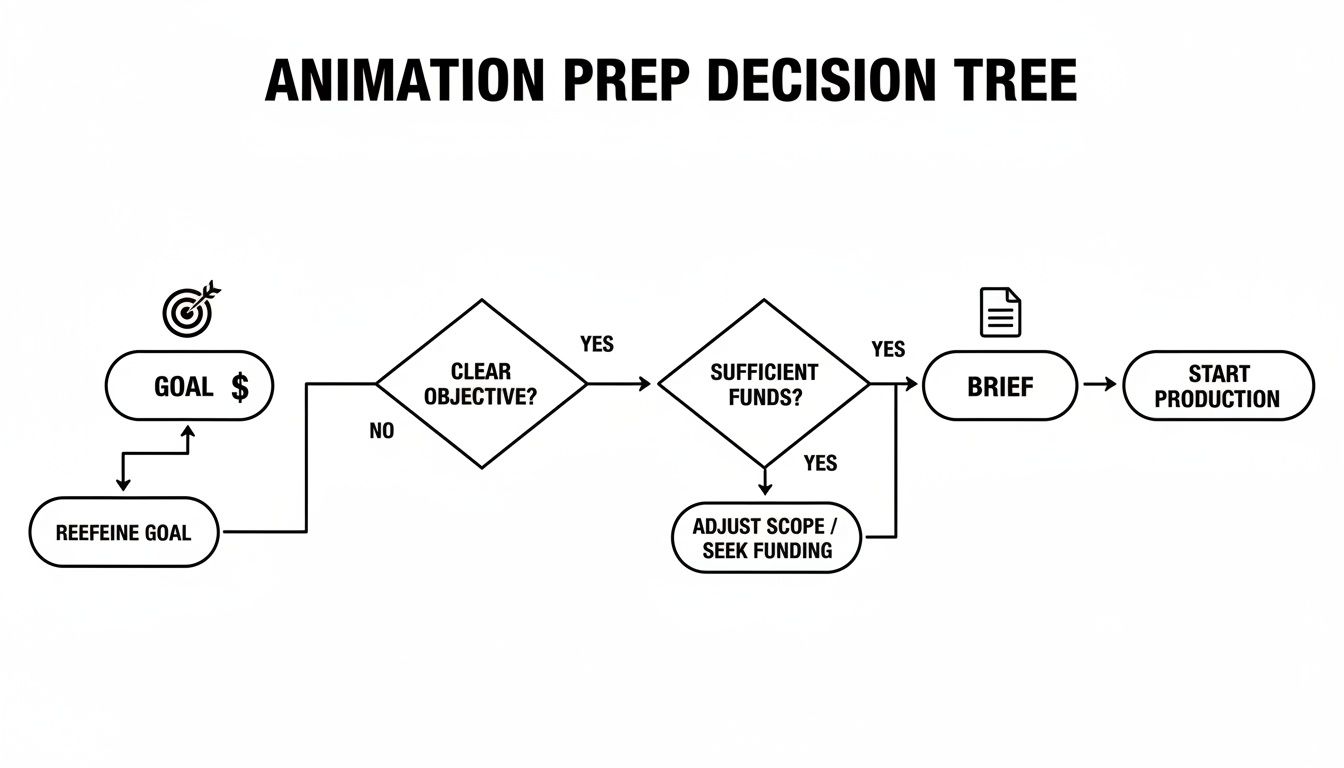
When you follow this path, you'll walk into conversations with studios armed with a well-defined project, making the whole selection process smoother and much more effective.
How to Analyse an Animation Studio's Portfolio
A studio's portfolio is their CV, and learning how to read it properly is a superpower. It's about looking past the flashy visuals to gauge their real capabilities and whether they’re a strategic fit for your brand. This step is all about digging deeper than surface-level aesthetics to find a partner who speaks your industry’s language.
Think of a portfolio not just as a gallery of pretty pictures, but as a collection of solved problems. Your goal is to find a studio that has already solved problems just like yours.
Look for Stylistic and Tonal Alignment
The first, and most obvious, check is for style. Does their work feel like it could belong to your brand? If your company has a playful, vibrant personality, a portfolio full of dark, corporate animations is an immediate red flag.
Don't write off a studio just because they haven't produced an exact copy of what you're picturing, though. A truly great studio is versatile. The real test is whether they show a command of different tones and styles.
Look for a range that proves they can adapt to a client's specific needs, not just roll out their own signature look over and over. When you explore examples of their animation work, you should see a clear talent for matching the visual style to the client's brand identity.
Prioritise Industry-Specific Experience
This is where you separate the generalists from the specialists. An animation studio with experience in your sector brings a massive amount of value to the table. They already know the jargon, the audience's expectations, and the common communication hurdles you face.
For instance, a studio that has successfully animated complex medical procedures will understand the level of precision and clarity your project demands. Likewise, a team with a background in automotive rendering can capture mechanical details with genuine authenticity.
A portfolio should prove more than just artistic skill; it should prove an understanding of business challenges. Look for evidence that they can translate complex ideas into clear, engaging visual stories for an audience just like yours.
In Poland, this is becoming more and more important. The local 3D animation and motion design market is scaling up fast, which is widening the quality gap between different providers. The parallel animation and VFX design software market in Poland, valued at USD 11.5 billion in 2025 and forecast to grow to USD 25.0 billion by 2033, shows just how quickly top studios are adopting advanced toolchains. To stay ahead, Polish brands should look for studios that reinvest in new software and pipelines. A proven track record with technical and medical animations, plus end-to-end post-production, is a good sign that a company is keeping up with this innovation curve.
Scrutinise Case Studies for Proof of Partnership
A great portfolio piece is more than just the final video. Hunt for detailed case studies that pull back the curtain on the creative process. These are your best window into what it's actually like to work with the studio.
A strong case study should tell a story:
- The Initial Challenge: What problem was the client trying to solve? This shows if the studio gets the business side of things.
- The Creative Solution: How did the studio tackle the problem? This reveals their strategic thinking.
- Client Testimonials: What did the client say about the experience? Look for comments on communication and collaboration, not just how much they liked the final product.
- Measurable Results: Did the animation actually work? Look for hard numbers like increased engagement, better conversion rates, or fewer support tickets.
This level of detail proves the studio isn't just a supplier taking orders, but a strategic partner who’s invested in your success.
Assess the Technical Quality and Polish
Finally, get granular. Pay close attention to the small details that signal professionalism and expertise. These are the things that take an animation from good to great.
Here’s a quick checklist of what to look for:
- Smoothness of Motion: Are the movements fluid and natural, or do they feel jerky and robotic? Professional animation just has a satisfying flow.
- Sound Design and Music: Does the audio add to the story, or does it feel like a cheap afterthought? High-quality sound design is a hallmark of a top-tier studio.
- Pacing and Timing: Does the video keep you hooked? Good pacing makes sure key messages land with impact and the story never drags.
- Consistency: In longer videos or a series of animations, is the quality consistent from start to finish? This shows they have a solid production pipeline and real attention to detail.
By analysing a portfolio with this framework, you stop being a passive viewer and become an informed evaluator. You'll be able to confidently shortlist studios that not only have the creative chops but also the strategic mindset to be the right animation partner for your brand.
4. Look Under the Hood at Their Production Workflow
A stunning portfolio is a great start, but it only shows you the final product. The real magic—and the difference between a smooth project and a stressful one—happens behind the scenes. You need to understand a studio's technical chops and, just as importantly, their production process.
When you hire an animation studio, you’re not just buying a video; you're investing in a partnership and a service. The quality of that service, from communication to project management, will make or break your experience. This is where you separate the true professionals from the hobbyists.
Demystifying the Animation Process
A well-run studio doesn’t just wing it. They follow a structured, repeatable process that turns a complex creative endeavour into a predictable journey. Ask them to walk you through their typical project stages from kickoff to final delivery.
You're listening for a clear, logical progression with built-in checkpoints for your feedback. A standard, battle-tested workflow usually looks something like this:
- Discovery & Scripting: The team works with you to nail down the core message and write a script that’s built for animation.
- Storyboarding & Animatics: This is where the script becomes visual. They’ll create a frame-by-frame blueprint, sometimes with rough timing and audio, to lock in the narrative flow before the heavy lifting begins.
- Style Frames & Design: Here, they develop the final look and feel of your characters, scenes, and graphics for your approval.
- Animation Production: The main event. Animators bring everything to life based on the approved designs and storyboard.
- Voiceover, Music & Sound Design: The audio layers are created and mixed to add emotion and impact to the visuals.
- Final Revisions & Delivery: The last round of polish before the studio exports the final files in all the formats you need.
To get a deeper understanding of what happens at each stage, check out this guide on the complete animation production pipeline. Knowing what to expect empowers you to ask better questions and stay ahead of the process.
Evaluating Their Technical Toolkit
Beyond a solid workflow, you need to be sure the studio has the technical muscle to pull off your vision, especially if it involves complex visuals. Don't be shy about digging into the details.
Here’s what you should be asking about:
- 2D vs. 3D Animation: Do they specialise in one, or are they masters of both? 3D is brilliant for showcasing physical products with a cinematic feel, while 2D is often better for explaining abstract ideas with clarity and style. A great partner can advise you on which approach best serves your story.
- Software Proficiency: What's in their tech stack? Studios using industry-standard tools like Adobe After Effects, Cinema 4D, or Maya show a commitment to professional-grade quality.
- Rendering Power: This is a big one for 3D projects, as rendering can be a huge time-sink. Ask about their rendering capabilities (like in-house or cloud-based render farms) to ensure they can deliver high-resolution files without blowing your timeline.
- Delivery Formats: Can they deliver files optimised for every platform you plan to use? This isn't just about sending an MP4. It's about knowing the nuances of different platforms, like mastering the latest Instagram Reels specifications for maximum impact.
A studio’s workflow is the backbone of your project. A transparent, collaborative process with clear milestones isn't just a nice-to-have; it's the single best predictor of a project that stays on schedule, on budget, and true to your vision.
Comparing Studio Production Models
Not all studios are built the same. Their internal structure can have a real impact on your project's cost, quality, and overall experience. Understanding the main models helps you pick the right fit.
Some studios are full-service, in-house operations with a dedicated team under one roof. Others operate as a lean core team that brings in trusted freelancers for each project. Neither is inherently better, but one will likely be a better match for your needs.
Here’s a quick comparison to help you see the difference:
| Attribute | Full-Service In-House Studio (e.g., Simple Frame) | Boutique or Freelancer-Network Studio |
|---|---|---|
| Team Structure | A dedicated, full-time team of specialists (directors, animators, designers) all working together in one place. | A small core team of producers and creative leads who assemble a custom team of freelancers for each project. |
| Consistency & Quality | Higher consistency and easier quality control since the entire team works together daily, using established processes. | Quality is highly dependent on the individual freelancers chosen and the producer’s management skills. Can vary. |
| Communication | More streamlined. You typically have a single point of contact who coordinates with the internal team directly. | Communication can sometimes be less direct, flowing from client to producer to a distributed team of freelancers. |
| Flexibility & Scalability | Can handle large, complex projects efficiently but may have less flexibility for very small, quick-turnaround tasks. | Highly flexible and can scale the team up or down as needed. Often a good fit for smaller, one-off projects. |
| Cost Structure | Often represents a higher investment, reflecting the overhead of a full-time, expert team and integrated infrastructure. | Can be more cost-effective for certain projects, as overhead is lower. Pricing can be more variable. |
Ultimately, a full-service studio often provides a more integrated, hands-off experience for you, which is a huge plus for busy marketing teams managing high-stakes projects. For simpler needs, a boutique model might offer the flexibility you're looking for. Consider your project's complexity and your own management style when making the choice.
Decoding Pricing Models and Contracts
Animation pricing can feel like a black box sometimes, leaving you wondering if a quote is fair or even complete. You need to get comfortable with the common pricing structures and know what to look for in the contract's fine print. This is how you accurately compare proposals and pick the right animation studio for your brand—without getting hit with surprise costs down the road.
Getting this right isn't about pinching pennies. It’s about securing real value and protecting your investment with a clear agreement that works for everyone.
Common Animation Pricing Structures
Studios usually price their work in a couple of different ways, and the best fit really depends on your project’s scope and how much flexibility you need. Simply asking a potential partner how they build their quotes is a great first step to understanding their process.
You'll most likely run into two models:
- Fixed-Project Fee: This is the most straightforward way to go. The studio gives you one, all-in price for the entire project based on the brief you provided. It's perfect for projects with a well-defined scope, like a 90-second explainer video, because it locks in your budget from day one. No guesswork.
- Day or Hourly Rates: For more open-ended or ongoing work, some studios charge by time. This can work well for a series of social media animations or if you know the creative direction might shift as you go. The catch? You have to manage it carefully to keep the scope—and your budget—from spiraling.
For most brands that need a specific video, a fixed-project fee is the way to go. It puts the responsibility on the studio to manage their time and resources efficiently. Everyone agrees on the final deliverable for a set cost.
Comparing Proposals Like an Expert
When those proposals start rolling in, fight the urge to just skip to the price at the bottom. That final number is just one piece of the puzzle. A cheaper quote can easily end up costing you more if it leaves out critical elements.
To really compare apples to apples, open up a simple spreadsheet and track how each proposal handles these key items:
- Number of Revision Rounds: This is a big one. How many chances do you get to give feedback at each stage (script, storyboard, animation)? Two rounds of revisions per stage is a pretty standard, solid offer. Any less, and you risk paying extra for small changes.
- Music and Voiceover Licensing: Does the price include a professional voiceover artist and a licensed music track? You need to clarify the terms. Is the licence just for web use, or does it cover broadcast and paid ads, too?
- Project Timeline: A detailed schedule with clear milestones and delivery dates is non-negotiable. It proves the studio has a professional workflow and takes your deadlines seriously.
- Asset Ownership: Who actually owns the final video and all the original project files? The contract needs to say, in no uncertain terms, that you own the final product.
A great proposal isn’t just a price list; it’s a project plan. It should give you a clear and confident understanding of the entire creative journey, leaving no room for ambiguity about what is—and isn’t—included.
Critical Contract Clauses You Cannot Ignore
Think of the contract as your project's ultimate safety net. It makes all the promises from the sales calls official and protects both you and the studio. While having a legal expert look over any agreement is always smart, you should personally check for a few key clauses.
Before you even get to the details, it helps to be clear on the type of agreement you're signing. For a deeper dive into what makes these business relationships tick, understanding service contracts and how they protect everyone involved is a great starting point.
Here are the absolute must-haves:
- Intellectual Property (IP) Rights: The contract must clearly state that once the final payment is made, all rights to the finished animation are transferred to your company. Without this clause, you might not legally own the very video you paid for.
- Payment Schedule: A typical structure is a percentage upfront (often 50%), with the rest of the payments tied to major milestones like storyboard approval and final delivery. This keeps the studio’s cash flow healthy while you only pay for work as it's completed.
- Confidentiality Clause: If your project involves a secret product launch or other sensitive company info, a non-disclosure agreement (NDA) or a strong confidentiality clause is vital to protect your plans.
Scrutinising the pricing and contracts isn't about being difficult—it's about being a diligent, prepared partner. Any professional studio will welcome your questions and provide a transparent, comprehensive agreement. That's how you set a project up for success from the very beginning.
The Strategic Advantage of Local Market Expertise
In a world full of remote teams, you can hire an animation studio from pretty much anywhere. But writing off local talent, especially those right in your primary market, could be a huge missed opportunity. Choosing a studio that gets the unique vibe of your region—whether that’s Warsaw, Berlin, or anywhere else in the EU—gives you a serious strategic edge that’s about more than just convenience.
A local partner just gets the cultural shorthand. They know the humour, the design trends, and the little inside jokes that make a message really land with a domestic audience. This goes deeper than just language; it's about being culturally fluent. An animation that feels genuinely local will always connect on a deeper, more emotional level and build real brand loyalty.
Beyond Culture: Technical and Regulatory Fluency
The benefits get even clearer when you’re talking about projects for broadcast or VOD. A local studio is already dialled into the complicated web of technical specs and compliance rules for regional TV networks and streaming services. That inside knowledge can save you a world of headaches and the high cost of re-rendering later on.
For example, a studio in Poland that works with local broadcasters day-in and day-out will know the exact delivery requirements for all the major networks. They already understand the advertising standards and age-rating systems without needing you to give them a crash course. This existing expertise is gold, ensuring your project isn't just creative, but also technically ready for launch where it counts.
Choosing the right animation studio for your brand means finding a partner who is not only a creative expert but also a market insider. Their local knowledge de-risks your project and amplifies its potential impact.
This local know-how is non-negotiable for Polish brands and agencies. On television, about 65% of animated content on European channels is produced locally, feeding more than 300 dedicated children’s channels. For a marketer in Poland, this means the perfect animation studio is one that lives and breathes the expectations of broadcasters and VOD platforms in the Polish and wider EU market. A Warsaw-based studio already serving these channels brings an invaluable familiarity with broadcast specs, compliance rules, and the visual tastes of Polish and European viewers. You can discover more about the European animation market and its trends.
The Practical Perks of Proximity
Sure, video calls get the job done. But nothing can truly replace the buzz and collaborative energy of an in-person kickoff meeting or a final review session. A local partner is simply more accessible.
This closeness makes communication smoother, helps build a stronger working relationship, and allows for quicker, more agile collaboration as the project unfolds. This is especially true when you're trying to nail down complex visual ideas or tweak subtle animation timing. Just being in the same time zone gets rid of those frustrating delays and keeps the project's momentum alive. A strong partnership is fundamental to effective marketing with video, as it keeps the final animation perfectly aligned with your bigger goals.
Ultimately, a local studio brings a mix of cultural insight, technical know-how, and practical convenience that an offshore partner often struggles to match. It’s an investment in making sure your animation is not just beautifully made, but also culturally sharp and perfectly positioned to win in its home market.
The Nitty-Gritty: Final Questions Before You Hire
Even with the best plan in the world, a few last-minute questions always seem to surface right before you're ready to make a decision. Getting straight answers to these is the final step in feeling confident about your choice and setting your project up for a smooth ride. This is your last-pass checklist before signing anything.
How Long Will My Animation Actually Take?
This is the big one, and the only honest answer is: it depends. A straightforward 60-second 2D motion graphics video, especially one that fits into your existing brand style, might wrap up in about 4-6 weeks.
On the other hand, if you're looking at a more complex 90-second 3D product animation that needs custom modelling and slick visual effects, you're more likely looking at 10-12 weeks, maybe even longer.
A professional studio will always give you a detailed production schedule with clear milestones. Be very cautious of anyone who promises an unbelievably fast turnaround. Good animation takes time, and rushing the process almost always means cutting corners on creativity or technical quality.
How Many Rounds of Revisions Should I Expect?
Feedback is essential to getting the final product right, but an endless cycle of tweaks can throw a project completely off track and over budget. The industry standard is usually two rounds of revisions at each major production stage.
Typically, this looks something like this:
- Scripting: Two revision rounds to nail the core message and tone.
- Storyboarding: Two rounds to lock in the visual flow and scene-by-scene action.
- Animation: Two rounds for final feedback on the movement, timing, and little details.
This structure gives you plenty of chances to give input while making sure the project keeps moving. If a studio’s proposal offers fewer than two rounds, it's worth asking why. Conversely, a studio offering "unlimited" revisions might sound great, but it can be a sign that they don't have a structured, efficient process in place.
Should I Go With 2D or 3D Animation?
Choosing between 2D and 3D isn't just about the look; it's a strategic call based on what you need to communicate. Neither is inherently "better"—they're just different tools for different jobs.
Go for 2D animation when:
- You're explaining an abstract idea, a service, or a complicated process and clarity is key.
- You need a relatively quick turnaround and have a tighter budget to work with.
- Your brand has a distinct, flat, graphic style that would come to life beautifully with motion.
Go for 3D animation when:
- You need to show off a physical product from all angles, highlighting its design and features.
- You want to create a realistic, cinematic, or high-impact visual experience that really wows the viewer.
- You’re thinking ahead and want to reuse the 3D models for other marketing materials, like static images or interactive product viewers.
A great studio won’t just ask you to pick one. They’ll dig into your goals and recommend the style that will best tell your story and hit the mark with your audience.
What Are the Biggest Red Flags to Look Out For?
Part of vetting a potential studio is knowing what warning signs to watch for. Keep your eyes peeled for these red flags during your discussions:
- Vague or Evasive Answers: If they can't clearly explain their process, pricing structure, or timeline, that's a huge problem.
- Poor Communication: Slow replies or messy, unclear communication during the sales process is a pretty good preview of what the project will be like.
- The "Yes to Everything" Attitude: A true partner will push back when needed, ask tough questions, and bring their own expertise to the table. They won't just blindly agree with every single thing you suggest.
- No Case Studies: A portfolio full of pretty videos is nice, but if they can't show you case studies that detail real client problems and the results they delivered, it suggests they might be more about visuals than strategy.
Ultimately, you need to trust your gut. A partnership with an animation studio is a big investment of both time and money, so finding a team you genuinely click with is critical for a successful outcome.
Ready to bring your brand’s story to life with animation that delivers results? At Simple Frame, we combine strategic thinking with creative excellence to produce stunning 2D and 3D animations that captivate audiences and achieve your business goals. Get in touch with us at Simple Frame.
 English
  Polish
  German