
Forensics Visualization: Transform Data Into Persuasive Courtroom Narratives
Forensics visualisation is all about turning dense, technical data from an investigation into a story that is clear, accurate, and easy to follow. It takes abstract details—things like accident physics, the path of a bullet, or digital footprints—and transforms them into scientifically precise 3D models and animations. This lets judges, juries, and other stakeholders see the evidence instead of just hearing a complicated explanation.
Bringing Complex Evidence into Clear Focus
Imagine trying to explain the chaotic physics of a multi-car pile-up or the exact trajectory of a ricocheting bullet using just words and a few static diagrams. It’s a massive challenge. The human brain simply isn’t wired to process long strings of abstract information, especially in a high-stakes setting like a courtroom.
This is where forensics visualisation steps in, acting as a powerful translator. It goes far beyond simple charts, converting tangled, technical evidence into a visual narrative that just makes sense. The goal isn’t to create flashy, Hollywood-style effects; it’s to meticulously rebuild a moment in time with absolute scientific precision.
The Power of Visual Clarity
When we take spreadsheets, laser scans, police reports, and expert testimony and rebuild them in an interactive 3D environment, we give legal teams a tool to present their case with undeniable clarity. A judge or juror can watch the sequence of events play out from any angle, making even the most intricate concepts immediately understandable.
This method delivers some major advantages:
- Simplifies Complexity: It cuts through technical jargon and confusing spatial relationships, turning them into visuals anyone can grasp.
- Enhances Understanding: People process and remember visual information far more effectively than things they only hear.
- Reveals Hidden Insights: Visualising the data can often uncover patterns or connections that would otherwise stay buried in raw numbers.
- Strengthens Arguments: A well-made visualisation provides compelling, data-driven backup for an expert’s testimony.
At its heart, forensic visualisation answers the critical questions of “what happened,” “how,” and “when” by showing, not just telling. It connects the dots between isolated pieces of evidence to build a cohesive, logical, and defensible story.
This technology allows stakeholders to walk through a digital twin of an accident scene or analyse the mechanical failure of a product with complete accuracy. You can see how we bring complex ideas to life across many different fields in our animation portfolio at https://simpleframe.com/portfolio/. The same principles apply in fields from legal cases to medical investigations. For a good look at how visual accuracy helps in a related discipline, you can explore the transformative power of 3D medical visualization.
Ultimately, forensics visualisation moves past abstract numbers and dry reports to deliver powerful, intuitive clarity when the stakes are high. It opens a window to the past, built entirely on a foundation of fact and evidence.
The Core Applications of Forensics Visualization
While the term might sound like a single, catch-all technique, forensics visualization is anything but a one-size-fits-all tool. It’s better to think of it as a highly specialised toolkit, where each instrument is precision-engineered to bring a different kind of complex evidence into sharp, undeniable focus.
This practice really stands on four key pillars, each designed to translate a unique form of data into a clear and defensible narrative. Looking at these core areas shows us how raw information from an investigation gets meticulously rebuilt into an accurate, understandable, and ultimately persuasive visual story. Each application has a distinct job to do in the search for truth.
Crime Scene Reconstruction
This is probably what most people picture when they hear “forensics visualization.” The main goal here is to digitally preserve a crime scene with millimetre-perfect accuracy, creating a “digital twin.” This allows investigators to revisit and analyse the scene long after the physical evidence has been bagged and the area cleared. This virtual world is painstakingly built from precise data captured by LiDAR scanners, photogrammetry, and old-fashioned detailed measurements.
Once the scene is digitally rebuilt, the possibilities open up. Investigators can:
- Test Hypotheses: Run through different theories about what happened, like figuring out where people were standing or the exact path of a weapon.
- Verify Witness Statements: Put a witness’s account to the test. Could they really see what they claim to have seen from their stated position? The model provides a definitive answer.
- Analyse Evidence in Context: See every piece of evidence in its original spatial relationship to everything else, which can instantly reveal connections that were impossible to spot otherwise.
This method allows a jury to virtually step right into the scene, giving them a level of understanding that stacks of photos and complicated diagrams could never achieve.
Accident Reconstruction
Accident reconstruction is all about untangling complex, dynamic events to show exactly how and why they unfolded. It’s absolutely essential for cases involving vehicle collisions, industrial accidents, or structural failures where the sequence of events is the entire crux of the argument. The resulting visualisation isn’t just a simple replay; it’s a physics-based simulation grounded in hard data.
Take a multi-car pile-up, for instance. A reconstruction can pinpoint the exact moment of impact, calculate vehicle speeds based on skid marks and crush damage, and show the devastating chain reaction that followed. This is all built from police reports, vehicle data recorders, and expert analysis. In an industrial setting, a similar visualisation could illustrate how a single mechanical failure led to a catastrophic event. To dive deeper into this area, you can learn more about technical 3D animation for industrial applications, which is built on the same principles of precision and clarity.
By animating the physics of an event, accident reconstruction moves beyond assigning blame to demonstrating causation with scientific rigour. It answers the “how” with compelling, data-driven proof.
Digital Forensics Visualization
When it comes to cybercrime, the “crime scene” isn’t a physical place—it’s a tangled web of interconnected systems. This is where digital forensics visualization comes in, helping to make sense of huge, abstract datasets by mapping out complex cyber-attacks or tracing the flow of illicit data. It turns dense logs, confusing timelines, and network traffic data into visual models that are actually intuitive.
This can help investigators show a jury precisely how a hacker breached a secure server, trace the path of stolen information, or map out the relationships between different players in a sophisticated fraud scheme. Instead of burying a jury in endless lines of code or overwhelming spreadsheets, a visualisation can present the attack as a clear, sequential event, making the unseen digital world tangible and easy to follow.
Medical-Forensic Visualization
When injuries are a central piece of evidence in a legal case, explaining their nature and cause can be a real challenge. You want to avoid using graphic photos that could be overly emotional or prejudicial. Medical-forensic visualization offers a perfect solution by creating accurate, clinical 3D models based on medical scans like CTs and MRIs.
These models can clearly illustrate the extent of an injury, show the path a projectile took through the body, or demonstrate how a specific impact caused a particular fracture. It gives the jury the critical medical detail they need in a clean, objective format, keeping the focus squarely on the evidence rather than an emotional reaction to graphic imagery. This application is crucial for clarifying complex medical testimony and ensuring the facts are understood with absolute precision.
To bring these applications together, here’s a quick summary of how each type of visualisation is used in the real world.
Key Applications of Forensics Visualization
A summary of the main types of forensic visualization and their primary use cases in legal and investigative contexts.
| Visualization Type | Primary Application | Example Scenario |
|---|---|---|
| Crime Scene Reconstruction | Digitally preserving and analysing a physical crime scene. | Creating a 3D model of a room to test bullet trajectories and verify witness lines of sight. |
| Accident Reconstruction | Simulating dynamic events to determine causation. | Animating a multi-vehicle collision based on physics data to show points of impact and speeds. |
| Digital Forensics | Mapping abstract data from cybercrime investigations. | Visualising a network data breach to show how hackers infiltrated a system and extracted files. |
| Medical-Forensic | Clarifying the nature and cause of complex injuries. | Using a 3D model from a CT scan to illustrate the path of a knife wound for a jury. |
Each of these applications provides a powerful way to bring clarity to chaos, transforming complex data points into a story that is not only compelling but, most importantly, backed by science.
The Technology Behind Recreating Reality
So, how do you turn the chaotic data from an incident scene into a scientifically accurate 3D world? It’s a meticulous process, blending high-precision technology with expert artistry. Every single step is designed to ensure the final product isn’t just visually clear, but also legally defensible.
This journey—from a cloud of data points to a dynamic, rendered animation—starts with capturing reality itself. This isn’t just about taking a few photos; it’s about creating a perfect ‘digital twin’ of a real-world location. Experts on-site use advanced tools to measure and record every detail with incredible precision, forming the bedrock upon which the entire visualisation is built.
The pipeline from data capture to final delivery follows a clear, logical path.
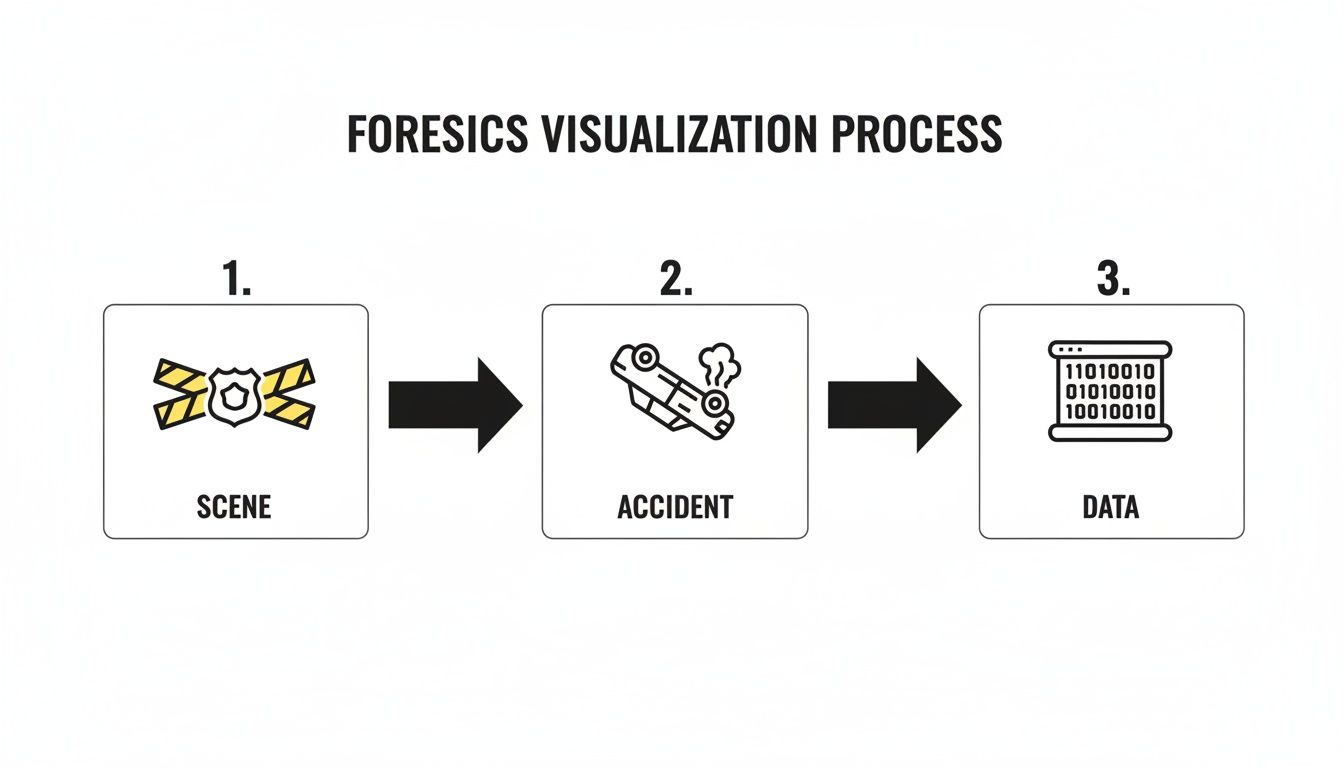
This progression shows how we move from the initial scene investigation to collecting the digital data needed for a full reconstruction.
Capturing the Scene with Precision
Two primary technologies really dominate this initial data capture phase, each offering a unique way to digitise a physical space.
- Photogrammetry: Think of this as 3D photography on an expert level. By taking hundreds or even thousands of overlapping high-resolution photos of a scene from multiple angles, specialised software can analyse the pixels and triangulate points to build a detailed 3D mesh. This technique is fantastic at capturing realistic textures and colours, making the final model look incredibly lifelike.
- LiDAR (Light Detection and Ranging): A LiDAR scanner works differently. It emits millions of laser pulses and measures the time it takes for them to bounce back. This creates a massive “point cloud”—a dense collection of millions of individual data points that perfectly maps the geometry of the environment. Its true strength is its unmatched dimensional accuracy, making it the gold standard for capturing precise measurements of buildings, terrain, and vehicle damage.
Advanced methods like unlocking the potential of 3D laser scanning with Scan to BIM are fundamental to accurately recreating scenes. These techniques provide the raw, verifiable data that everything else is built on.
Building the Digital World
Once the scene is captured, that data is brought into powerful 3D modelling software. This is where the raw point cloud or photogrammetry mesh is cleaned up, optimised, and transformed into solid, usable digital assets. Our technicians and artists meticulously build the digital elements—vehicles, buildings, characters, and any other relevant objects.
Every asset is constructed to exact specifications based on forensic reports, blueprints, or manufacturer data. For instance, a car involved in a collision isn’t just modelled to look correct; it has the precise dimensions and crush damage detailed in the official accident report. This step is far more about technical accuracy than artistic freedom.
This digital construction phase is where the foundation of evidence is laid. If the models are not accurate representations of their real-world counterparts, the entire visualisation loses its credibility.
Animating the Sequence of Events
With the digital stage set and the actors (the assets) ready, our animators bring the scene to life. But unlike in entertainment, a forensic animator’s role isn’t to invent action. It’s to choreograph it based strictly on the facts. They use expert testimony, physics calculations, and official timelines to animate the sequence of events exactly as they happened.
This is where the narrative truly takes shape. The animation will show a vehicle’s path based on its calculated speed and trajectory, or illustrate a person’s movements exactly as described in witness statements. Every single movement and interaction is timed and positioned according to the established evidence.
This structured workflow shares many principles with other forms of professional media creation. To get a broader view of how complex projects like this are managed, you can learn more about a typical animation production pipeline and see how each stage builds upon the last.
Finally, the scene is rendered. This involves adding realistic lighting, textures, and camera angles designed to present the information as clearly as possible. The end result is a compelling, data-driven animation that can withstand the intense scrutiny of a courtroom, transforming complex evidence into a clear and verifiable story.
Navigating Critical Legal and Ethical Standards
A compelling visualisation can powerfully sway a jury, but that power is built entirely on credibility. This is the fundamental difference between forensic visualisation and Hollywood entertainment. A blockbuster film can bend the laws of physics for a thrilling scene, but a forensic animation must be an unwavering representation of scientific fact. Professionals in this field walk a delicate ethical tightrope, balancing visual clarity with uncompromising accuracy.
This responsibility is more important than ever. Thanks to the well-documented “CSI effect,” jurors often come into the courtroom with unrealistic expectations about forensic science. The goal isn’t to feed this with dramatic fiction but to counter it with grounded, evidence-based reconstructions. Every frame has to be defensible, every movement justified by data, and every conclusion backed by expert analysis.
Ensuring Admissibility in Court
For a visualisation to be useful, it must first be admitted into court, and the standards are incredibly high. In legal systems like the one in the United States, frameworks such as the Daubert Standard are used to scrutinise any expert testimony and the evidence supporting it. A forensic animation falls squarely into this category.
To pass this test, the visualisation must be proven to be:
- A Fair and Accurate Representation: The animation needs to reflect the underlying data and expert reports precisely, without any exaggeration or omission.
- Relevant to the Case: It must help clarify a key point of disagreement, such as the sequence of events or the cause of an incident.
- More Probative than Prejudicial: Its value in explaining the facts has to outweigh any potential it might have to unfairly bias the jury.
This legal gauntlet ensures that technology serves justice instead of distorting it. The entire process behind the animation, from the initial data collection to the final render, has to be transparent and meticulously documented to survive this level of scrutiny.
The Illusion of Accuracy and Professional Responsibility
The very clarity that makes forensic visualisation so effective also presents an ethical challenge. A polished, photorealistic animation can project an “illusion of accuracy,” leading viewers to accept what they see without question, even if the data it’s based on is flawed. This is a significant worry for legal professionals and visualisation experts alike.
The core ethical duty in forensic visualisation is to present a visual argument based on evidence, not to create a seamless reality that masks uncertainty. If the data is incomplete or ambiguous, that ambiguity must be represented honestly.
For this reason, continuous professional development is vital. For example, specialised workshops bring experts together to discuss the real-world application of 3D reconstructions in shooting incidents and vehicle collisions. These sessions focus heavily on reducing risks like the illusion of accuracy, a concern also noted in Polish legal circles where magistrates assess such reports. To see how experts are tackling these challenges, discover more insights from a key forensic visualisation workshop. This commitment to best practices ensures the final product is a genuine tool for understanding, not an instrument of bias.
Ultimately, navigating these legal and ethical standards is what gives forensic visualisation its real power. It’s a discipline where artistic skill is completely in service to scientific truth, ensuring that every visual presented in a high-stakes environment is not just compelling, but fundamentally honest.
Crafting a Clear and Persuasive Visual Narrative
Here’s a hard truth: a scientifically perfect animation that confuses its audience is a failed one. The real goal of forensics visualization isn’t just to reconstruct an event, but to communicate a set of complex facts in a way that’s clear, logical, and ultimately persuasive. This takes more than just technical skill; it demands a real understanding of visual storytelling.
You can think of it as building a visual argument, piece by piece. The aim is to ensure a jury, a judge, or any other stakeholder fully grasps the significance of the evidence being shown. It’s a delicate dance between packing in critical detail and avoiding information overload. A successful narrative guides the viewer through the evidence, creating a coherent story they can follow and remember.
Guiding the Viewer’s Attention
Effective storytelling in a forensic context is all about controlling the narrative without being manipulative. Every single choice, from the camera’s viewpoint to the animation’s pacing, is made with one goal in mind: enhancing clarity. We want to direct the audience’s focus to the most critical parts of the evidence at precisely the right moment.
Several techniques are vital to making this happen:
- Strategic Camera Angles: A wide shot can quickly establish the scene’s geography, giving viewers their bearings. A tight close-up, on the other hand, can highlight a crucial detail, like the exact position of a shell casing.
- Controlled Pacing: In an accident reconstruction, slowing down the animation at the moment of impact helps the audience process what happened. Conversely, speeding up a timeline can efficiently show the progression of a complex digital data breach over several hours.
- On-Screen Callouts: Simple text labels, arrows, or highlighted areas are fantastic tools. They draw attention to key elements without disrupting the visual flow, ensuring the most important details don’t get missed.
These tools aren’t used randomly; they build a logical sequence. Information is presented in an order that makes intuitive sense and constantly reinforces the expert’s conclusions.
The core of a persuasive visual narrative is intentionality. Every frame should serve the purpose of making a complex point simpler and a hidden fact visible, transforming raw data into a compelling, data-driven story.
Structuring the Narrative for Impact
Just like a good report or a film, a forensic animation needs a clear structure—a beginning, a middle, and an end. This classic structure helps viewers follow the logic and, most importantly, retain the information presented to them.
A typical narrative might start by establishing the environment, then introduce the key actors or objects, and finally, animate the sequence of events as dictated by the physical and digital evidence.
For instance, an accident reconstruction might begin with an aerial view of the intersection, followed by a focus on each vehicle’s path just before the collision. This step-by-step approach prevents cognitive overload. By the time the critical event is shown, the audience has all the context they need to understand its significance.
Ultimately, crafting a clear narrative is about translating forensic truth into a universal visual language. The final animation must resonate with everyone, from a panel of engineers to a jury of laypeople, making the complex clear and the abstract tangible. It’s this meticulous approach to storytelling that elevates a scientifically accurate model into a truly persuasive piece of evidence.
Choosing the Right Professional Visualization Partner
The success of any forensic visualisation project really comes down to the skill, experience, and integrity of the team you choose. This isn’t like hiring a standard creative agency; it’s about finding a studio that speaks two very different languages—the art of 3D animation and the strict, evidence-based demands of the legal world. Making the wrong choice can get your exhibit thrown out or, worse, lead to a narrative that misrepresents the facts and puts your entire case at risk.
Your partner needs to be a unique blend of a technical artist and a scientific analyst. They must have the creative vision to tell a clear story but also the discipline to make sure every single pixel is backed by solid, verifiable data. This mix of skills is what turns a pretty picture into a powerful, legally defensible piece of evidence.
Key Questions for Your Potential Partner
When you’re looking at different studios, you have to go deeper than just their portfolio. A polished final render is great, but it’s the process and principles behind that render that truly matter. A genuinely professional studio will not only expect but welcome tough questions about their methodology.
Here are the critical questions you need to be asking:
- Data Handling and Chain of Custody: How do you receive, document, and secure evidence and data files? Can you show us an unbroken chain of custody for all materials involved in the project?
- Scientific and Methodological Rigour: What is your process for validating the physics, measurements, and timelines in your animations? How do you ensure your work is a fair and accurate representation of the expert reports?
- Courtroom and Testimony Experience: Has your work been admitted as evidence in court before? Do your experts have experience on the stand, defending their visualisations under cross-examination?
- Collaboration and Review Process: What does your workflow look like for collaborating with legal teams and expert witnesses? How many review cycles are built in to guarantee absolute accuracy?
The right partner acts as an extension of your legal team, giving a visual voice to your expert’s testimony. Their primary goal should always be clarity and defensibility, not just creating a visually impressive animation.
Bridging Technical Skill with Legal Acumen
This specialised work carves out a unique niche in the market. For creative studios like Simple Frame in Warsaw, it opens up opportunities to produce high-end 2D and 3D animations that explain complex forensic data, like bullet trajectories or accident reconstructions, making abstract evidence tangible for judges and juries. As advertising and PR agencies look for premium animations and medical firms require technical visualisations, companies like Simple Frame are perfectly positioned to turn raw data into persuasive narratives for both legal and commercial purposes.
Ultimately, your choice of partner will define the impact of your visual evidence. You need a team that understands the immense responsibility they hold—one that can deliver a product that is not just visually stunning but also accurate, defensible, and effective when it matters most. Exploring how a professional post-production studio handles complex visual projects can offer more insight into the kind of detailed workflow required.
Frequently Asked Questions About Forensics Visualization
Even after seeing how powerful forensics visualization can be, many people have practical questions about how it all works. We get it. Let’s tackle some of the most common queries to clear up the role, legal standing, and creation process behind these incredible visual tools.
How Is a Forensic Animation Different from Hollywood CGI?
This is a great question, and the answer boils down to one word: truth. Hollywood CGI is all about entertainment and drama, often bending the laws of physics to create a thrilling shot. A forensic animation is the polar opposite. Its only purpose is to explain what happened, and it must be built entirely on a foundation of verified facts, expert analysis, and scientific principles.
Every single detail, from how fast a car was moving to where an object was sitting, has to be defensible and tied directly to the evidence. We’re not creating a spectacle; we’re building a visual affidavit. The goal is always accuracy and clarity, never cinematic flair.
Is Forensics Visualization Admissible in Court?
Yes, it often is, but there are strict rules. Visualisations are usually submitted as demonstrative evidence, which means they are there to help illustrate an expert’s testimony and make it easier for a jury to understand. Before a judge allows it, the legal team has to prove that the animation is a fair and precise representation of the evidence presented.
The visualisation must also be directly relevant to the case. Its ability to prove an important fact (its “probative value”) has to be more significant than any risk of creating an unfair bias. The data, methods, and software used to create the animation will be scrutinised intensely, which is exactly why you need a meticulous, professional studio handling the work.
What Is the Typical Creation Process?
It’s a very methodical and collaborative journey. We always start with in-depth consultations with the legal teams and expert witnesses to get a complete picture of the case facts and evidence. From there, we gather and analyse every piece of relevant data—police reports, blueprints, LiDAR scans, witness statements, you name it.
Next, we create a preliminary 3D model or a simplified draft animation, known as an animatic, for everyone to review.
Based on the feedback from all stakeholders, we refine this draft until it perfectly matches the evidence. Only when every party signs off on its accuracy do we proceed to create the final, detailed animation. Every step is carefully documented to make sure the final product is legally sound.
Throughout the entire process, our focus is unwavering: transform complex, often confusing data into a clear, defensible, and understandable story for any audience.
At Simple Frame, we specialise in creating clear, accurate, and compelling 2D and 3D animations that make complex information easy to understand. Whether for legal, technical, or marketing purposes, our team has the expertise to bring your data to life. Discover how we can help you build a powerful visual narrative at https://simpleframe.com.
 English
  Polish
  German