
Why Educational Animation Is a Game Changer for Learning
Educational animation is all about taking complex, sometimes dry, information and turning it into a visual story that’s not just easy to follow but genuinely engaging. Forget dense manuals or static slides; animation uses motion, colour, and sound to make learning feel intuitive and, most importantly, memorable.
What Is Educational Animation and Why Is It So Effective?
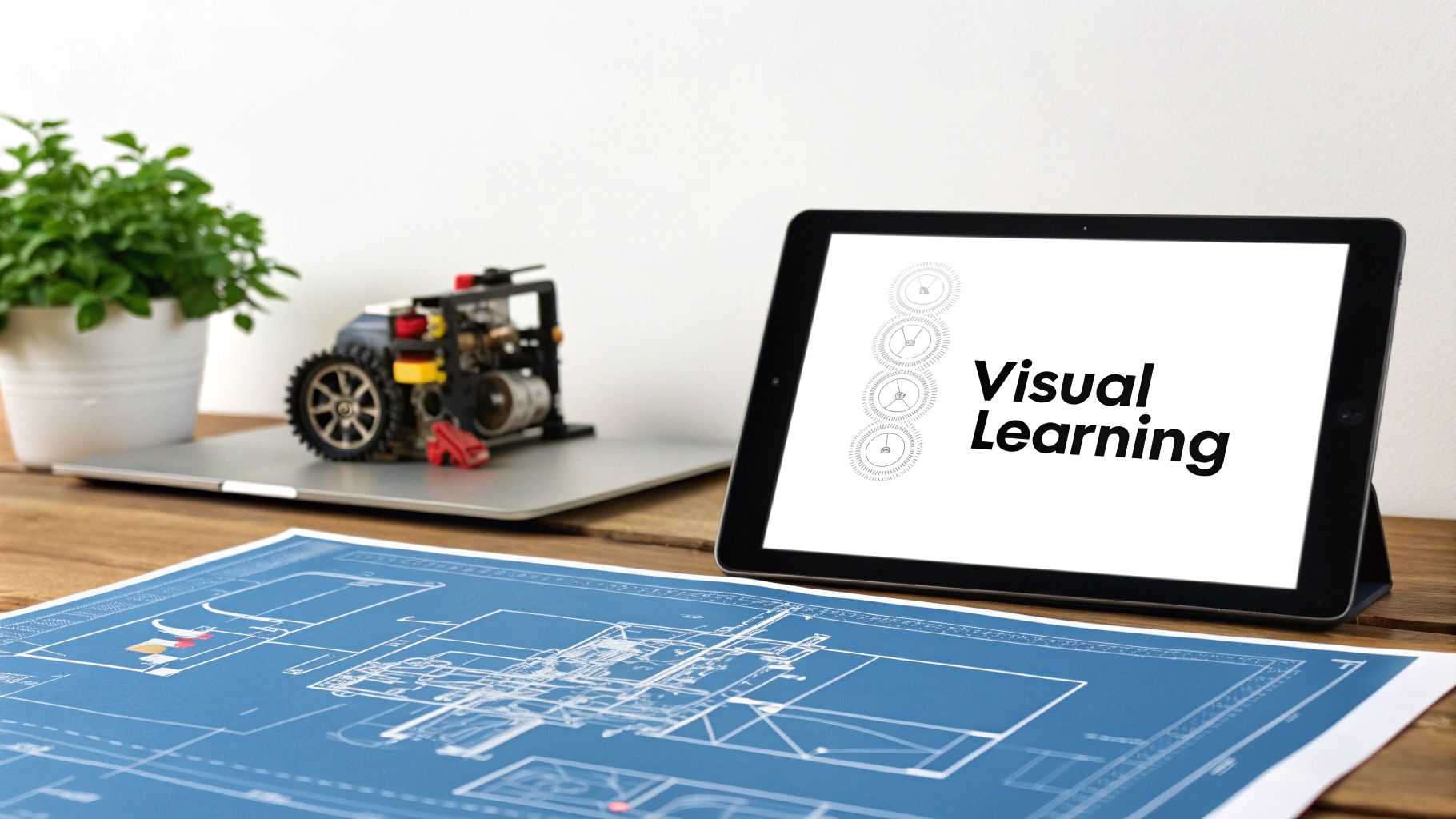
Imagine you’re trying to figure out how a car engine works just by looking at a technical blueprint. It’s doable, sure, but it demands a ton of focus and some existing knowledge. Now, picture an animated 3D model that pulls the engine apart piece by piece, showing you exactly how each part moves and interacts with the others.
That’s the magic of educational animation. It acts as a bridge between abstract ideas and real-world understanding. By transforming static data into a dynamic narrative, it cuts through the complexity and brings concepts to life in a way that plain text never could.
How Animation Taps Into the Brain for Better Learning
This isn’t just a feeling—it’s backed by some pretty solid cognitive science. Animation works because it aligns with how our brains are naturally wired. We process visual information far more efficiently than text, and animation speaks that universal language of movement and imagery.
A key idea here is the dual coding theory. This theory basically says our brains have two separate channels for processing information: one for verbal stuff (like words and language) and another for visual things (like images and video). When you watch an educational animation, you’re getting information fed to both channels at the same time.
- The Visual Channel: You see the characters moving, the charts building, and the data visualisations unfolding on screen.
- The Verbal Channel: You hear the narrator explaining the ideas, or you read short, clear text that pops up to support the visuals.
By engaging both channels, the learning experience is reinforced. This creates stronger connections in the brain, making it much easier to recall the information later on. You aren’t just reading about a process; you’re seeing and hearing it in action.
By combining sight and sound, educational animation helps viewers build a much richer, more complete mental picture of a topic. This leads to a deeper level of understanding and seriously boosts long-term retention compared to single-channel methods.
The Real-World Impact on Retention and Understanding
The benefits of this approach are clear and well-documented. Research across Europe has shown that students can remember up to 65% more information when their lessons include animated elements. Even better, animated content can help people grasp tricky concepts in half the time it would take using traditional teaching methods.
When you consider that Poland’s higher education sector had 1,245,200 students enrolled in the 2023-24 academic year, the potential for integrating animation is huge. If you’re curious, you can discover more insights about animation in education from recent studies.
In the end, educational animation just works because it taps into how we naturally learn. It grabs our attention, simplifies complicated subjects, and makes the whole learning process more enjoyable and effective—whether you’re a university student or an employee in a corporate training session.
Choosing the Right Animation Style for Your Message
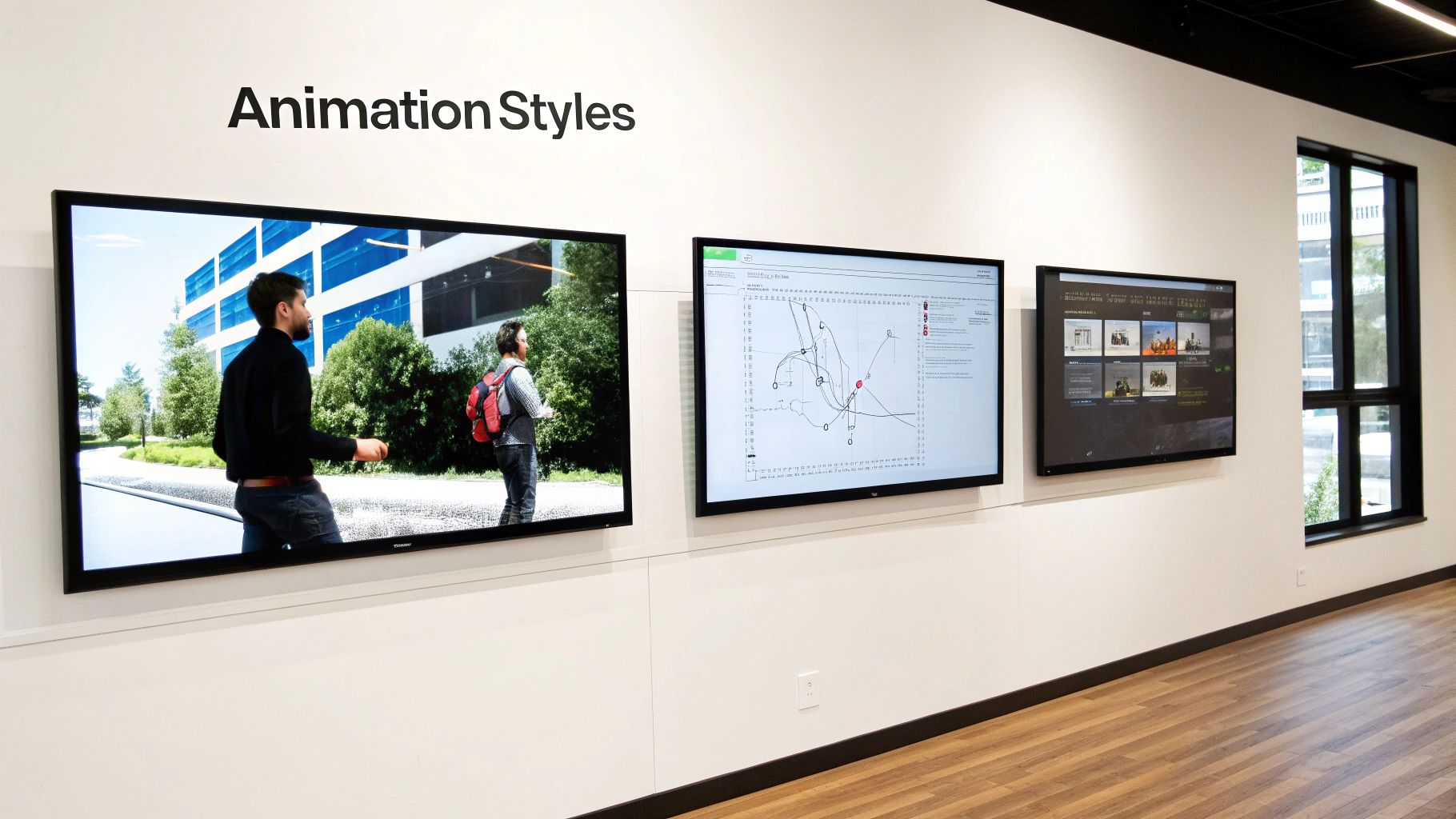
Picking an animation style is a bit like choosing the right tool for a job. You wouldn’t use a sledgehammer to hang a picture frame, would you? In the same way, the format you select for your educational animation has a massive impact on how well your message lands with your audience. The style you choose sets the tone, defines the clarity, and ultimately determines the power of your content.
Every style of animation has its own personality and strengths, making some better suited for certain tasks than others. This isn’t just about what looks good—it’s about strategically matching the visual language to your learning goals, the complexity of your subject, and, of course, your budget.
Whiteboard and Explainer Animations
Think of whiteboard animation as the classic visual storyteller. It’s fantastic for walking viewers through a process one step at a time. The hand-drawn, sequential reveal keeps people hooked, building anticipation and maintaining focus. This makes it perfect for breaking down intricate workflows or laying out historical timelines in a way that feels personal and easy to follow.
In a similar vein, 2D motion graphics are the reliable workhorses for corporate training and product walkthroughs. Their strength lies in animating abstract concepts—bringing data, charts, and icons to life with clean, professional movement. If you need to explain how software works or present company stats in a sharp, modern way, motion graphics deliver clarity without overwhelming the viewer.
2D and 3D Character Animation
When your message needs a human touch to really connect, nothing works quite like character animation. 2D character animation is brilliant for storytelling, allowing you to create relatable scenarios that resonate emotionally. It can make tricky subjects more approachable or turn dry compliance training into an engaging narrative, using characters to show the right—and wrong—ways to handle a situation.
3D animation, on the other hand, brings an incredible level of detail and realism to the table. It’s the go-to style for visualising complex machinery, detailed medical procedures, or architectural walkthroughs. If your audience needs to understand the inner mechanics of a physical product or see a concept from every conceivable angle, 3D provides the depth and accuracy needed for true comprehension.
Choosing the right style comes down to balancing three key things: the complexity of your topic, the emotional tone you want to set, and the resources you have available. The aim is always to find the perfect medium that ensures your information isn’t just seen, but genuinely understood.
Comparing Educational Animation Styles
To help make the decision a little easier, it’s useful to see these popular styles laid out side-by-side. The table below breaks down which approach fits best with different educational needs.
| Animation Style | Best For | Key Benefit | Complexity/Cost |
|---|---|---|---|
| Whiteboard | Step-by-step processes, historical narratives | High engagement through progressive reveals | Low to Medium |
| Motion Graphics | Data visualisation, software tutorials, abstract ideas | Clean, modern, and excellent for clarity | Low to Medium |
| 2D Character | Storytelling, behavioural training, relatable scenarios | Builds emotional connection and empathy | Medium |
| 3D Modelling | Product demos, medical/technical simulations | Unparalleled detail, depth, and realism | High |
While this table is a great starting point, keep in mind that many of the best projects blend different techniques to get the job done. The real key is starting with a crystal-clear picture of what you need to teach. For a deeper look, our guide covers many other types of animation that are perfect for educational content.
Ultimately, the most effective educational animation is one where the style serves the message, not the other way around. By thinking carefully about your audience and what you want them to learn, you can pick a format that makes your content not just visually impressive, but a truly powerful teaching tool.
Putting Educational Animation to Work in Your Business
Understanding the power of educational animation is one thing, but seeing it deliver real, measurable business results is something else entirely. We’re moving beyond theory here. Animation is a practical tool that companies are using right now to solve critical challenges, streamline how they work, and ultimately, boost their bottom line. It’s how abstract goals become concrete outcomes.
This is the point where animation shifts from a creative “nice-to-have” to a strategic necessity. Imagine slashing the time it takes for a new hire to become fully productive. Or picture a world where customer support calls plummet because your product’s features are finally crystal clear to everyone. These aren’t just hypotheticals; they’re the real-world impacts of well-made animated content.
Streamlining Internal Training and Onboarding
One of the most immediate and impactful uses for educational animation is internal training. We’ve all been there—faced with dense handbooks or click-through presentations that lose your attention almost instantly. Traditional onboarding can be a slow, inconsistent slog.
Animation flips this entire dynamic on its head. A series of short, engaging videos can completely standardise the onboarding experience, guaranteeing every new team member gets the same clear, concise information. This works especially well for tricky subjects, such as:
- Compliance and Safety Procedures: It’s one thing to read about a safety protocol; it’s another to see it demonstrated. Animated scenarios can clearly show the right way to do things—and the consequences of mistakes—in a safe, controlled environment.
- Company Culture and Values: How do you explain your company’s “vibe”? Character animation is perfect for telling your brand’s story, making abstract values feel tangible and relatable to new starters.
- Software and Systems Training: Showing is always better than telling. Motion graphics can walk employees through new software step-by-step, making a potentially intimidating learning process feel simple and straightforward.
When you make training more engaging, you get better knowledge retention and faster integration of new team members. That leads directly to a more efficient and capable workforce, right from day one.
The core benefit here is consistency and clarity. An animated video delivers the perfect message every single time, eliminating the variability of live training and ensuring crucial information is never missed.
Enhancing Customer Education and Support
Just as animation helps your own team get up to speed, it’s a game-changer for educating your customers. When you launch a new product or a slick software feature, your customers need to “get it” fast. A sharp, animated explainer video can be the difference between enthusiastic adoption and user frustration.
Think about the customer’s journey. An animated product demo on your website can break down complex features, helping potential buyers see exactly what they’re getting. This clarity doesn’t just improve conversion rates; it sets realistic expectations, which is vital for keeping customers happy in the long run.
What’s more, building a library of animated tutorials can drastically reduce the load on your support team. Instead of fielding the same questions over and over, agents can point customers to a short video that visually explains the solution. This empowers customers to solve problems themselves and frees up your support staff to tackle the truly complex issues. For a fantastic example of this in action, check out our case study on creating a training animation for complex heating solutions.
This proactive approach builds a more self-sufficient and confident user base, which strengthens brand loyalty and improves the entire customer experience. Educational animation becomes a scalable tool for customer success.
Your Step-by-Step Animation Production Playbook
Making a professional animation might look like a huge, complicated task, but it’s actually a very organised journey broken down into clear, easy-to-follow stages. When you understand this process, the whole thing stops being a mysterious “black box” and becomes a predictable, collaborative project. This playbook will walk you through every phase, from that first spark of an idea to the final, polished video.
Sticking to a solid production process means every decision has a purpose, ensuring the final educational animation hits the mark you set at the very beginning. Think of it as a roadmap that keeps the entire team on the same page, on time, and within budget.
Stage 1: Discovery and Scripting
Every great project starts with a solid foundation. The very first step is to nail down exactly what you want to achieve. Are you training staff on a new safety procedure? Or maybe explaining a complex software feature to first-time users? You need to set a single, primary learning objective to keep the entire project laser-focused.
Once the goal is clear, it’s time to write a script that connects with your audience. This isn’t just about jotting down words for a narrator to read; it’s the architectural blueprint for the whole video. A brilliant script tells a clear story, lays out information logically, and speaks in a tone that feels natural to your viewers. Every single word matters, especially in a visual medium like animation where getting straight to the point is key.
Stage 2: Storyboarding and Visual Design
With the script locked in, the project shifts into its first visual phase: the storyboard. Picture a storyboard as a comic book version of your animation. It’s a sequence of simple sketches that maps out every scene, showing what’s happening on screen as the narration plays out. This is where we figure out camera angles, character movements, and how one scene flows into the next, making sure the visuals and the script work together perfectly.
At the same time, we start developing the animation’s visual style. This involves designing the characters, picking a colour palette, and creating key background art, often called “style frames.” This stage defines the entire look and feel of the animation, ensuring it’s consistent with your brand and the message you want to send.
This is one of the most important moments for feedback. It’s far, far easier to change a simple drawing on a storyboard than it is to re-animate a whole scene later on. Clear communication here saves a massive amount of time and money down the road.
Stage 3: Production and Animation
Now for the part where the magic really happens. All the individual visual pieces—the characters, backgrounds, and graphics—are polished and prepped for animation. We bring in a professional voiceover artist to record the script, someone who can deliver the narrative with just the right energy and tone.
Next, our animators bring it all to life. They take the approved designs and storyboard frames and create fluid, believable motion, syncing every action on screen with the voiceover. It’s a detailed process that demands a blend of technical skill and artistic flair to make sure every movement feels smooth and engaging. If you want to dive deeper into the nuts and bolts, check out our guide on the animation production pipeline.
This stage is also being reshaped by new technology. The global animation market was valued at USD 394.6 billion in 2022 and is expected to hit USD 528.8 billion by 2030, partly because new tools are making production more efficient. For anyone looking to innovate, understanding how to start creating videos with AI can be a real game-changer for educational content. For Polish educational institutions, these tools are making it more possible than ever to produce high-quality animation on a tight budget.
Stage 4: Post-Production and Final Delivery
The last leg of the journey is about adding the finishing touches that turn a good animation into a great one. Our sound designers layer in music and sound effects to build atmosphere and highlight key moments. This audio work adds emotional weight and makes the whole experience much more immersive.
Finally, all the elements are brought together, the colours are perfected, and the final video file is rendered. After one last review and your final sign-off, the educational animation is delivered in all the formats you need, ready to be shared with your audience and start making an impact.
Core Principles of High-Impact Educational Videos
Anyone can commission an animation. The real art lies in crafting one that genuinely teaches something—an animation that sticks with your audience long after they’ve clicked away. High-impact educational videos aren’t just about flashy visuals; they’re built on a solid foundation of instructional design. Get these principles right, and you’ll create content that educates, not just entertains.
The most critical first step? Defining a single, crystal-clear learning objective. Every single element, from the script to the sound effects, must serve this one primary goal. Without that laser focus, your video risks becoming a jumble of cool facts instead of the powerful teaching tool you need it to be.
Define One Clear Learning Objective
Before you even think about storyboards or character designs, ask this one simple question: What is the one thing I want my viewer to know or do after watching this? This single objective becomes your North Star, guiding every creative decision. It keeps the script tight, the visuals relevant, and the message sharp.
A focused objective is your best defence against cognitive overload. Throwing too much information at a viewer too quickly is a surefire way to cause confusion and lose their attention. When you centre the entire video around one key takeaway, you make it dramatically easier for your audience to absorb, process, and actually remember the lesson.
Craft a Compelling Narrative
Let’s face it, humans are wired for stories. A narrative structure, even a simple one with a beginning, a middle, and an end, is what hooks viewers and keeps them watching. Ditch the dry bullet points and frame your information within a relatable story or a problem-solution scenario. This simple shift transforms passive viewing into an active, engaging journey.
Think about it: an animation explaining a new software feature is far more powerful when it follows a character struggling with an old, clunky workflow. When they discover the new tool and solve their problem, the lesson becomes memorable, practical, and much more impactful.
This infographic gives a bird’s-eye view of how a polished animation comes to life, highlighting the essential planning stages.
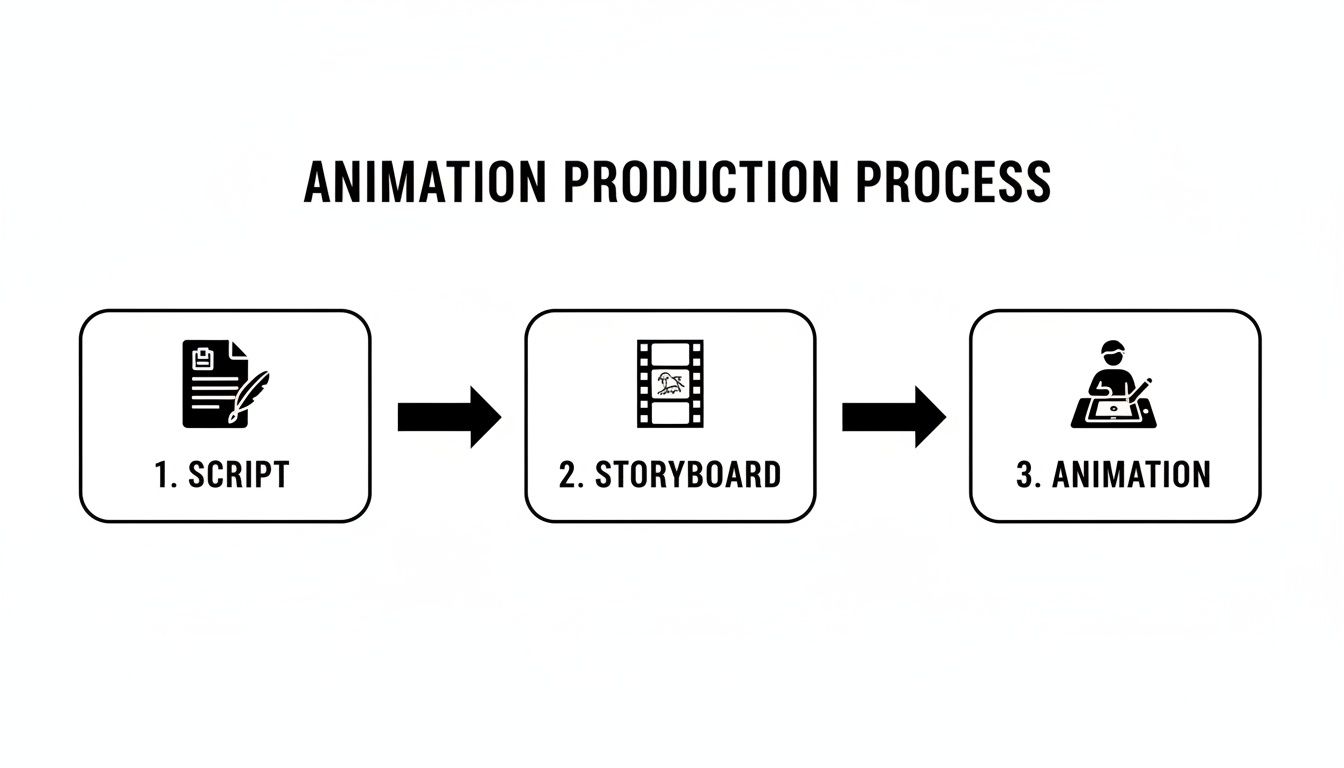
As you can see, a rock-solid script and storyboard aren’t just nice-to-haves; they are the absolute bedrock of a successful animation.
Prioritise Clarity and Accessibility
Your visuals should clarify, not clutter. Every graphic, character, and line of text on screen needs a purpose—one that directly supports the learning objective. Animation is brilliant for simplifying complex ideas, like showing the inner workings of an engine or making abstract data easy to grasp. Don’t waste that power on purely decorative fluff.
We’ve learned that audio quality is just as crucial as the visuals. A crisp, professional voiceover and clean sound ensure the message is heard loud and clear, keeping viewers focused and happy.
Accessibility is non-negotiable. This means using clear, high-contrast colours, providing accurate captions, and making sure on-screen text is big enough for everyone to read. Animation is uniquely suited to break down learning barriers. The blend of visuals, audio, and movement caters to different learning styles simultaneously. In Poland, for instance, where boosting STEM engagement is a national priority, animation is a fantastic tool for bringing tough scientific concepts to life. Currently, the proportion of STEM graduates per 1,000 people aged 20-34 is only 11.9%, trailing the EU average of 14.3%.
To really knock your educational videos out of the park, it’s always a good idea to brush up on general content creation best practices as well.
Partnering for Success in Animation Production
Creating a truly effective educational animation is about more than just slick visuals. It’s about a strategic partnership where creative expertise meets your specific goals. Our unique approach is built on collaboration, blending proven instructional design with compelling storytelling to produce animations that don’t just look great—they deliver real results.
We believe the best projects start with a deep dive into your objectives. From our very first discovery call, we’re focused on what you need to achieve, whether that’s boosting knowledge retention for your team or simplifying a complex product for your customers. This goal-oriented mindset steers every decision we make.
Our Collaborative Production Process
Transparency and collaboration are the cornerstones of our process. We guide you through each stage, ensuring the final animation is a perfect reflection of your brand and educational aims. Our workflow is designed to be clear and interactive, giving you confidence and control from start to finish.
This commitment to partnership is essential for creating high-impact content. We see ourselves as an extension of your team, bringing our specialised skills to help you communicate more effectively through the power of visual storytelling. As an experienced explainer video agency, we have honed this process for maximum efficiency and quality.
Aligning Creativity with Strategic Outcomes
Our process isn’t just about managing a project; it’s about crafting a powerful learning tool. We meticulously align our creative direction with your desired outcomes, making sure every scene, character, and sound effect serves the main learning objective. This blend of artistry and strategy is what really makes our work stand out.
A great educational animation does two things perfectly: it captures the viewer’s attention and it delivers a clear, memorable message. Our entire process is organised to ensure we achieve both, turning your vision into an asset that works.
This approach is especially relevant in today’s learning environments. Poland’s educational sector, for instance, is in the middle of a huge digital shift where animation is becoming a key pedagogical tool. The country is investing heavily to modernise its infrastructure, with government spending on pre-primary education rising by 63% between 2015 and 2022 and primary teacher salaries increasing by 32.8% in 2024. This push includes a plan to train over 320,000 people in new digital skills, creating the perfect conditions for animation to thrive. You can read the full report on Poland’s educational transformation to learn more.
Ultimately, our partnership model is designed for one thing: to help you achieve measurable success. By combining our production expertise with your industry knowledge, we create educational animations that not only engage your audience but also help you reach your most important business and educational goals.
Frequently Asked Questions About Educational Animation
Even when you’re sold on the benefits, kicking off an educational animation project naturally brings up a few practical questions. We get it. This section cuts straight to the chase, answering the most common queries we hear from clients to help you plan your next move with total confidence.
How Much Does an Educational Animation Typically Cost?
There’s no one-size-fits-all price tag for an educational animation. The best way to think about it is like building a house—the final cost hinges on the size, materials, and complexity of the design. The biggest variables that will shape your budget are the animation style you choose, the video’s length, and the level of visual detail required.
For example, a clean 2D motion graphics or whiteboard video is usually the most wallet-friendly route, perfect for getting a straightforward point across. On the flip side, a highly detailed 3D animation, say for intricate medical training, demands more specialised skills and represents a larger investment. The trick is to see it not as an expense, but as an investment in a learning tool that will serve you for years. The only way to get a real number is to chat with a studio about your goals to get a custom quote that makes sense for you.
How Long Does It Take to Produce an Animated Educational Video?
For a professionally produced educational animation, you’re typically looking at a timeline of 4 to 12 weeks. This window is shaped by the project’s complexity, its final length, and just as importantly, how quickly your team can provide feedback at key checkpoints. A standard 60-90 second 2D animation usually lands somewhere in the 6-8 week range.
The whole process is broken down into clear, sequential phases: scriptwriting, storyboarding, design, voiceover, and finally, the animation itself. We can’t move to the next stage until you’ve given the thumbs-up on the current one.
If there’s one secret to keeping a project on schedule, it’s this: clear, decisive feedback. A detailed brief at the start and prompt responses during reviews are the fuel for a smooth and efficient production journey.
Can it be done faster? Sometimes, but rushing the process often means bringing more hands on deck, which can bump up the cost.
How Can I Measure the ROI of My Educational Animation?
Measuring the Return on Investment (ROI) of your animation all comes down to the goal you set in the first place. Before a single frame is designed, you need to decide on the key performance indicators (KPIs) you’ll be watching. This is the only way to know for sure if the video did its job after you launch it.
Here are a few real-world examples based on common goals:
- Employee Training: For internal videos, you could track things like a reduction in onboarding time for new hires, better scores on compliance quizzes, or even a measurable drop in workplace safety incidents.
- Customer Education: When the video is for your customers, look at engagement rates (how long they watch, completion rate), a decrease in support tickets about the topic you covered, or a jump in the adoption of a specific product feature you explained.
By linking your animation to specific, measurable business outcomes, you can clearly prove its value. The key is to establish those benchmarks before you start, turning your animation into a powerful tool for improvement.
Ready to turn your complex ideas into learning tools that are clear, engaging, and actually work? The team at Simple Frame specialises in creating high-quality educational animation that delivers real results. Let’s discuss your project today.
 English
  Polish
  German