
Corporate Animated Training Video Production Services: Onboarding & Compliance
Let's face it, traditional training methods are broken. Piles of manuals, mind-numbing slideshows, and seminars that drag on for days just don't cut it anymore. They struggle to hold anyone's attention, and the information rarely sticks. This is precisely where corporate animated training video production services come in, offering a fresh way to turn dense, complex topics into content that’s actually memorable and easy to absorb. It's like swapping a dusty old textbook for an interactive, hands-on workshop.
Why Traditional Training Methods Are Falling Short
The modern workplace is fast-paced, but old-school training has been left in the dust. Employees are handed thick binders or forced to sit through hours of lectures, a recipe for disengagement and poor knowledge retention. For any growing organisation, this dated approach creates some serious roadblocks.
One of the biggest problems is consistency. When different managers or trainers are left to deliver the same material, the core message can get twisted and diluted. This leads to a patchy learning experience across the board—some employees get top-tier instruction, while others are left with a watered-down version.
The Engagement Gap
The single greatest failure of old-school training is its complete inability to hold attention. Walls of text and monotonous presentations do nothing to fire up the brain's visual and auditory learning centres, which are crucial for making information stick.
Today's workforce is used to slick, engaging digital content in their everyday lives. When their professional training feels like a chore, the key lessons are quickly forgotten, leading to recurring mistakes and the constant, costly need for retraining.
This issue is especially glaring during the onboarding process. New hires can feel completely overwhelmed and disconnected, which dramatically slows down their integration into the company. It's a common story that highlights why traditional communication methods for onboarding are being replaced by more dynamic, modern tools.
The Cost of Inefficiency
Beyond the lack of engagement, traditional training is often a logistical and financial nightmare. It’s incredibly inefficient and a real headache to scale, especially for global teams. In-person sessions demand a mountain of coordination—from scheduling and travel to venue hire and material costs.
To put it in perspective, let’s quickly compare the two approaches.
Traditional Training vs Animated Video: A Quick Comparison
Here's a straightforward table breaking down the key differences between the old way and the new.
| Feature | Traditional Training (Manuals, Seminars) | Animated Training Videos |
|---|---|---|
| Engagement | Low; often passive and text-heavy. | High; uses dynamic visuals and audio. |
| Consistency | Varies wildly by instructor and location. | Standardised; everyone gets the exact same message. |
| Scalability | Difficult and expensive for remote teams. | Easy to distribute globally at a minimal cost. |
| Accessibility | Limited to physical sessions or documents. | On-demand; accessible anytime, anywhere. |
| Retention | Poor; learners forget information almost immediately. | Improved; visual storytelling boosts memory. |
As you can see, the benefits of animated videos quickly stack up.
Plus, think about all those printed manuals. They become outdated the moment a procedure changes, forcing costly reprints and a massive distribution effort. This static approach simply can't keep up with evolving compliance rules or new internal processes without a complete and expensive overhaul. Corporate animated training video production services neatly solve these problems, offering a flexible, engaging, and cost-effective alternative built for the demands of a modern workforce.
How Animated Videos Drive Modern Workforce Development
Animated videos aren't just a passing trend; they've become a powerhouse for building a smarter, more skilled workforce. By tapping into both sight and sound, animation fundamentally changes how employees absorb and hold onto crucial information. It's this dual-channel learning that makes tricky subjects not just easier to grasp, but much harder to forget.
Think about the difference between reading a dense instruction manual and watching a clear, visual walkthrough. Animation brings abstract concepts to life, making them tangible and practical. That’s exactly why businesses are increasingly partnering with corporate animated training video production services to crack their toughest training nuts.
Creating Consistent and Welcoming Onboarding
First impressions count, especially with new hires. Animated videos deliver a standardised, welcoming onboarding experience for every single employee, whether they're at head office or working remotely. A thoughtfully crafted animation can introduce the company culture, explain core values, and guide new starters through those initial admin tasks in a genuinely engaging way.
This consistency is key. It removes the natural variations that come with in-person talks and guarantees every new team member gets the same high-quality introduction, setting a positive tone right from day one.
Simplifying Complex Processes and Procedures
Let's be honest, some topics are just plain difficult to teach with text alone. Imagine trying to explain a complex software workflow or a detailed safety protocol using only a PDF document. Animation slices right through that complexity by showing people what to do, not just telling them.
For instance, a video can visually map out every click and function needed to navigate a new CRM system. This is a core strength of educational animation, which excels at breaking down intimidating subjects into bite-sized, visual steps.
Animated training videos transform daunting procedures into clear, step-by-step visual guides. This method reduces errors, accelerates learning curves, and empowers employees to perform tasks correctly and confidently from the start.
This visual-first approach is also a game-changer for safety training. Instead of just listing rules, an animation can simulate hazardous situations in a completely safe, controlled environment, demonstrating the correct procedures without putting anyone at risk.
Boosting Product Knowledge and Technical Skills
When you're launching a new product, your sales and support teams need to know it inside and out. Animated videos are the perfect tool for demonstrating features, explaining technical specs, and showcasing unique selling points in a way that’s dynamic and memorable.
A punchy animation can explain the inner workings of a new piece of hardware or the key benefits of a software update far more effectively than a dry data sheet. This arms your customer-facing teams with the confidence and knowledge they need to handle any question that comes their way.
The demand for these visual tools is exploding worldwide. In Poland, animation studios are becoming central to this growth, particularly in 2D techniques for corporate and educational content. This is happening as the global 3D animation market is projected to hit £26.63 billion in 2025, a jump from £24.33 billion in 2024. For Poland, this translates into a massive uptake in corporate training, with adoption expected to climb by at least 40% by 2025 as companies recognise animation's superior knowledge retention.
Of course, to get the most out of your videos, it helps to follow best practices for creating effective training materials. At the end of the day, investing in animation is an investment in your people, delivering real, measurable improvements in performance, confidence, and overall skill.
Choosing the Right Style for Your Training Animation
Deciding to use animation for corporate training is a brilliant first step, but it’s really just the beginning of the journey. Much like a skilled craftsman has a whole workshop of different tools, animation offers a variety of styles, each with its own unique strengths. The style you pick has a huge impact on how your message lands, making it critical for creating training that truly engages your team.
Think about it this way: trying to explain a new software interface using a character-driven story could get messy, while a simple 2D graphic just won’t cut it for showing a complex medical procedure. Getting to grips with these differences helps you have a much more productive conversation with your production partner, ensuring the final video nails your training goals. It’s a key part of the service that a corporate animated training video production services provider brings to the table.
2D Animation The Versatile Storyteller
When most people think of classic cartoons, they're picturing 2D animation. This style brings characters and scenes to life in a two-dimensional space. It’s incredibly versatile, making it perfect for telling stories, breaking down abstract ideas, and creating relatable characters to guide employees through the training material.
Because it’s so adaptable, 2D animation is a go-to for a huge range of training needs. It really shines when it comes to:
- Employee Onboarding: Crafting friendly, character-led videos that introduce new hires to your company culture and values.
- Soft Skills Training: Showing ideal workplace scenarios, like how to handle a difficult customer or resolve team conflicts.
- Brand Storytelling: Weaving a narrative that connects employees to your company’s mission in a powerful way.
This style gives your training a human touch, making complex information more memorable and emotionally resonant.
Motion Graphics The Data Visualiser
If 2D animation is the storyteller, then motion graphics is the expert communicator. This style is all about animating graphic elements—text, charts, icons, and logos—to create a sleek, dynamic presentation. It’s less about characters and narrative and more about breathing life into data and abstract concepts in a way that’s crystal clear.
Motion graphics are second to none when it comes to turning complex data and processes into clean, engaging visuals. This style cuts through the noise to present information with clarity and impact, making it perfect for topics heavy on facts and figures.
You’ll see motion graphics used most often for:
- Explaining Processes: Visualising a step-by-step workflow or a complicated supply chain.
- Presenting Data: Transforming dull spreadsheet statistics into an engaging animated infographic.
- Software Tutorials: Highlighting key features and guiding users through an interface with clean, animated pointers.
Motion graphics delivers information with a modern, professional polish, making it a staple for corporate communications.
3D Animation The Product Expert
When your training needs a realistic look at a product or environment, 3D animation is the undisputed champion. By building objects in a three-dimensional digital space, this style lets you show a product from every possible angle, reveal its internal mechanics, or even create lifelike simulations.
It’s a more technically demanding and often pricier option, but for the right job, its value is simply unmatched.
- Product Training: Showcase a new piece of machinery in action, letting sales teams get to know it before it even hits the factory floor.
- Technical Demonstrations: Animate the full assembly of a complex device or the inner workings of a mechanical part.
- Safety Simulations: Create realistic virtual environments to train employees on hazardous procedures without any real-world risk.
For companies in manufacturing, engineering, or technology, 3D animation offers a level of detail and realism no other style can touch. Its power to showcase products and concepts with true depth makes it an essential tool for any successful animated brand video.
Specialised Animation Medical and Technical
Moving beyond the main categories, some training demands highly specialised animation. Technical and medical animations are sub-genres that require an incredible level of precision and deep subject matter expertise. These videos are built to explain intricate scientific concepts, complex surgical procedures, or the inner workings of highly specialised equipment.
The entire focus here is on absolute accuracy. These animations don’t just have to look good; they have to be factually perfect, down to the last detail. This makes them indispensable for training in fields like healthcare, pharmaceuticals, and advanced engineering, where getting the information wrong can have serious consequences. This specialised skill is a hallmark of truly professional corporate animated training video production services.
Your Guide to the Animation Production Process
Creating a top-tier animated training video isn't magic; it's a structured, collaborative process. Think of it like building a custom piece of furniture. You don't just start cutting wood. You begin with a detailed design, select the right materials, and assemble everything piece by piece. A professional corporate animated training video production services provider acts as your master craftsman, guiding you from a rough idea to a polished final product.
This isn't about guesswork. It's a transparent journey designed to turn your training goals into an effective visual tool. Let's walk through the key phases of bringing your animated video to life.
Concept and Discovery
This is the blueprint stage. Before we even think about drawing a single frame, we need to get to the heart of your project. We'll kick things off with a deep-dive conversation to understand your goals. What should your team be able to do after watching this? Who are we talking to? What are the absolute must-know takeaways?
In this phase, we work together to pin down the video's core message, its tone of voice, and the visual style that will resonate with your audience. Getting this right from the start is crucial—it ensures we're all on the same page and prevents costly changes down the line.
Scriptwriting and Storyboarding
With a solid concept locked in, we start building the narrative. The script is the soul of your video; it shapes the story, delivers the essential information, and dictates the pace. A great script isn't just written to be read; it's crafted to be heard, making complex ideas clear and concise.
Once the script gets your seal of approval, we move on to the storyboard. This is your first real glimpse of the final video. It’s a visual roadmap, a sequence of sketches that lays out every scene, character movement, and graphic element. It allows you to see the flow and feel of the video, giving you a chance to make adjustments before the intensive animation work begins.
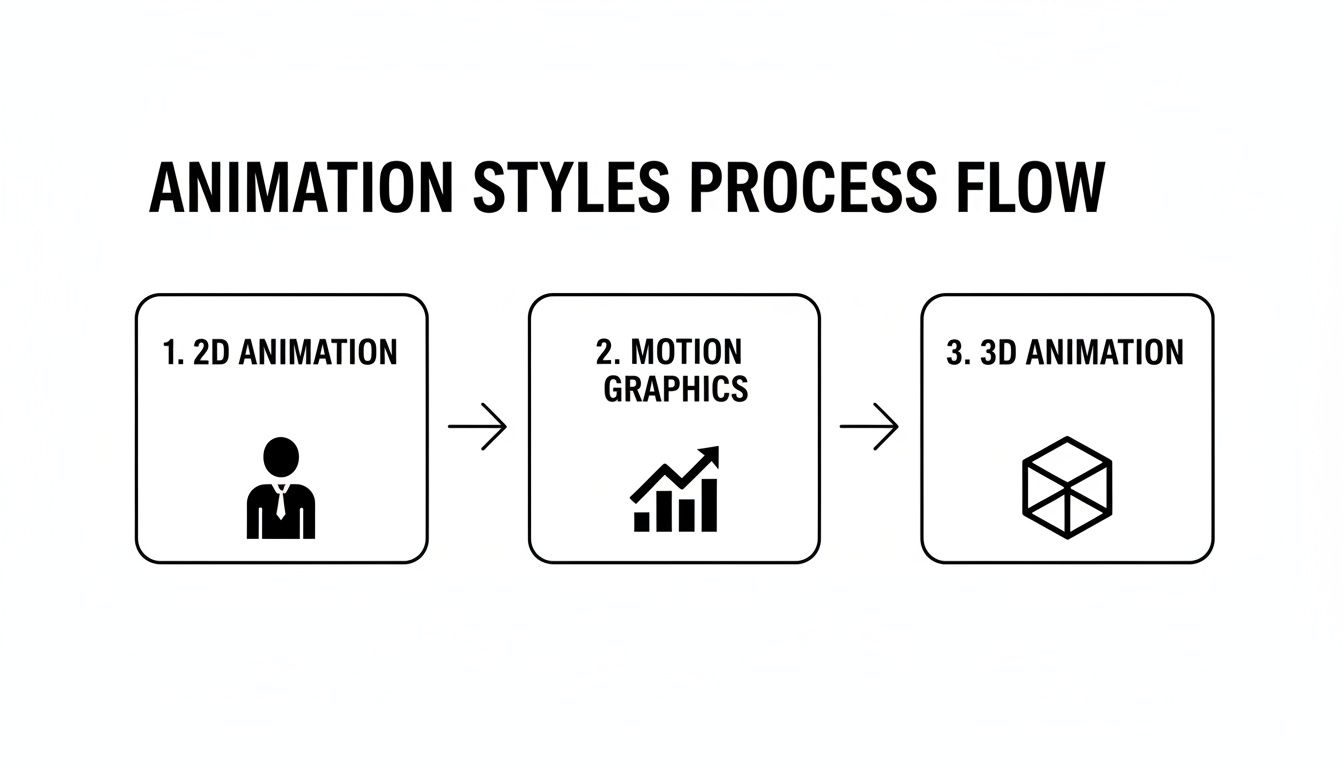
This visual flow helps illustrate how we select the right animation style—be it 2D, motion graphics, or 3D—based on the specific training objectives we defined during our discovery sessions.
Voiceover and Sound Design
Now it's time to give your video a voice. A professional voiceover artist does more than just read the script; they bring it to life, infusing it with a personality and tone that truly connects with your team. The right voice can make all the difference in holding attention and making the information stick.
Sound design adds the final layer of polish. This includes everything from the background music that sets the mood to the subtle sound effects that accentuate the on-screen action. These audio cues are vital for creating an immersive experience that keeps viewers focused and reinforces the key learning points. You can take a closer look at how all these pieces fit together in our complete animation production pipeline.
Animation and Production
Here's where the real magic happens. Our animators take the approved storyboard, illustrations, and audio tracks and start breathing life into them. Using specialised software, they meticulously animate each scene, ensuring every movement is smooth, transitions are seamless, and the visuals sync perfectly with the voiceover.
The production phase is the most time-intensive part of the process. It's where skilled artists transform static assets into a dynamic, flowing narrative that educates and engages your employees.
This isn't a "disappear and deliver" process. We provide regular updates and previews for your feedback, ensuring the final animation is exactly what you envisioned. It's a detailed, creative endeavour that demands a blend of technical expertise and artistic flair.
Post-Production and Localisation
With the animation complete, we move into the final finishing stage. Post-production is all about polish—adding visual effects, fine-tuning the colour, and mixing the sound for a crisp, professional result. We comb through every detail to make sure the video is flawless and ready for your team.
This is also where we handle localisation. If your training programme needs to reach a global audience, we can add subtitles or record new voiceovers in multiple languages. This ensures your message is clear, consistent, and effective, no matter where your employees are. The post-production industry in Poland is a testament to this global demand. As of 2025, Poland is home to 1,597 post-production businesses, and the sector has seen a robust 6.8% annual growth rate since 2020. This boom highlights the region's deep expertise in delivering world-class visual content.
How to Find the Right Animation Production Partner
Choosing a creative partner isn't just about hiring a vendor; it’s about finding a team that truly becomes an extension of your own. Your project's success hinges on their ability to grasp your vision and turn it into a compelling training tool. This decision lays the groundwork for everything that follows, so it pays to approach it with a clear strategy.
The hunt for the perfect corporate animated training video production services provider can seem daunting, but it really boils down to a few core things. You're looking for a partner with the right mix of creative flair, technical skill, and a proven history of delivering real results.
Evaluate Their Portfolio and Relevant Experience
First things first: dive deep into a potential partner’s portfolio. Don't just get wowed by slick visuals; look for work that’s actually relevant to your industry and what you’re trying to teach. An agency that's brilliant at creating flashy product ads might not have the knack for detailed technical or compliance training.
You need to see specific examples that line up with what you need.
- Industry Alignment: Have they done work for companies in your field before? It’s a huge advantage if they already speak your industry’s language and understand its unique challenges.
- Style Versatility: Does their portfolio showcase a range of animation styles, like 2D, 3D, and motion graphics? This is a good sign they can suggest the best style for your project, not just the one they know how to do.
- Clarity and Purpose: Do their videos actually manage to explain complex ideas clearly? A beautiful video that leaves people confused is, at the end of the day, a failure.
A strong, relevant portfolio is the best proof you’ll get that a studio can handle the specific demands of your training content.
Scrutinise Their Process and Communication
A great animated video is always the result of a great process. A reliable partner will have a transparent, collaborative way of working that keeps you in the loop every step of the way. They should be able to walk you through their process from the initial idea and script all the way to animation and final delivery.
A transparent and structured production process isn't just about efficiency; it's about building trust. It ensures there are no surprises, feedback is incorporated smoothly, and the final video is a true reflection of your goals.
Make sure to ask potential partners how they handle feedback and revisions. A collaborative spirit is the mark of a true partner who values your input, not just a supplier trying to tick a box and move on. Good, open communication is the foundation of any successful project.
Verify Their Reputation Through Testimonials
Client testimonials and case studies give you an invaluable, unfiltered peek into what it’s actually like to work with an agency. You want to look for feedback that talks about their reliability, creativity, and ability to hit deadlines. Glowing reviews are nice, but detailed stories about how the agency solved a specific problem are even better.
This is also where regional expertise can make a difference. Poland, for example, has a buzzing animation scene with at least 15 top-tier agencies that specialise in everything from SaaS explainers to corporate training. Studios like BluBlu in Warsaw, which gets praise from over 95% of reviewers for their 2D and 3D work, show the high level of talent available. For a closer look at what makes a great creative partner, our guide on selecting an explainer video agency is a great resource, as many of the same principles apply.
Common Questions About Animated Training Videos
So, you're thinking about making the switch to animated training. It's totally normal to have questions about the practical side of things—how much it costs, how long it takes, and what kind of results you can actually expect.
This final section tackles the most common queries we hear from businesses before they dive into corporate animated training video production services. Getting clear, straightforward answers is the best way to clear up any lingering doubts and help you move forward with confidence.
How Much Do Corporate Animated Training Videos Cost?
This is usually the first question on everyone's mind. The honest answer? It depends. The cost of an animated video isn't a simple, one-size-fits-all figure. It’s really shaped by a few key things: the style of animation you choose, how complex the visuals are, and, of course, the video's length.
Think of it like commissioning a painting. A simple pencil sketch is going to cost a lot less than an intricate oil masterpiece. It’s the same with animation. A straightforward motion graphics video that uses icons and text will be much more budget-friendly than a detailed 2D character animation or a photorealistic 3D product rendering.
To give you a clearer picture, here’s a general breakdown:
- Simple Motion Graphics/Infographics: Perfect for visualising data, stats, and processes. Costs often start around £600–£800 per minute.
- 2D Character Animation: When you need storytelling and character-led scenarios, prices typically start in the £1,400–£1,900 per minute range, simply because it requires more detailed illustration and movement.
- Complex 3D Animation: This is the most resource-heavy style, ideal for highly technical visualisations. Costs can vary a lot but generally start higher because of the specialised skills and rendering time needed.
These are just starting points, of course. The final price tag will be tailored to the specifics of your project—everything from the script's complexity to the level of detail in the visuals. Any transparent production partner will always give you a detailed quote based on your unique training goals.
What Is the Average Timeline for Production?
Just like cost, the production timeline flexes to fit the project's scope. A simple, short video can be turned around pretty quickly, while a more complex series of training modules will naturally take a bit longer.
On average, a standard animated training video takes between four to eight weeks from our initial kick-off call to the final delivery.
That timeline is deliberately structured to allow for collaboration and your feedback at every key stage. Here’s how that time is typically spent:
- Concept, Script, and Storyboard (1-3 weeks): This is the foundation. It's where we lock down the core message and the visual plan.
- Voiceover and Illustration (1-2 weeks): Once the storyboard gets your thumbs-up, we move on to recording the voiceover and creating all the visual assets.
- Animation and Sound Design (2-4 weeks): This is where the magic happens. It’s the most intensive phase where our artists bring everything to life and sync it all with the audio.
- Revisions and Final Delivery (1 week): We always build in time for your feedback to make sure the final video is exactly what you need.
A smooth, efficient process really boils down to clear communication. A good partner keeps you in the loop every step of the way, making sure the project stays on track and hits your deadline without any last-minute surprises.
How Can We Measure the ROI of Our Training Video?
Measuring the return on your investment is absolutely crucial. You need to prove the value of this new approach. The great thing about video is that, unlike the vague feedback from old-school seminars, it offers tangible metrics that you can connect directly to business outcomes. The trick is to define what success looks like before you even start production.
You can track your ROI using both hard numbers and real-world observations.
- Quantitative Metrics: These are your hard numbers. Using your Learning Management System (LMS), you can track things like completion rates, quiz scores, and pass/fail stats. A clear improvement in these figures after launching the video is a solid win.
- Qualitative Metrics: This is more about observing changes on the ground. Are you seeing fewer support tickets related to a new piece of software? Have on-the-job errors for a certain procedure gone down? You can also gather direct feedback through employee surveys to see how confident and clear they feel about the topic.
The real measure of success for a training video isn't just how many people watched it, but how effectively it changed behaviour. By tracking key performance indicators before and after the training, you can draw a direct line from your investment to improved efficiency, reduced errors, and a more skilled workforce.
Do You Offer Localisation for International Teams?
Absolutely. In a global business, training content has to be accessible and feel relevant to employees everywhere. We know that a one-language-fits-all approach just doesn't cut it for international teams, which is why localisation is a core part of what we do.
We can adapt your animated training videos for different languages and cultures to ensure your message lands perfectly, no matter the region. This might involve:
- Subtitling: Adding translated text is a straightforward way to make your video accessible to a much wider audience.
- Voiceover Replacement: For a more polished, immersive experience, we can record new voiceovers with professional artists who are native speakers of the target language.
- Cultural Adaptation: Sometimes it’s about more than just the words. We can also adjust visual elements, examples, or even colours to make them more culturally relevant and avoid any accidental misunderstandings.
This ensures every single member of your team gets the same high-quality, consistent training, no matter where they are in the world.
Ready to transform your corporate training with engaging, effective animated videos? At Simple Frame, we combine creative storytelling with a clear process to produce content that delivers real results. Let’s talk about your project today.
 English
  Polish
  German