
A Modern Animated Video Marketing Strategy For Businesses
An animated video marketing strategy isn't just about making slick cartoons. It's a calculated way to break down complex ideas, give your brand a human touch, and drive real, measurable growth. It all comes down to setting clear goals, picking the right animation style, and creating content that actually teaches and converts. Think of it as your roadmap for building a system that delivers tangible results, like better engagement and stronger brand recall.
Why Animation Is a Strategic Business Tool

In a digital world overflowing with the same old content, animation gives you a real edge. It offers a unique way for companies—from tech start-ups to established B2B firms—to cut through the noise. The true power of animation is its knack for making abstract concepts tangible and complicated ideas simple.
Imagine a software company launching a new platform with a ton of intricate features. A live-action video would have a hard time showing the back-end processes or data flows without confusing everyone. An animated video, on the other hand, can visualise these abstract concepts with ease, walking the viewer through the user journey in a clean, digestible way. This clarity is exactly why 91% of people say they want to see more online videos from the brands they follow.
Beyond Aesthetics to Tangible Goals
The real value of an animated video strategy is how it connects directly to specific, measurable business objectives. This isn't just about creating something that looks cool; it's about building a sustainable system that produces a genuine return on your investment.
That means shifting away from one-off attempts at going viral and moving towards a structured content plan where every single video has a clear purpose:
- Higher Conversion Rates: A snappy explainer on a landing page can clarify a product’s value in under 90 seconds. We've seen this lead to a significant lift in sign-ups and sales time and time again.
- Better Customer Education: Onboarding new customers or explaining a complex process is so much easier with animation. It can seriously reduce the strain on your support teams.
- Stronger Brand Recall: Memorable characters and a consistent visual style help lodge your brand in your audience's memory, making you stand out from the competition.
A well-executed animation does more than just explain; it builds trust. By breaking down complex topics into clear, engaging visuals, you demonstrate a deep understanding of your customer's challenges and position your brand as a helpful authority.
Building a Cohesive Visual Language
One of the biggest perks of animation is the total creative control. Unlike live-action shoots, which are tied to physical locations and actors, animation lets you build a world that perfectly mirrors your brand’s personality. You can keep your colours, fonts, and character designs perfectly consistent across every video you produce.
This consistency creates a unified visual language that strengthens your brand identity every time someone hits play. Over time, your audience will learn to recognise your content instantly, even with the sound off. For any business trying to make its mark, that kind of immediate recognition is an invaluable asset. If you're curious about how this applies across different platforms, you might find our guide on marketing with video useful. Taking a strategic approach ensures every animated piece you create contributes to a larger, more impactful brand narrative.
Building a Rock-Solid Foundation for Your Video
A brilliant animated video doesn't just happen. The real magic isn't in the software; it's in the careful planning that happens long before a single frame gets rendered. This pre-production stage is, without a doubt, the most important part of the entire journey. Get this right, and you're set up for success. Get it wrong, and you risk a costly creative exercise that misses the mark.
Think of it this way: without a solid foundation, even the most beautiful animation is just a pretty video with no purpose. It won't connect with viewers or push them to take the action you need. This is where we turn a rough idea into a concrete, goal-driven project plan.
Define Your Primary Video Goal
Before you even think about colours, characters, or music, you have to answer one simple question: What is this video supposed to achieve? Getting crystal clear on this is the first real step in any animated video marketing strategy. Vague goals like "build brand awareness" just don't cut it.
You have to get specific. Make your goals measurable. This single point of focus will dictate every other decision you make, from the script's tone of voice to the final call-to-action.
- Generate Qualified Leads: Is the aim to get more demo requests from your landing page? A great goal would be a 15% increase in form submissions.
- Reduce Customer Support Tickets: Maybe you're creating an explainer to clear up a common user problem. Success could mean a 20% reduction in support queries related to that topic.
- Improve Onboarding: Need to help new clients get up and running faster? Your goal might be a 10% increase in key feature adoption within their first 30 days.
By defining one primary goal, you keep the message laser-focused. Trying to do too much with a single video will only muddy the waters and leave your audience confused.
Know Your Audience Deeply
Once you know what you want to achieve, you need to know who you're talking to. And "everyone" is never the right answer. To create an animation that truly connects, you need to get inside the heads of your ideal viewers—understand their specific pains, what motivates them, and the language they use every day.
Dig deeper than basic demographics. What are their biggest headaches at work? What other solutions have they already tried? What kind of content do they already watch and trust? Building out this detailed persona is what allows your video to speak their language and solve their specific problems.
A video created for a sceptical, time-poor CTO will have a completely different look, feel, and tone from one made for an enthusiastic marketing manager. Getting their mindset right is the secret to crafting a message that lands with real impact.
Crafting the All-Important Creative Brief
The creative brief is the single most important document you'll produce. It's the blueprint. This is where your strategy, goals, and audience insights are translated into a clear set of instructions for the creative team. A well-written brief kills guesswork and makes sure everyone, from your own team to your animation partner, is on the exact same page.
A weak or fuzzy brief is the number one reason for painful revisions, blown budgets, and missed deadlines. Your brief needs to be a comprehensive guide that leaves nothing open to interpretation.
Essential Elements of a Creative Brief:
- Project Overview: A quick summary of what the project is and what it needs to accomplish for the business.
- Target Audience Profile: Describe exactly who the video is for. Include their job titles, their biggest challenges, and what drives their decisions.
- Core Message: If the audience only remembers one thing, what should it be? This is your single, most important takeaway.
- Key Talking Points: The specific points or features that must be mentioned to support that core message.
- Call-to-Action (CTA): What is the very next step you want the viewer to take? Be specific (e.g., "Schedule a Demo," "Download the Whitepaper").
- Tone and Style: How should the video feel? Professional and serious? Fun and quirky? It helps to provide links to other videos you admire.
- Distribution Plan: Where will this video be seen? A video for a LinkedIn feed has different requirements (aspect ratio, length) than one for a website's homepage.
Nailing down these foundational elements is what separates good videos from great ones. Once you understand the strategic power of animation, it’s vital to get the fundamentals of creating impactful content right. For a deeper dive, you can learn more about how to make marketing videos that drive conversions. This groundwork ensures your animation isn't just another piece of content, but a powerful business tool built to perform.
Choosing the Right Animation Style for Your Message
With your video's foundation locked in, it’s time for the fun part: deciding how it will look and feel. Choosing the right animation style is about so much more than just picking something that looks cool; it's a strategic move that dictates how your audience will connect with your message. The visual tone has to be a perfect match for your brand, your audience, and just how complex your topic is.
Your entire animated video marketing strategy pivots on this decision. For instance, a fun, character-driven 2D animation might be the perfect choice for a B2C brand that wants to build an emotional rapport. But for an industrial firm showing off the inner workings of a complex machine, a slick and precise 3D technical animation is the only way to go.
This process ensures your video’s visuals are pulling in the same direction as your strategy, flowing from your core goals, through audience analysis, and into a detailed creative brief.
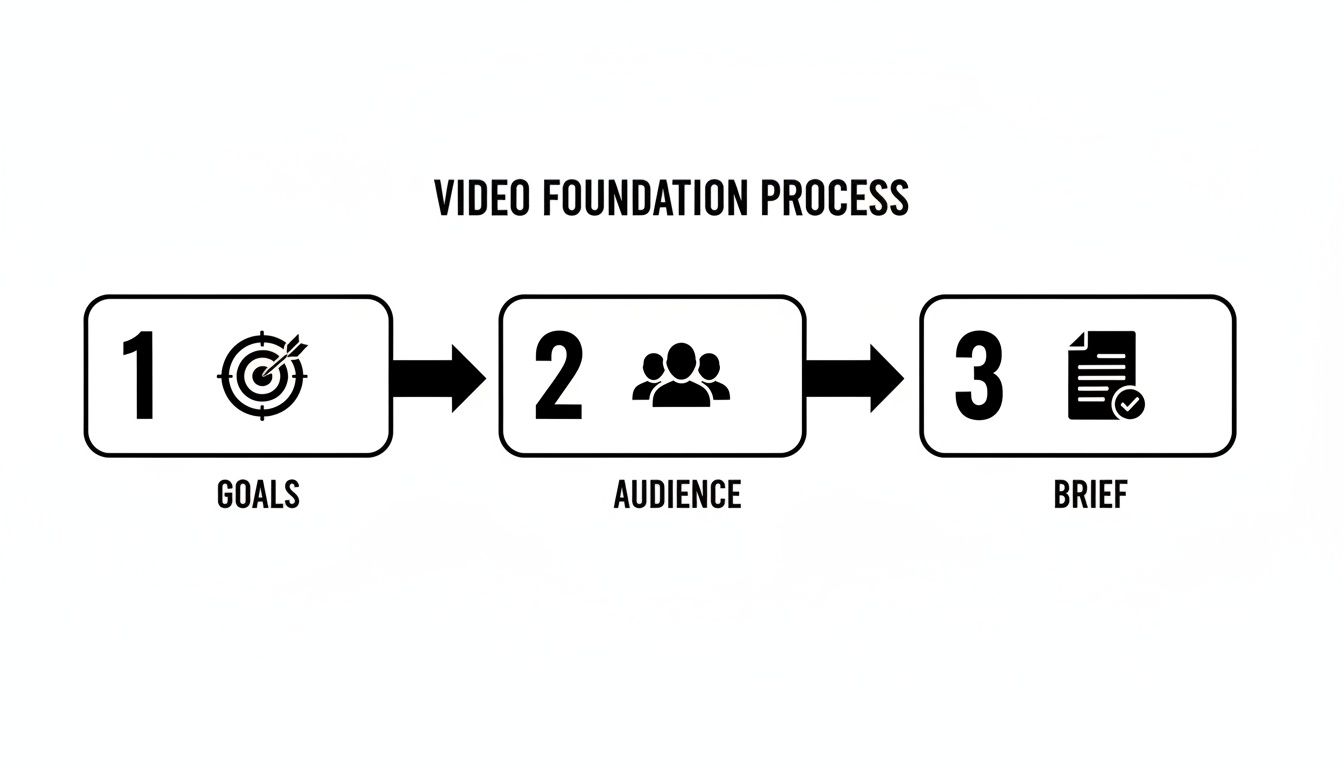
This simple flow is a great reminder that a powerful video isn't an accident. It's built on a clear path from strategy to a detailed brief, which then points you directly to the best animation style for the job.
A Look at Common Animation Styles
You've got a whole spectrum of animation options out there, but for most businesses, the decision usually comes down to a few core styles. Each one brings its own unique strengths, production needs, and ideal use cases to the table. Getting to know these differences is what will empower you to make a smart choice that fits both your budget and your business objectives.
Let's break down some of the most popular and effective styles we see in business communication today.
- 2D Motion Graphics: This is the absolute workhorse of corporate video. It brings shapes, text, and icons to life to create clean, dynamic visuals. It's fantastic for explaining processes, visualising data, or making abstract concepts tangible. We love it because it’s versatile, cost-effective, and a go-to for B2B explainer videos.
- 3D Technical Animation: When you absolutely need to show a product from every angle, reveal its internal mechanics, or simulate a physical process, nothing beats 3D. It provides a level of realism and detail that’s non-negotiable for sectors like engineering, medicine, and manufacturing.
- Whiteboard Animation: This style mimics a hand sketching out illustrations on a whiteboard. It has a natural, teacher-like feel that’s incredibly effective for tutorials and step-by-step guides. It keeps viewers hooked by constantly revealing what’s coming next.
- Character Animation (2D or 3D): Want to add a human touch? Bring in a character. This style is perfect for telling stories, sharing your brand's journey, or for things like HR videos where building empathy and making the content relatable is the main goal.
If you’re keen to explore these and other options in more detail, have a look at the different types of animation for business videos to see what clicks with your brand.
Animation Style Selection Guide
Choosing the right style can feel overwhelming. To make it easier, we've put together this quick-reference table. It breaks down the most common styles to help you see, at a glance, which one might be the best fit for your project.
| Animation Style | Best For | Typical Budget Range | Complexity Level | Example Use Case |
|---|---|---|---|---|
| 2D Motion Graphics | Explaining services, data visualisation, SaaS demos | ££ | Low to Medium | A fintech company explaining its investment platform. |
| 3D Technical Animation | Product visualisation, machinery demos, medical procedures | ££££ | High | An engineering firm showcasing a new engine design. |
| Whiteboard Animation | Educational content, tutorials, simplifying complex topics | £ | Low | An online course breaking down a historical event. |
| 2D Character Animation | Storytelling, brand videos, internal communications | £££ | Medium | A non-profit sharing a powerful personal story. |
| 3D Character Animation | Cinematic ads, brand mascots, high-impact campaigns | £££££ | Very High | A major brand's primetime television commercial. |
This table is a starting point. The best choice always comes from a deep understanding of your specific goals, audience, and the story you need to tell.
Matching the Style to Your Goal and Audience
The best animation style isn't just about looking good—it's about doing a job. Your final choice should be a direct reflection of your message and the people you're trying to reach. A mismatch can leave viewers confused or, even worse, damage your credibility.
Just think about these scenarios:
- Your Goal: Explain a SaaS platform to new users. A clean motion graphics video, perhaps with screen recordings, is the perfect fit. It's direct, clear, and keeps the focus squarely on the user interface.
- Your Goal: Showcase a new medical device to a room full of surgeons. There's no other choice but a highly detailed and accurate 3D technical animation. It communicates precision, expertise, and trustworthiness.
- Your Goal: Announce a new company-wide benefits programme to employees. A friendly 2D character animation can make dense information feel approachable and less "corporate," boosting engagement.
The most effective animation style is the one that feels invisible. It shouldn’t distract from the message but elevate it, making complex information feel intuitive and engaging for the person watching.
We're seeing just how crucial this alignment is, especially in specialised sectors. For example, recent trends in Poland’s tech and B2B industries show that animated explainers are no longer a "nice-to-have" but a core marketing asset. Data from ExplainVisually, a Warsaw-based studio, shows that B2B companies using animation in their sales and training materials see an average 25% bump in engagement and 20% higher message retention. Their work with Polish fintechs also revealed that animated explainers on landing pages can increase conversions by 15–30%, particularly for videos under 90 seconds. This data makes it crystal clear: a strategic choice in animation has a direct and measurable impact on your bottom line.
Getting Your Animated Video Seen by the Right People

So, you’ve created a stunning animated video. That’s a huge achievement, but it's only half the battle. An amazing asset that nobody ever sees has an ROI of exactly zero. This is where effective distribution becomes the critical link, turning a creative piece into a genuine marketing powerhouse. It's time to move beyond the old "upload and pray" approach and start thinking like a strategist.
The goal is simple: get your video in front of the right eyeballs at the right time. This means digging into where your audience actually spends their time online and tailoring your content to fit the unique environment of each platform. A one-size-fits-all distribution plan just won’t cut it anymore.
Optimise for Every Platform
Each social platform has its own unwritten rules of engagement. A video that absolutely crushes it on LinkedIn might fall completely flat on Instagram. Real success comes from customising your animated video for each channel’s specific audience and, just as importantly, its technical requirements.
You need to get the fundamentals right for each key platform your audience uses:
- Your Website: This is your home turf, so make it count. Embed your video on relevant pages—the homepage, a key product page, or a dedicated landing page—using a professional player like Wistia or Vimeo to unlock advanced analytics. Stick to the standard 16:9 aspect ratio here.
- LinkedIn: For a professional B2B crowd, a square (1:1) or vertical (4:5) format is your best bet for the mobile feed. Always include burnt-in captions, as most users browse with the sound off. The tone should be professional, with a message laser-focused on business value.
- Meta (Facebook & Instagram): These platforms are visual, fast-paced, and noisy. Vertical video (9:16 for Reels and Stories) is non-negotiable. Your first three seconds are absolutely everything, so lead with your most compelling visual hook to stop the scroll.
- YouTube: Think of it as a search engine, but for video. SEO is your friend here. Optimise your title, description, and tags with relevant keywords. A strong, custom thumbnail can make a massive difference to your click-through rate.
Your video's distribution plan shouldn't be an afterthought; it should be baked into the creative brief from the very beginning. Knowing a video is destined for Instagram Stories informs animation choices differently than one designed for a trade show booth.
Blend Organic and Paid Strategies
A truly robust animated video marketing strategy combines the slow burn of organic reach with the immediate impact of paid amplification. Organic tactics build a long-term foundation of trust and authority, while paid advertising gives you a direct, scalable way to reach new, highly targeted audiences.
Just look at how Poland has become one of Central Europe’s most video-savvy markets. Between 2019 and 2023, online video ad spend in the country more than doubled, hitting approximately 1.64 billion PLN. This explosion is driven by brand campaigns on YouTube and Meta, where animated formats are hugely popular for their cost-effective localisation.
Of course, to give your videos the best chance of being seen, exploring proven ways to increase organic traffic is a must.
Repurpose a Single Animation into a Full Campaign
One of the biggest advantages of animation is its incredible versatility. That single, two-minute explainer video you produced isn’t just one asset; it’s a goldmine of content waiting to be sliced, diced, and repurposed. This approach dramatically extends the life and impact of your initial investment.
From one primary video, you can easily spin out a dozen micro-assets for different stages of the marketing funnel. This is a core part of an efficient animated video marketing strategy for businesses.
How to Repurpose Your Master Video:
- Create Short Social Media Clips: Pull out punchy 15-30 second clips that highlight a key feature or benefit. These are perfect for social ads or organic posts.
- Export High-Quality GIFs: Turn a visually engaging loop into a GIF to use in emails or social media replies, adding a touch of dynamic movement.
- Design Static Image Thumbnails: Grab high-impact frames from the video to create compelling thumbnails or social media graphics that keep your branding consistent.
- Embed in Email Nurture Sequences: Break down the video's core messages and embed short clips into a series of emails to educate and nurture leads over time.
By atomising your content like this, you create a cohesive campaign that reinforces your message across multiple touchpoints. If grabbing attention in crowded social feeds is a priority, it's also worth seeing what a specialised motion graphics agency for social media ads can bring to the table. This kind of strategic repurposing ensures you get maximum value from every single second of animation you produce.
Measuring Performance and Optimising for ROI
Getting your animated video out into the world is a fantastic milestone, but it’s really just the beginning of the journey. A truly successful animated video marketing strategy is built on solid data, not just hopeful assumptions. This is the part where we connect all that creative work back to real business results and show the true value of your investment.
Without proper measurement, you’re flying blind. By keeping an eye on the right metrics, you can figure out exactly what’s hitting the mark, what isn't, and how to make your next video even more powerful. This turns a single project into a repeatable, high-performing asset in your marketing toolkit.
Identifying the Metrics That Matter
It's easy to get caught up in "vanity metrics" like the total number of views. While they might feel good, they don't paint the full picture. To really understand performance, you need to dive into data that shows engagement and action—metrics that link directly back to the goals you laid out in your creative brief.
The specific Key Performance Indicators (KPIs) you’ll want to track will naturally change depending on where you host your video and what you're trying to achieve.
- Audience Retention: This is probably the most critical metric of them all. Platforms like YouTube and Wistia give you a graph that shows the exact moment viewers start to drop off. A big dip in the first 10 seconds? That could mean your intro isn’t grabbing them. A sudden drop during a key feature explanation? Perhaps that section was a bit confusing or dragged on too long.
- View-Through Rate (VTR): This is especially important for paid ads. It tells you the percentage of people who watched your entire video (or at least a significant chunk of it). A high VTR is a strong signal that your content is compelling and well-matched to the audience you're targeting.
- Click-Through Rate (CTR): This one’s straightforward—it measures how many people clicked on your call-to-action (CTA). If you have great retention but a low CTR, it could be a sign that your CTA is unclear, badly timed, or just isn't compelling enough.
- On-Page Conversions: If your video lives on a landing page, this is the ultimate test. Are more people filling out that demo form or adding a product to their basket after watching? This metric draws a direct line from your video to your return on investment.
The real aim isn't just to see if people watched, but to understand how they watched. The data from your video hosting platform is a treasure map, showing you exactly where your message is connecting and where it's losing steam.
Using Platform Analytics to Gather Insights
Most professional video platforms come with a powerful suite of analytics tools. It’s easy to feel overwhelmed by all the dashboards and charts, so just focus on finding insights you can actually act on.
For example, if you embed a video on your site using Wistia, you get access to incredibly detailed heatmaps. These visuals show you which parts of the video people re-watched, which parts they skipped, and exactly where they stopped watching. If you notice a lot of re-watches around a specific product feature, that’s a clear sign it's either very interesting or maybe a little confusing—either way, it might be worth creating more content about it.
Over on YouTube Analytics, the "Audience" tab is an absolute goldmine. It can tell you about your viewers' demographics, what other channels they follow, and even what time of day they’re most active. Let's say you discover a huge chunk of your audience is in a country you weren't expecting—that’s a perfect opportunity to think about localising your content with subtitles or a fresh voiceover.
Continuously Improve Through A/B Testing
Data is only useful when you use it to make better decisions. A/B testing is a simple, methodical way to improve your video's performance over time by testing just one variable at a time. It's how you turn good results into great ones.
You don't need to re-animate the whole video. Start with small, high-impact changes that are easy to implement.
- Test Your Thumbnails: Come up with two different thumbnail images. One could feature a friendly character from your video, and the other might highlight a key statistic. Let them run for a week and see which one gets a better click-through rate.
- Experiment with CTAs: Try tweaking the wording or the placement of your call-to-action. Does “Schedule a Demo” work better than “See It in Action”? Sometimes, just moving the CTA button a bit earlier can capture viewers before they have a chance to drop off.
- Vary Your Video Titles: On platforms like YouTube, the title is hugely important for discovery. You could test a benefit-focused title like "How to Save 10 Hours a Week" against a more direct, feature-based one such as "Our New Automation Feature Explained."
By testing methodically and looking at the results, you stop making guesses and start building a real, data-driven understanding of what your audience wants. This cycle of measuring, learning, and optimising is what separates a one-hit wonder from a long-term, high-ROI animated video strategy.
Finding the Right Animation Production Partner
Choosing an animation studio is easily one of the most important decisions you’ll make for your project. The right partner does so much more than just animate; they become a strategic collaborator, someone who can take your initial concept, elevate it, and make sure it perfectly aligns with your business goals. This final step is all about making that choice with total confidence.
It's easy to get wowed by a flashy showreel, but you've got to look deeper than that. The best partnerships are built on a shared strategic understanding. A great studio will dig in with probing questions about your audience, your goals, and your distribution plan long before they ever talk about a single keyframe.
Vetting Potential Studios
When you start looking at potential partners, go beyond their portfolio and really examine their process. A transparent, well-defined workflow is a huge sign that you’re dealing with a professional team that can deliver on time and stick to the budget.
Here are a few critical questions you should ask any studio you're considering:
- What does your typical production process look like? Ask them to walk you through it, step-by-step, from the creative brief all the way to final delivery.
- How do you handle client feedback and revisions? You need to know how many rounds of revisions are included at each stage (like the script, storyboard, and animation phases).
- Who will be my main point of contact? Clear communication is everything. A dedicated project manager is a massive plus.
- How will you make sure the final video aligns with our marketing objectives? Their answer here will tell you if they think like marketers or just artists.
The difference between a simple vendor and a true strategic partner is their willingness to challenge your ideas. A good partner won't just take your order; they will offer insights and suggestions to make the final video more effective.
From Vendor to Collaborator
Ultimately, the goal is to find a team that feels like an extension of your own. They should be just as invested in the success of your animated video marketing strategy for businesses as you are. That collaborative spirit is what turns a good video into a great one—an asset that not only looks incredible but also drives real business results.
Finding a partner who truly understands the nuances of different animation styles is key. For instance, if you need a clear, compelling way to simplify a complex topic, working with a specialised explainer video agency can make all the difference. They bring a focused expertise that guarantees your message lands with clarity and impact. This thoughtful selection process will set you up to find a reliable studio that will guide you, collaborate with you, and ultimately help you smash your goals.
Your Questions Answered
What’s the Right Length for an Animated Marketing Video?
This is a question we get all the time, and the honest answer is: it depends on where people will see it. For most general-purpose videos, like an explainer on your website, the sweet spot is between 60 and 90 seconds. That’s just enough time to get your main point across without your audience's attention starting to drift.
But when you’re thinking about social media feeds, like LinkedIn or Instagram, you have to be much quicker. You're competing for attention with a million other things. Here, you'll want to aim for snappy, scroll-stopping clips of 15 to 30 seconds that land a single, memorable punch.
What Does an Animated Video Actually Cost?
The price of an animated video can vary quite a bit, and it really comes down to a few key things:
- Style and Complexity: A straightforward 2D motion graphics video is going to be a lot more budget-friendly than, say, a highly detailed 3D technical animation that shows the inner workings of a complex machine.
- Length: It's simple maths—longer videos mean more time in the studio for our animators and designers.
- Production Partner: You'll see a wide range of quotes. A freelancer will have different rates than a boutique studio like ours, which in turn will differ from a large, full-service agency.
As a rough guide, a solid, professionally made animated video might start from a few thousand pounds. On the other end, complex, high-end productions can easily run into the tens of thousands. The most important thing is to get a detailed quote that breaks down exactly what you're paying for before you sign anything.
Can I Just Make an Animated Video Myself?
There are certainly more DIY animation tools available now than ever before. However, turning out a video that looks truly professional requires a deep set of skills—scriptwriting, storyboarding, illustration, sound design, and, of course, animation. A polished animated video marketing strategy for businesses depends on quality to build trust and credibility with your audience.
For most businesses, working with a professional studio or a seasoned freelancer isn't just a cost; it's an investment. It guarantees a final product that not only looks great but is built to achieve your business goals, and it frees you from a steep learning curve that takes you away from what you do best.
Ready to build an animated video marketing strategy that delivers real results? The team at Simple Frame specialises in creating high-quality, strategic animations that help businesses explain complex ideas and achieve their marketing goals. Learn more about our animation services and start your project today.
 English
  Polish
  German