
Animated Brand Video: Master an animated brand video to Captivate Audiences
So, what exactly is an animated brand video? Think of it as a short, dynamic piece of visual storytelling that uses animation to introduce your company, explain what you do, or share the values that drive you. It’s much more than a cartoon; it’s a carefully crafted marketing tool designed to simplify complex ideas and forge a real, emotional connection with your audience in a way that static text or images just can’t.
Why Your Brand Needs an Animated Video

In today’s flood of digital content, grabbing and holding someone’s attention feels like a monumental task. This is where an animated brand video becomes your secret weapon, cutting through the endless noise with vibrant visuals and stories that stick.
Animation offers a creative freedom that live-action often can’t match. Need to show the inner workings of an abstract piece of software? Animation can bring that interface to life. Want to tell your company’s origin story? You can transport viewers back in time without needing expensive sets or actors. It’s this incredible flexibility that makes it such a powerful medium.
Simplify the Complex and Boost Engagement
It’s a well-known fact that our brains process visuals 60,000 times faster than text. Animation leans into this perfectly. By blending moving images, sound, and a little bit of text, an animated video can break down even the most complicated topics into messages that are easy to digest and hard to forget.
Here’s where it really shines:
- Clarifies Your Message: Animation makes abstract concepts tangible, helping potential customers instantly grasp what your product or service is all about.
- Increases Retention: People are far more likely to remember a message wrapped in an engaging story than one they skimmed in a block of text.
- Evokes Emotion: With the right characters, colours, and music, you can craft a specific mood that builds a much stronger, more personal bond with your brand.
An animated brand video isn’t just an explainer—it’s a core brand-building asset. It helps define your company’s personality, communicates your purpose, and leaves a lasting impression that drives action and builds loyalty.
Animated Video vs Live-Action Video at a Glance
Choosing between animation and live-action isn’t always straightforward; each has its unique strengths. Animation excels at simplifying abstract ideas and creating unique visual worlds, while live-action is fantastic for building human connection and showcasing physical products.
Here’s a quick comparison to help you see where each one shines:
| Feature | Animated Brand Video | Live-Action Video |
|---|---|---|
| Best For | Explaining complex or abstract concepts, services, and software. | Building trust through testimonials, interviews, and showing real-world products. |
| Visual Style | Limitless creativity; can create any world, character, or style. | Grounded in reality; authenticity is key. |
| Flexibility | Easily updated to reflect branding changes or new features. | Re-shoots can be costly and time-consuming. |
| Cost Factors | Based on animation complexity, style, and length. | Dependent on location, actors, crew, and equipment. |
Ultimately, the best choice depends entirely on your message, your audience, and what you want to achieve. Both are powerful tools in a modern marketing toolkit.
A Growing Industry with Proven Impact
The demand for high-quality animation is absolutely booming, and it’s turning Poland into a major creative hub in Europe. The Film, Video & Television Programme Post-Production industry here now includes 1,597 businesses, and it’s been growing at a solid 6.8% each year between 2020 and 2025. This isn’t just a trend; it shows how much businesses are relying on animation to hit their goals.
Deciding to create an animated brand video is a strategic move. It gives you complete control over every single pixel of your story, making sure your message lands exactly how you intend it to. If you’re looking for more ideas on bringing video into your strategy, check out our comprehensive guide on marketing with video. It’s an essential tool for any modern brand wanting to make a genuine connection.
Choosing the Right Animation Style for Your Story
Picking the right animation style for your brand video is a lot like an author choosing the perfect illustration style for a book. The technique you settle on doesn’t just change how the story looks; it completely shifts how it feels and how well the message lands with your audience. Each style has its own unique personality and is better suited for certain types of storytelling.
Understanding these differences is the key to creating an animated brand video that not only looks brilliant but also nails your specific business goals. You don’t need to be an animation expert to make a smart choice. Just by thinking about your core message and who you’re talking to, you can zero in on the style that will truly bring your vision to life.
2D Animation: The Digital Storybook
Think of 2D animation as a classic, character-driven storybook that’s been given motion. It works on a flat plane, using height and width to create worlds filled with charm and personality. This style is incredibly versatile, making it perfect for telling engaging stories, forging emotional connections, and breaking down complex ideas with relatable characters.
Because it’s so adaptable, 2D animation is a popular choice for:
- Brand Origin Stories: Its natural storytelling ability makes it ideal for sharing your company’s journey in a way people will remember.
- Character-Driven Explainers: Adding a friendly character can make even the most technical product feel human and easy to approach.
- Emotional Campaigns: The artistic freedom of 2D allows for a huge range of emotional expression, from heartwarming moments to laugh-out-loud humour.
A fintech company, for instance, could use a simple 2D character to walk a new user through their app. This approach turns a potentially dry tutorial into a friendly, engaging experience, helping customers retain information and build a positive feeling about the brand.
3D Animation: Creating Immersive Worlds
If 2D animation is a storybook, then 3D animation is a fully realised, interactive world you can step into. By adding the third dimension—depth—3D creates a sense of realism and tangibility that’s simply unmatched. This style is perfect for showcasing physical products, visualising complex machinery, or creating a high-impact, cinematic feel that demands attention.
The real power of 3D animation lies in its ability to make the abstract feel completely real. It can spin a product 360 degrees, fly you through the inner workings of an engine, or build an entire architectural visualisation before a single brick has been laid.
This makes 3D the go-to choice when you need to demonstrate something with absolute precision and detail. A medical device company, for example, could use 3D animation to show surgeons exactly how a new instrument works, providing a level of clarity that live-action footage could never achieve. It transforms a complex explanation into a crystal-clear visual demonstration.
Motion Graphics: The Dynamic Infographic
Motion graphics are the masters of making information move. This style isn’t about character-based stories; instead, it focuses on animating text, shapes, logos, and icons. Think of it as a dynamic, living infographic that can turn dry data and abstract concepts into clean, compelling, and incredibly easy-to-understand visuals.
Its clean, modern aesthetic makes it a favourite for corporate communications and tech explainers. Motion graphics are brilliant for:
- Visualising statistics and data.
- Explaining processes or service workflows.
- Adding a professional polish to corporate videos.
A software company, for example, could use sleek motion graphics to illustrate how its platform streamlines a customer’s workflow. Using animated icons and flowing text to highlight key features is far more engaging than a static diagram ever could be. For a deeper dive into these options, our guide explores the various types of animation in more detail, helping you find the perfect match for your project.
Your Animated Video Production Roadmap
Turning a great idea into a polished animated video isn’t magic; it’s a structured journey. Think of it as a collaborative roadmap that takes your vision from a simple concept to a final, engaging asset ready to share with the world. Understanding these phases demystifies the whole process, making it clear what we need from you and what you can expect from us at every step.
This roadmap is all about ensuring a smooth, predictable partnership. Each phase builds on the last, which helps prevent costly revisions down the line and keeps the project laser-focused on your goals from day one.
Phase 1: Pre-Production and Creative Development
This is the foundation. Every great animated video starts here. Pre-production is where we nail down the strategy, planning, and creative direction. It’s our chance to translate your business goals into a compelling visual story, making sure the final video doesn’t just look amazing but also gets results.
The key steps in this phase are:
- Creative Brief: This is the project’s north star. A detailed brief outlines your goals, target audience, key message, and brand guidelines. The more we know, the better the outcome.
- Concept & Scriptwriting: Using the brief as our guide, we develop the core creative idea and write the script. This isn’t just dialogue; it outlines the voiceover, on-screen text, and visual cues, acting as the blueprint for the entire video.
- Storyboarding: With an approved script, we move to the storyboard. This is essentially a comic-book version of your video, a sequence of sketches that maps out each scene. For animation, creating a storyboard for your animated video is a crucial planning step that brings the script to life and locks in the visual direction before a single frame is animated.
Phase 2: Design and Asset Creation
Once we have a solid blueprint, we get to the fun part: design. This is where the visual personality of your animated video really emerges. Our artists craft the unique look and feel that will define your story, making sure every single element is on-brand and visually striking.
Here’s what happens during this stage:
- Style Frames: These are high-quality, fully designed stills from key moments in the storyboard. They establish the final colour palette, illustration style, and overall vibe of the video before we commit to animating the whole thing.
- Asset Creation: After you’ve signed off on the style frames, our team designs all the individual visual elements needed. This includes characters, backgrounds, icons, typography—everything that will appear on screen.
The image below shows how the production path can differ depending on the chosen animation style.
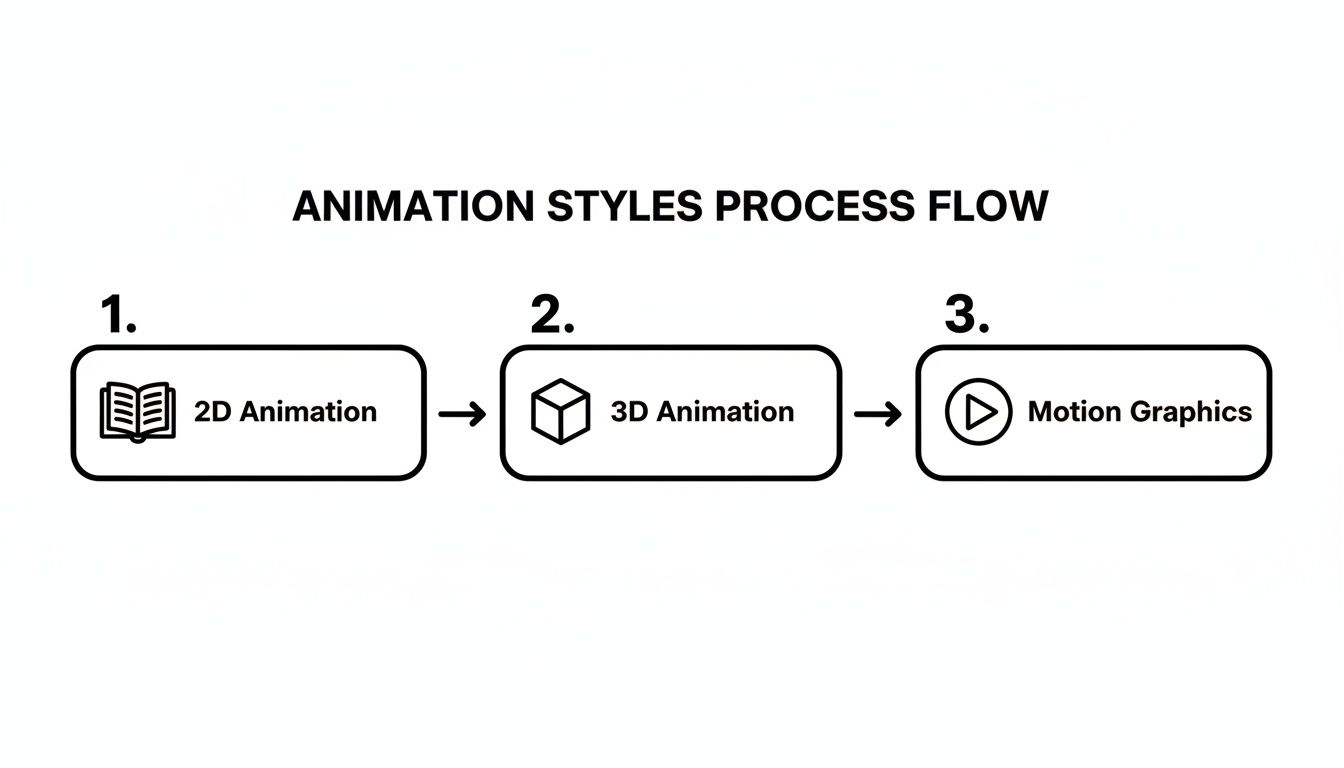
Whether we’re building a charming 2D world, an immersive 3D environment, or a sleek motion graphics sequence, this visual guide highlights how the workflow adapts to the medium.
Phase 3: Production and Animation
This is where your video truly comes to life. The production phase takes all the approved assets and carefully laid plans and puts them into motion. It’s a meticulous process that combines technical skill with artistic flair to create the fluid movement that grabs and holds an audience’s attention.
Every frame is a deliberate choice. The animation process is where timing, movement, and emotion converge to transform static designs into a dynamic story that connects with viewers.
This stage involves a few things happening at once:
- Voiceover Recording: We bring in professional voice artists to record the script, making sure the tone and delivery perfectly match the mood of the video.
- Animation: Our animators get to work, taking the design assets and bringing them to life according to the storyboard and script. This is often the most time-consuming part of the project, requiring incredible precision and creativity. To see how all these pieces fit together, our guide on the complete animation production pipeline offers a much deeper look.
Phase 4: Post-Production and Final Delivery
The final stretch is all about adding the polish. Post-production is where we add the finishing touches that elevate a great animation into an exceptional one. This stage is dedicated to making sure every element works together harmoniously for a powerful and immersive experience.
The last few steps are:
- Sound Design & Music: We add a custom-selected music track and sound effects (SFX) to amplify the visuals and stir the right emotions. Sound is a powerful tool for setting the pace and making the video more engaging.
- Review & Revisions: We’ll share a near-final version of the video for your feedback. This is your chance to request any minor tweaks to get everything just right.
- Final Render & Delivery: Once you give the final approval, we render the video file in all the formats you need—for your website, social media, or anywhere else. Your animated brand video is now ready to captivate your audience.
Decoding Animation Costs and Timelines
Two questions always come up first when a client is thinking about an animated brand video: how much will it cost, and how long will it take? There’s no simple, one-size-fits-all answer. The final budget and timeline really depend on three key things: the style, how complex it is, and how long you want it to be. Getting your head around these variables is the first step to setting realistic expectations.
Think of it like commissioning a painting. A simple watercolour sketch is naturally going to be quicker and less expensive than a huge, detailed oil painting. Animation works exactly the same way. A short, minimalist motion graphics video just doesn’t require the same investment as a full 3D character animation with custom environments and intricate movements.
Every little detail we add, from designing a unique character to crafting those smooth, seamless scene transitions, adds to the production time. That’s why having a clear vision right from the start is so important—it helps us scope the work properly and give you a transparent breakdown of where every part of your investment is going.
Breaking Down the Budget
The cost of an animated brand video is a direct reflection of the creative talent and pure hours needed to bring your idea to life. A bigger budget doesn’t just mean a fancier video; it means more time for our artists to refine the story, perfect every movement, and create a truly polished final piece that really stands out.
Here’s a look at what typically shapes the final price tag:
- Animation Style: 3D animation is generally more resource-intensive than 2D. That’s down to the sheer complexity of modelling, texturing, and rendering everything in three dimensions.
- Complexity & Detail: Custom characters, detailed backgrounds, and fluid, lifelike movements all demand more specialised skills and, of course, more time.
- Video Length: It makes sense that a longer video requires more hours of animation, sound design, and project management. For many brands, a 60-second video is a great starting point.
A well-defined budget empowers the creative process. It sets clear parameters, allowing the production team to focus on maximising quality and impact within the agreed scope, ensuring there are no surprises along the way.
The Polish animation market offers a fantastic blend of world-class quality and really competitive pricing. Studios here are leading the charge in creating brilliant animated brand videos, with reviewers often praising their professionalism and creativity. For this kind of work, average project costs range from $10,000 to $49,000, which makes high-quality animation accessible. You can discover more insights about Poland’s leading video production agencies on clutch.co.
Mapping Out the Production Timeline
Just like the budget, the production timeline is tailored to what the project actually needs. A straightforward 60-second 2D motion graphics video might take around 4-6 weeks from the initial brief to the final delivery. This gives us enough time for scriptwriting, storyboarding, design, animation, and revisions without rushing the creative flow.
For more involved projects, like a 90-second video with custom 2D characters or a detailed 3D product visualisation, the timeline usually stretches to 8-12 weeks or even more. This longer timeframe accounts for the extra steps involved, like character rigging, 3D modelling, and the more intensive rendering times that come with that level of detail.
Here’s a general guide to what you can expect:
| Project Scope | Typical Timeline | Best For |
|---|---|---|
| Simple Motion Graphics (60s) | 4–6 Weeks | Explaining simple concepts, social media ads, or data visualisation. |
| Standard 2D Animation (60-90s) | 6–10 Weeks | Character-driven explainers, brand stories, and engaging tutorials. |
| Complex 3D Animation (60-90s) | 10–14+ Weeks | High-impact product showcases, technical visualisations, and cinematic ads. |
This structured approach makes sure every phase of the project gets the attention it deserves. When you work with an experienced explainer video agency, you get a partner who can expertly guide you through this timeline, keeping everything on track and delivering something exceptional. A bit of planning ahead is the key to a smooth and successful launch.
How to Write a Brief That Inspires Great Animation
A truly great animated brand video doesn’t just happen by accident. It’s born from a clear vision that’s perfectly understood and executed by a creative team. The bridge connecting that initial idea to the final product? The creative brief. Think of it as the project’s DNA—a detailed map that lays out every vital element, making sure everyone is on the same page from day one.
Without a solid brief, even the most talented animators are essentially flying blind. A well-thought-out brief, on the other hand, cuts through the noise, minimises the need for costly revisions, and gives the creative team the clarity they need to do their best work. It’s easily the single most important document you’ll create for the entire project.
To get your animated video project started on the right foot, understanding how to write a creative brief is essential. It’s what turns your abstract ideas into a concrete, actionable plan.
Core Components of an Effective Brief
Your brief needs to be a comprehensive guide that answers all the big questions an agency might have. It’s all about providing context, setting clear boundaries, and defining what a successful outcome actually looks like.
Here are the absolute essentials to include:
- Your Core Objectives: What’s the main goal here? Are you looking to build brand awareness, generate new leads, explain a tricky product, or directly drive sales? Be specific. Instead of “more leads,” aim for something like, “Increase demo sign-ups by 15%.”
- Target Audience Profile: Who are you trying to reach? Go deeper than just basic demographics. What are their pain points? What motivates them? What do they genuinely care about? The more detailed you can be, the better the team can tailor the message and style.
- Key Messages: If your audience could only remember one thing after watching, what would it be? Nail down your single primary message first, then list any secondary points. But keep it tight—overloading the video with too many ideas will just water down its impact.
Defining the Creative Vision
This is the part of the brief where you steer the aesthetic and emotional tone of the video. The goal is to get everyone aligned on a creative direction early on, which saves a massive amount of time down the line. It’s less about dictating every tiny detail and more about providing clear, inspiring direction.
Often, the most valuable part of a creative brief isn’t the words, but the examples you share. Showcasing videos you love—and just as importantly, those you don’t—is a powerful shortcut to helping us understand your taste and expectations.
To really nail down your vision, make sure you cover these points:
- Brand Guidelines: Send over your logo (in a vector format), your official colour palettes, fonts, and any other branding rules. Consistency is absolutely key to building brand recognition.
- Visual References: Share links to 2-3 animated videos that have the look, feel, or tone you’re aiming for. It’s crucial to explain what you like about each one. Is it the character design, the colour scheme, the pacing, or something else?
- Tone of Voice: How should the video feel? Should it be humorous, serious, inspirational, or technical? Use descriptive words like “playful and energetic” or “professional and trustworthy” to paint a clear picture.
By investing a little time upfront to create a thorough brief, you set your animated brand video project up for success. This ensures the final animation not only looks fantastic but, more importantly, achieves its strategic business goals.
Measuring the Real-World Impact of Your Video
Creating a brilliant animated brand video is a strategic investment, not just a creative line item on a budget. So, how do you prove its value? It’s tempting to focus on vanity metrics like total views, but real success lies in tracking Key Performance Indicators (KPIs) that connect directly back to your business goals.
Moving beyond those surface-level numbers helps you understand how your video actually influences what your audience does next. Whether you want to build brand awareness, generate qualified leads, or just make a complex topic simple, the right metrics paint a clear picture of your return on investment (ROI). This data-driven approach turns your animation from a one-off creative piece into a hard-working, measurable performance asset.
Aligning Metrics with Business Objectives
The first step is matching your KPIs to the video’s main purpose. A video designed to get your name out there will have completely different success metrics than one created to drive product demo sign-ups. Getting this alignment right from the start ensures you’re tracking data that actually gives you useful insights.
Let’s break down a few common goals and the KPIs that go with them:
- For Brand Awareness: The goal here is all about reach and recall. You want your brand to become more familiar to your target audience.
- Impressions and Reach: How many unique people actually saw your video?
- View-Through Rate (VTR): What percentage of viewers watched the whole thing? A high VTR is a great sign that your content is genuinely engaging.
- Audience Retention: Where are people dropping off? This data is gold for figuring out which parts of your story resonate the most.
- For Lead Generation: Now, the focus shifts to action. You need viewers to take that next step.
- Click-Through Rate (CTR): How many people clicked on your call-to-action (CTA)?
- Conversion Rate: Of those who clicked, what percentage completed the goal, like filling out a form or downloading a guide?
- Cost Per Lead (CPL): How much did it cost to get each new lead through this video campaign?
Tracking the right KPIs is about telling the full story of your video’s performance. It’s the difference between saying, “Our video got 100,000 views,” and saying, “Our video generated 300 qualified leads at a 20% lower cost than our other channels.”
Proving ROI with Strategic Distribution
A fantastic video is only effective if the right people see it. This is where a strategic distribution budget becomes every bit as important as the production cost itself. A well-planned promotional strategy can amplify your message and deliver a huge return on your initial investment.
The video advertising market in Poland is growing fast, with spending on short-form digital content expected to hit US$176.82 million in 2025. Here’s a practical example of how this plays out: investing 20,000 PLN in production and another 80,000 PLN in targeted distribution can generate up to 1.6 million complete views. This makes it a perfect strategy for brand awareness campaigns designed to run over several months. You can explore more data and find deeper insights by checking out these video advertising trends in Poland on wowmediametrics.com.
Beyond Marketing: The Unseen Value
The impact of an animated brand video often goes far beyond traditional marketing metrics. For instance, a clear and concise explainer video can have a direct, positive effect on your operational efficiency and customer happiness.
Think about these indirect benefits:
- Reduced Support Tickets: A great tutorial or FAQ video can answer common customer questions before they even ask, freeing up your support team for more complex issues.
- Improved Sales Enablement: Your sales team now has a powerful, consistent tool to explain your product’s value proposition during demos and meetings.
- Enhanced Onboarding: A well-crafted onboarding video helps new customers get comfortable with your product faster, leading to better adoption and less churn.
By tracking things like a decrease in support queries or gathering feedback from your sales team, you can demonstrate the video’s value across multiple departments. This holistic view gives you a much more accurate and compelling case for the true ROI of your animated brand video.
Frequently Asked Questions About Animated Brand Videos
Even with the best plan in place, a few practical questions always pop up when you’re diving into an animated brand video for the first time. Getting these sorted early on builds confidence and makes sure your project starts on the right foot. We’ve pulled together the most common queries we hear to give you some clear, straightforward answers.
Think of this as your cheat sheet for navigating the production process. It’ll help you set the right expectations from the get-go and give your creative partners exactly what they need to knock it out of the park.
How Long Should My Animated Brand Video Be?
There’s no magic number here—the perfect length is all about your goal and where the video will be seen. The platform itself and how much time your audience is willing to give you are your biggest clues.
If you’re trying to stop the scroll on social media, think short and punchy. You’ll want to aim for something under 60 seconds to grab attention fast. On the other hand, for a detailed explainer on your website’s landing page, where you already have a captive audience, you have more room to breathe. A video between 90 seconds and 3 minutes usually hits the sweet spot, giving you enough time to tell a great story without overstaying your welcome.
The golden rule? Be efficient. Get your message across as concisely as you can. When you respect your viewer’s time, they’re far more likely to stick around until the end.
Ultimately, your focus should be on telling a complete and satisfying story in the shortest time that feels right.
Can Animation Work for a Serious B2B Brand?
Absolutely. Animation isn’t just for cartoons; it’s an incredibly versatile medium. For serious B2B companies, a sophisticated motion graphics piece or a clean 2D animation can be a seriously powerful asset.
These styles are brilliant for:
- Explaining Complex Services: They can break down intricate software, dense financial products, or technical processes into simple, visual steps that anyone can follow.
- Visualising Data: You can turn boring spreadsheets and abstract numbers into dynamic charts and infographics that are actually interesting to look at.
- Boosting Credibility: A polished, professionally made animation sends a strong signal of quality and attention to detail, which helps reinforce your brand’s authority.
The style can be perfectly tailored to feel professional and elegant, slotting right into your established brand identity while making complex ideas accessible to a high-level audience.
What Do I Need to Give an Animation Studio?
To get the ball rolling, the single most important thing you can provide is a well-thought-out creative brief. This is the document where you’ll lay out your goals, who you’re trying to reach, and the key messages you need to communicate.
Alongside the brief, you’ll also need to hand over your official brand guidelines. This should include your logo in a vector format (like an .ai or .eps file), your brand’s exact colour codes, and any official fonts you use. It’s also incredibly helpful to share a few examples of videos you love—this helps everyone get on the same page creatively. From there, a good studio will guide you on any other bits and pieces they need as the project progresses.
Ready to bring your brand’s story to life with an animated video that truly connects? The team at Simple Frame specialises in creating high-quality animations that make complex ideas clear and compelling. Explore our animation services and start your project today.
 English
  Polish
  German