
Affordable 2D Animation Studio for Small Businesses: Budget-Friendly Guide
Finding a great, affordable 2D animation studio for small businesses isn’t the impossible task it once was. It's actually a smart, strategic move that can level the playing field. Professional animation delivers a powerful return on investment, making complex ideas simple and turning casual viewers into loyal customers—all without needing a blockbuster budget.
Why 2D Animation Is a Smart Move for Small Businesses
In a crowded market, small businesses need to grab attention and hold it. This is where 2D animation truly shines. It blends visual appeal with clear storytelling in a way that live-action video often struggles to match, especially when you're watching the bottom line. It’s an incredibly versatile medium that can break down complicated products or services into engaging, easy-to-understand content.
This unique ability to explain and entertain is what drives real results. An animated video can make your brand more memorable, give your social media a much-needed boost, and keep viewers watching longer. When a potential customer truly gets your value proposition in under 90 seconds, they’re far more likely to take the next step. Our own guide to marketing with video dives deeper into how this kind of dynamic content can completely reshape your outreach.
Simplifying Complex Ideas
Is your business built around a sophisticated piece of software or a service with a lot of moving parts? Trying to explain it with text alone can be a bit dry, but a 2D animation brings the whole concept to life. Using clever metaphors and crisp visuals, you can demonstrate processes and highlight benefits in a way that just clicks with your audience.
Boosting Brand Personality and Recall
Animation gives you complete creative freedom. You can build a world that perfectly mirrors your brand’s personality. Whether you want to come across as friendly, innovative, or rock-solid trustworthy, the right animation style communicates these traits far more powerfully than stock photos ever could. This unique visual identity helps your brand stick in people's minds.
For a small business, memorability is currency. 2D animation allows you to create a distinct visual language that sets you apart from larger competitors, making your brand instantly recognisable across different platforms.
Driving Growth in a Competitive Market
The demand for cost-effective visual content is growing fast. Take Poland, for example, where small and medium-sized enterprises (SMEs) make up a staggering 99.8% of all businesses. The animation market there is booming. The Poland 3D Animation and Motion Design Market—which is closely tied to 2D practices—is set to grow from USD 20.5 billion in 2025 to USD 52.0 billion by 2033.
This growth is being fuelled by SMEs looking for affordable marketing tools. 2D animation is a popular choice because it can be 30-50% less expensive than 3D. To see a common, real-world application of this trend, check out this ultimate guide to HTML5 banner animation, a format many businesses rely on.
Setting a Realistic Animation Budget and Scope
Figuring out a budget is usually the first—and most daunting—part of the journey for any small business looking to get into 2D animation. Animation pricing can feel like a black box, but it really boils down to a few key things. Once you get a handle on them, you'll be in a much better position to set a realistic budget and define a project that gets you the most bang for your buck.
The single biggest factor that drives the cost is time. More specifically, the animator's time. A more complex and longer video simply requires more hours to create. It makes sense, right? A punchy 30-second motion graphic with animated text and icons will always be cheaper than a 90-second explainer video with custom characters and intricate scene changes.
Deconstructing Animation Costs
To really get a clear picture, let's pull back the curtain on the main elements that shape the final price. Every single one of these adds another layer of work, which naturally nudges the budget.
- Animation Length: This one’s the most straightforward. A 60-second video is double the work of a 30-second one. Keeping your message tight and concise is probably the most powerful cost-control lever you can pull.
- Style Complexity: A clean, minimalist line-art style is far quicker to produce than a richly detailed animation filled with textures and fluid character movements.
- Character Design: Building a custom character from the ground up involves concept art, sketching, revisions, and rigging it for movement. If the budget is tight, opting for simpler, more abstract characters can be a smart move.
- Sound Design and Music: A professional voice-over and a custom-composed score will have a different price point than a licensed track from a royalty-free music library.
This flowchart shows how a good animation can grab a potential customer's attention and walk them all the way to a sale.
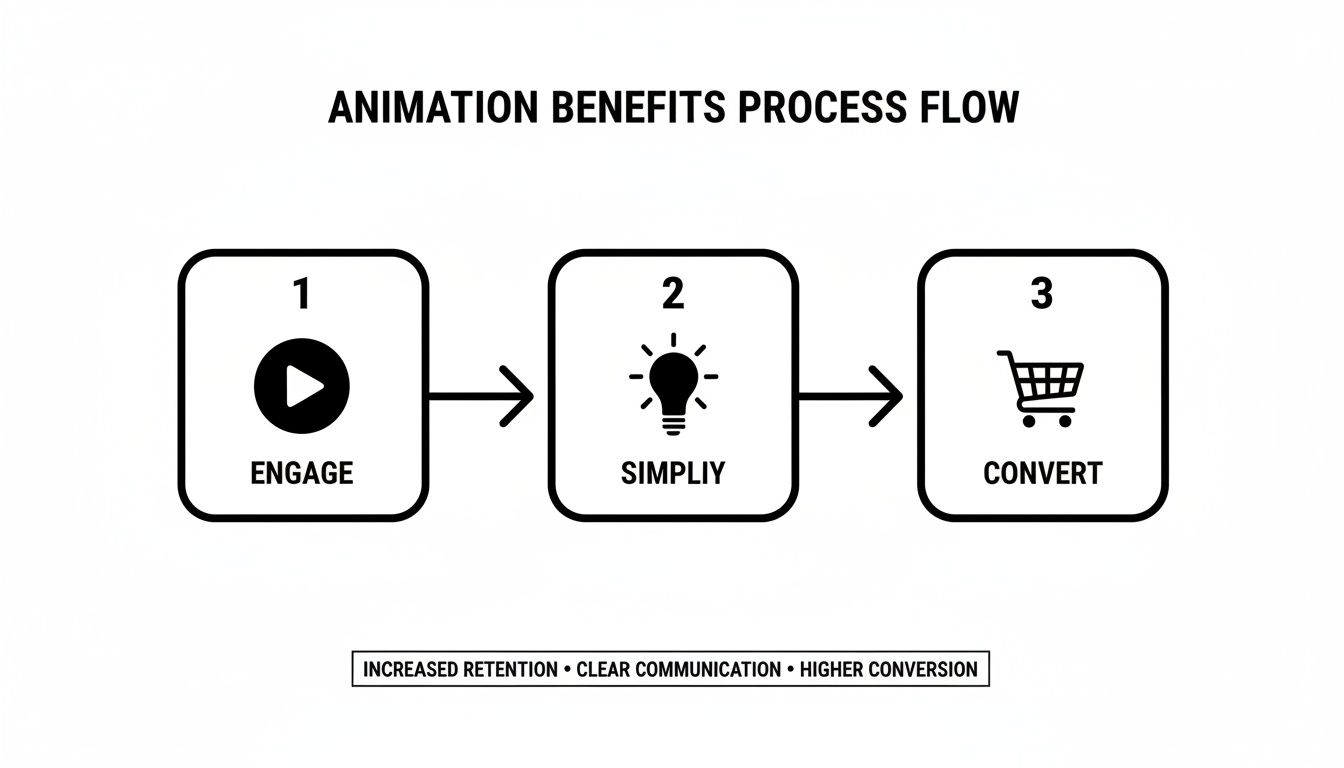
It’s a simple but powerful flow: you engage them, simplify your message, and make it easier for them to convert.
Understanding Budget Tiers
Knowing what different budget levels can get you is key to aligning your ambitions with what's actually possible. For most small businesses, animation projects tend to fall into a few common brackets.
A budget under £4,000 is typically a great fit for shorter, simpler animations. We're talking about 30-45 second videos that use kinetic text, basic motion graphics, or a straightforward icon-based style. This is a fantastic starting point for social media ads or quick overviews of your services.
When you move into the £4,000 to £8,000 range, your options open up quite a bit. This is often enough for a 60-90 second explainer video complete with custom illustrations, a simple character, and a professional voice-over. For many small businesses, this is the sweet spot for a high-quality video to put front and centre on their homepage. To see what this kind of investment can get you, it's worth learning more about what goes into a professional product explainer video.
By focusing on the core message and choosing a simpler visual style, you can produce a highly effective animation without overspending. The key is strategic 'scope control'—prioritising what truly matters to your audience and eliminating unnecessary frills that inflate the cost.
At the end of the day, just being open about your budget with a potential studio is the best way to go. An experienced team won't try to max it out; they'll guide you on how to best use your funds, often coming up with creative solutions that respect your bottom line while still delivering something you can be proud of.
Writing a Creative Brief That Gets Accurate Quotes
Think of your creative brief as the blueprint for your animation. If you try to build a house without one, you're asking for a wobbly foundation, surprise costs, and a final product that just doesn't feel right. For any affordable 2D animation studio for small businesses, a solid brief is the single most important thing you can give them. It cuts out the guesswork and lets them give you a sharp, competitive quote from day one.
This document doesn’t need to be a formal masterpiece, but it absolutely must be clear. It’s your opportunity to get the vision out of your head and onto paper in a way that animators can actually use. A great brief gets everyone speaking the same language, preventing those little misunderstandings that can spiral into expensive revisions later on.
Core Components of an Effective Brief
To get quotes you can actually trust, your brief needs to paint the full picture. Studios need this context to wrap their heads around the project's scope and complexity.
Start with the essentials:
- Project Goal: What, specifically, do you want this video to achieve? Is it about driving sign-ups on your website? Explaining a tricky new software feature? Or maybe just building some brand buzz on social media? Get specific.
- Target Audience: Who are you talking to? A video for tech-savvy millennials will feel completely different from one aimed at retired homeowners.
- Core Message: If your viewer only remembers one thing, what is it? Try to boil it down to one clear, powerful sentence.
- Call to Action (CTA): What’s the very next step you want the viewer to take? "Visit Our Website," "Download the App," or "Schedule a Demo" are all good examples.
Getting this clarity upfront is vital. It shapes every single creative decision, from the script to the visual style, and it’s a foundational piece of the entire animation production pipeline that studios rely on.
Providing Clear Creative Direction
This is where you steer the ship, visually and emotionally. Vague feedback like "make it look modern" is a recipe for disaster because it means something different to everyone. You need to provide concrete examples.
The best way to do this is to send links to two or three animations you absolutely love and, just as importantly, one or two that you really don't like. For each one, write a quick note explaining why. Maybe you love the fluid transitions in one video but can't stand the chunky character designs in another.
A great tip is to separate your 'must-haves' from your 'nice-to-haves.' This simple bit of prioritisation helps a studio understand where to focus their energy and how to build a quote that respects both your budget and your most important goals.
This gives the studio a direct look into your taste, which is far more useful than trying to describe a visual style with words. The more specific your examples, the more accurate the quotes will be.
The Polish animation scene is a perfect example of how technology is making top-tier production more accessible. The Poland Animation and VFX Design Software Market is forecast to hit USD 25.0 billion by 2033, with tools like Adobe Animate and Toon Boom slashing production costs by up to 35% in 2D workflows. This is a huge deal, as reports show 58% of Polish startups are already putting 10-15% of their marketing budgets into 2D videos, which can lift conversion rates by a staggering 80%.
How to Evaluate Studio Portfolios and Proposals
You've sent out your brief, and now the proposals are rolling in. This is where the real work begins. It’s easy to get caught up in the excitement of different creative concepts, but now's the time to put on your critical hat and properly vet each potential partner. Finding the right affordable 2D animation studio means looking past a flashy showreel to see the real substance in their work and process.
A portfolio is much more than just a collection of cool animations; it’s proof of what a studio can actually do. First, look for range. Can they adapt their style to different brands, or does every video have the same look and feel? A studio that can shift its tone from playful and fun to serious and corporate is far more likely to capture your unique voice.
Looking Beyond the Visuals
While a great aesthetic is a must, it's the storytelling that truly makes an impact. As you watch their past projects, ask yourself if the videos actually work.
- Is the message clear? After watching, do you have a crystal-clear understanding of the product or service being explained?
- How's the pacing? Does the story flow naturally, or are there moments that drag or feel rushed? A great animation guides your attention effortlessly.
- Does it connect emotionally? Can you feel anything when you watch it? Even a straightforward explainer video needs a personality that resonates with the people it’s made for.
Ultimately, you aren't just hiring an animator; you're looking for a communication expert. You need a team that understands how to use visuals to hit a business goal, not just create art for the sake of it.
Analysing the Proposal Details
Once you've sized up their creative chops, it's time to get into the nitty-gritty of the proposals. Remember, the lowest price tag doesn't automatically mean the best deal. A cheap quote might be hiding limitations that end up costing you more down the line.
A classic trap is glossing over the number of revision rounds included. A proposal with only one round leaves almost no room for feedback. You could get stuck with a video you don't love or face extra charges for every little tweak.
Compare what each proposal includes, side-by-side. Look for specific details on scriptwriting, storyboarding, voice-over artists, and music licensing. A thorough proposal that breaks down every stage of production is a sign of professionalism and transparency. That level of detail shows you're dealing with an organised partner who knows how to manage a project from start to finish. Our team at Simple Frame, as a professional explainer video agency, always lays out a clear project roadmap to make sure we're all on the same page from day one.
Poland's animation scene has exploded, offering incredible quality for the price. Fresh analysis from 2025 shows that Warsaw-based studios can offer rates up to 40% lower than their Western European counterparts, with a full 2D explainer video often landing between PLN 25,000-50,000. This doesn't mean a drop in quality, either. A PARP report from the same year found that 72% of Polish SMEs using animation saw a 35% jump in lead generation, proving just how powerful the return on investment can be. You can dive deeper into the top animation companies in Poland and see the impact they're making.
Smart Ways to Maximise Your Animation Budget
Finding an affordable 2D animation studio is a great start, but making every złoty count is where the real magic happens. With a bit of smart planning and a few insider strategies, you can stretch your budget much further than you'd imagine, ending up with a high-quality video without breaking the bank.
One of the most powerful moves you can make is planning for asset reuse right from the get-go. If you know you'll need a series of videos down the line, talk to your studio about creating a library of reusable assets—things like character models, unique backgrounds, and custom icons. There’s an upfront investment, sure, but it pays for itself many times over when your next videos can be produced faster and for a fraction of the cost.
Another incredibly simple yet effective approach? Go for a less complex design style. A minimalist aesthetic with clean lines and simple shapes can be just as powerful as a hyper-detailed one, but it takes significantly fewer hours to animate.
Proactive Cost-Saving Measures
Getting actively involved in the production process can shave a surprising amount off your final bill. Supplying your own assets is a classic way to trim the budget. For instance, if you've already got a professionally recorded voice-over or a subscription to a royalty-free music library, you can pull those costs right out of the studio's quote.
You can also look at how new tech can help during pre-production. To really get the most from your animation budget, you could explore efficient script-to-video AI solutions that can help visualise a written script, which can seriously cut down on time and expense.
Here's a free tip that saves real money: be decisive and organised during feedback rounds. Vague comments or changing your mind on core ideas late in the game means more work, which means more charges. Give clear, consolidated feedback at each stage to keep the project moving smoothly and on budget.
Strategic Hacks for Immediate Savings
If you need your budget to work harder right now, zero in on these three high-impact strategies. They are easy to implement and can make a genuine difference to your final invoice.
- Ask About Package Deals: Many studios will cut you a deal if you commit to several videos at once. If you’re planning a whole campaign’s worth of content, bundling the production could unlock a much better rate.
- Keep It Short and Sweet: Let's be honest, attention spans are short. A sharp, punchy 30-60 second video is often far more effective than a three-minute epic. It’s also significantly cheaper to produce, so this is a genuine win-win.
- Embrace Simplicity: It's easy to get carried away with flashy effects or intricate character animations, but if they don't actually serve the story, they're just adding to the cost. A clear message delivered with clean, simple visuals will always beat a confusing but elaborate video.
By weaving these tactics together, you can partner with an affordable 2D animation studio and create a video that not only looks brilliant but also represents a smart, strategic investment for your business. It’s all about working smarter, not just spending more.
Frequently Asked Questions About Finding an Animation Partner
Diving into the world of animation can feel a bit overwhelming, and you probably have a lot of questions, especially when you’re trying to make a smart investment. Here are some of the most common things small businesses ask when looking for an affordable 2D animation studio, along with some straight-to-the-point answers.
What’s the Real Minimum Budget for a Professional Animation?
This is the big one, and the honest answer is: it really depends. But to give you a solid starting point, a professionally produced, short 2D animation (think 30-45 seconds) typically begins in the £2,000 to £4,000 range. For that price, you can usually get a sharp-looking motion graphics video or a clean, icon-based explainer.
Of course, things like custom characters, complex scenes, or a longer runtime will push that number up. The best advice I can give is to be upfront about your budget. A good studio won’t try to upsell you; they'll work with you to figure out the best possible video you can get for your money.
How Long Does Animation Production Actually Take?
The timeline is completely tied to the complexity of the project. A fairly straightforward 60-second animated video will usually take somewhere between four to six weeks from the moment you sign off on the brief to the final file delivery. That window covers all the essential stages: scripting, storyboarding, illustration, the animation itself, and sound design.
Bear in mind, this is a two-way street. The project's schedule heavily depends on you providing clear and timely feedback. If approvals get delayed at any stage, it can easily stretch out the production timeline.
Can I Save Money by Supplying My Own Script or Voice-Over?
Absolutely! This is one of the smartest ways to bring down costs. If you already have a well-written script or a professional-quality voice-over, it can take a decent chunk off the final quote from the studio.
Just be open to a bit of feedback. The studio lives and breathes animation, so they might suggest a few tweaks to your script to help with pacing or to make it flow better visually. It's a collaborative process, and that teamwork almost always leads to a better end result.
What if I Don’t Like the Final Video?
That’s a totally valid fear, but the way professional animation is produced is designed specifically to prevent that from happening. You’re not just left in the dark until the big reveal. The whole process is built on key milestones where you have to give your approval before anything else happens:
- The Script: You’ll sign off on the story and the core message.
- The Storyboard: You’ll approve the visual plan, seeing how each scene is framed.
- Style Frames: You’ll agree on the final look and colour palette.
By the time the animators start their work, there shouldn't be any surprises. On top of that, most studios include one or two rounds of revisions in their contract for any small tweaks needed after you see the first full version. This structured approach makes sure the final video is exactly what you envisioned and approved along the way.
Ready to bring your ideas to life with stunning 2D animation? The team at Simple Frame specialises in creating high-quality, engaging videos that fit the goals and budgets of small businesses. Start your project with us today!
 English
  Polish
  German