
How to Choose a 3D Animation Production Company
Long before you even think about searching for a "3D animation production company," the real work needs to happen. The success of your project won't be found in a list of studios; it's forged in the clarity of your own vision. Getting this foundation right turns a vague idea into a solid, actionable plan.
Defining Your Project Before You Search
Jumping into the hiring process without a clear plan is like setting sail without a map. You might find a partner, but they won’t have a clue where you're trying to go. From my experience, the most successful animation projects are the ones built on a rock-solid foundation of in-house prep, long before a single creative brief is ever sent out.
This is where you translate your business objectives into a creative vision. The big question is: why do you need this animation? The answer will shape every single decision that follows.
Pinpoint Your Core Business Goal
Is the main goal to drive sales for a new product? Maybe you need to simplify a complex medical procedure for patients, or perhaps you want to tell an unforgettable brand story that connects with your audience on an emotional level. Each of these goals demands a completely different creative strategy.
A corporate marketing team launching new software, for instance, might want an explainer video that cuts down support tickets by 25%. On the other hand, an ad agency might be laser-focused on a stunning commercial that boosts brand recall by 40%.
You have to define one primary goal. Think of it as the project's north star—it guides every creative choice and ensures the final animation delivers a real, measurable return on your investment.
Understand Your Target Audience
Who are you actually trying to talk to? An animation built for seasoned engineers will look and feel completely different from one made for new parents. When you define your audience, you give the animation company the insight they need to tailor the tone, style, and message for maximum impact.
Think about these factors:
- Demographics: What's their age, location, and professional background?
- Pain Points: What specific problem does your product or service solve for them?
- Viewing Habits: Where will they see this? On social media during a coffee break, blown up on a screen at a trade show, or in a one-on-one sales pitch?
Answering these questions helps the story connect on a much more personal level, making it far more powerful than a generic message aimed at everybody and nobody. The visual below shows how your goals and audience knowledge feed directly into a well-structured creative brief.
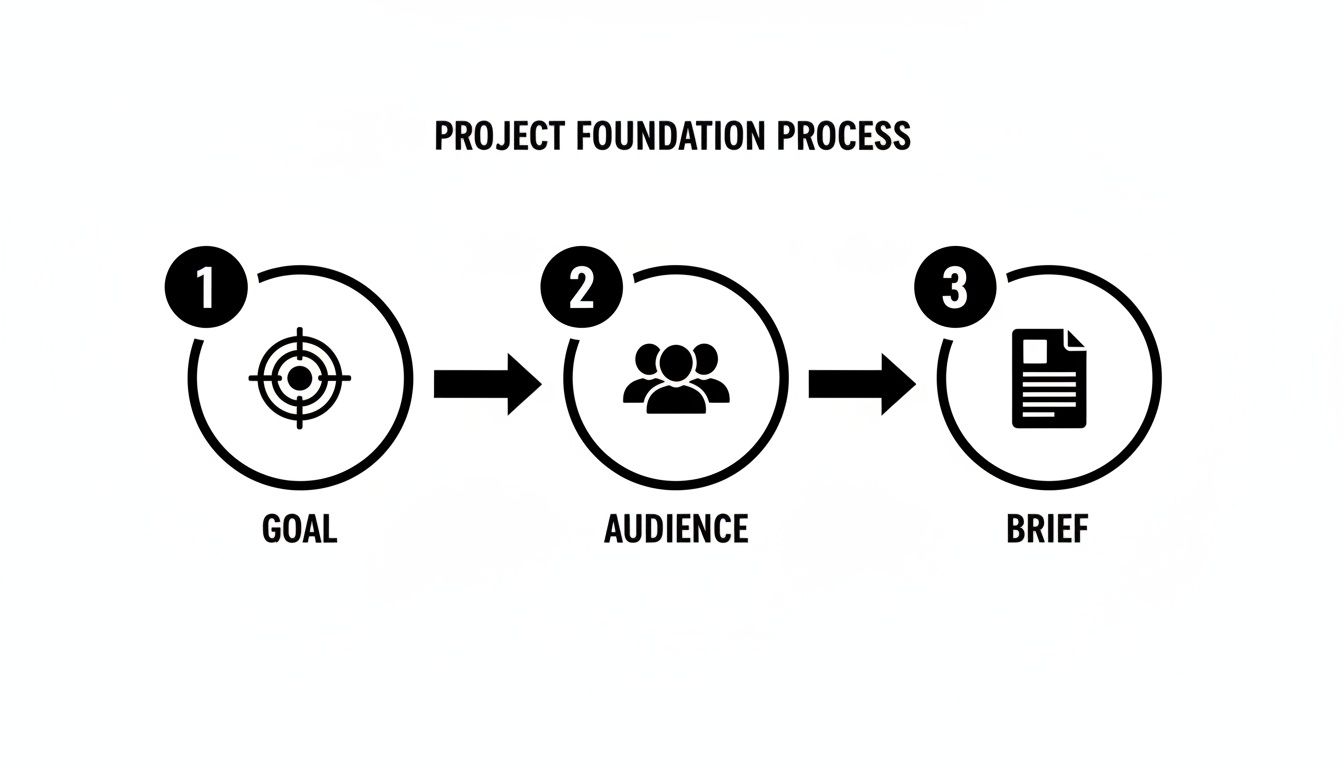
This flow is critical. A concrete goal and a well-defined audience are the essential ingredients for a brief that a studio can actually run with.
Draft an Initial Creative Brief
Your creative brief is the single most important document you’ll give to a potential 3D animation production company. It doesn't have to be a masterpiece at this stage, but it needs enough detail to get your vision across. It’s the bridge between your business goals and the creative work. If you want to see how studios turn these briefs into reality, it's worth understanding the stages of a professional animation production pipeline.
Your initial brief should cover:
- The Core Message: If the viewer remembers only one thing, what should it be?
- Tone of Voice: Does this need to be serious and technical, or is it inspirational, funny, or something else entirely?
- Visual Style: Have you seen other animations you like? Drop in some links as references for colour palettes, character designs, or motion graphics.
- Key Performance Indicators (KPIs): How will you know if it worked? This loops right back to your main business goal—whether it's views, click-through rates, or new leads.
With this prep work done, you can start your search with confidence. You’re not just looking for a vendor anymore; you’re looking for a strategic partner who can bring your well-defined vision to life.
Nailing Down a Realistic Budget and Production Timeline
This is where the rubber meets the road. Aligning your creative vision with the realities of time and money is often the biggest test any animation project will face. When you see a quote from a 3D animation production company, those numbers aren't just pulled out of thin air; they represent hundreds, sometimes thousands, of hours of highly specialised work.
To set a budget that actually works, you first need to understand what's driving the costs. Every single stage, from early concept sketches and storyboards all the way to the final render, demands a huge time investment. A simple 30-second animation with one character in a basic setting is a completely different beast from a multi-character scene filled with complex physics and photorealistic textures.
Decoding the Cost Drivers in 3D Animation
Think of your final animation cost as a sum of its creative and technical components. A longer video doesn't just mean more animation—it means more of everything. More modelling, more texturing, more lighting, and a whole lot more rendering time.
Here are the big-ticket items that will shape your budget:
- Complexity: The level of detail is a massive variable. A photorealistic render of a medical device requires far more intricate modelling and texturing than a stylised, cartoonish character.
- Duration: While you get some economy of scale, a 90-second video isn't just three times the cost of a 30-second one. Longer videos still need a linear increase in animation and rendering resources.
- Artistic Style: A minimalist, motion-graphics-heavy style is often kinder to your wallet than a project demanding custom character creation, rigging, and tricky fluid simulations like water or fire.
- Talent and Revisions: This is an iterative process, so your budget has to account for a reasonable number of feedback rounds. Requesting huge changes late in the game, like altering a character model after the animation has already started, can cause major cost overruns.
For smaller businesses just exploring their options, it's also smart to compare the costs of different animation types. You can get some valuable perspective by checking out our guide on finding an affordable 2D animation studio to see how the processes stack up.
Mapping a Typical Production Timeline
You can't rush quality animation. A typical 60-second, high-quality 3D animation can take anywhere from 6 to 12 weeks, and sometimes even longer, depending on the complexity we've talked about. Trying to force an unrealistic deadline usually means the 3D animation production company has to cut corners, and trust us, it will show in the final product.
A realistic timeline respects the distinct phases of production:
- Pre-Production (1-3 weeks): This is all about laying a solid foundation. It covers script finalisation, storyboarding, and getting approval on concept art.
- Production (3-6 weeks): This is where the heavy lifting happens—3D modelling, texturing, rigging, and all the core animation work.
- Post-Production (2-3 weeks): The final stretch involves rendering all the frames, compositing, sound design, and colour correction.
A common mistake is underestimating the rendering phase. This is an intensely computational process where powerful computers can be tied up for hours or even days to generate the final, polished images. It's a critical bottleneck that can't be rushed without throwing immense resources at it.
The availability of specialised talent also plays a huge part in both cost and timelines. The animation industry is currently facing a major talent shortage. Demand for skilled 3D animators is estimated to outpace supply by around 35% in key markets. Niche skills like character rigging and motion physics are especially hard to come by, often bumping up project costs by 15-20% due to the premium rates these specialists can command. This reality makes booking a quality studio well in advance an essential part of your planning.
Once you’ve got a shortlist of potential animation studios, their portfolio is your best tool for telling the good from the great. A flashy showreel is designed to grab your attention, but it rarely tells the whole story. You need to dig deeper, looking past the surface gloss to analyse the work from your project’s unique perspective.
A truly skilled 3D animation production company won’t just show off their greatest hits; they’ll demonstrate their range. This is where you start connecting the dots between their past projects and your future goals.
Looking Beyond the Highlight Reel
The real aim here is to find a strong creative and narrative match. Don't just watch the sizzle reel—explore their individual project case studies. Look for work that vibes with the tone and style you’ve already mapped out in your creative brief. A studio that shines with whimsical, stylised characters might not be the right choice for a photorealistic visualisation of industrial machinery.
As you review their work, ask yourself a few key questions:
- Narrative Clarity: Can they actually tell a story? Even a short product animation should have a clear beginning, middle, and end that keeps you engaged and delivers a message.
- Emotional Connection: Does the animation make you feel anything? Whether it’s excitement for a new gadget or empathy for a character, that emotional spark is the hallmark of sophisticated storytelling.
- Stylistic Range: Do all their projects have the same look, or can they pivot their style to fit different brands and messages? A versatile portfolio shows they’re a creative team that listens, rather than just applying a one-size-fits-all house style.
For a concrete example of this kind of range, you can browse the Simple Frame portfolio. It’s a great showcase of projects from corporate films to highly detailed animations, giving you a real-world feel for stylistic breadth.
Assessing Their Technical Pipeline
You don’t need to be a software guru to understand a studio's technical capabilities. The goal is simply to make sure they have the right tools and processes to handle your project's complexity and scale without hitting snags. Their "pipeline" is just their step-by-step production process, from initial modelling to the final render, and the software they use to connect those steps.
Any professional studio should be open about how they work. A few targeted questions can tell you a lot about their technical maturity and whether they can deliver top-quality results time and time again.
A studio’s technical pipeline is like the foundation of a house. You may not see it in the final product, but its strength and structure determine the quality and durability of everything built on top. A weak or disorganised pipeline often leads to missed deadlines and inconsistent quality.
When you chat with a potential 3D animation production company, ask about their core software stack. You’ll likely hear names like Cinema 4D, Blender, Maya, or 3ds Max. While the specific tool is less important than the artist wielding it, their fluency with these industry-standard platforms is a good sign of professional experience.
It’s also wise to probe their skills in a few key areas that have a direct impact on the final visuals.
Key Technical Areas to Discuss
Your project’s specific needs will dictate which technical skills matter most. If you're a corporate marketing team creating a product video, rendering quality is everything. For an ad agency working on a character-led campaign, the rigging and animation skills will be non-negotiable.
Here’s a practical checklist to help you evaluate portfolios based on what different clients typically need.
Key Portfolio Evaluation Checklist
This table helps you systematically break down what to look for, ensuring the studio's strengths align with your project's demands.
| Evaluation Criteria | What to Look For (Advertising Agency) | What to Look For (Corporate/Technical Client) |
|---|---|---|
| Animation & Rigging | Look for fluid, believable character movements and expressive facial animations. Does the timing feel natural and dynamic? | Check for precise, mechanical movements in product animations. Is the motion clean and accurate? |
| Rendering & Lighting | Assess the mood and atmosphere. Do they use lighting effectively to create cinematic, high-impact visuals that enhance the brand story? | Focus on photorealism and material accuracy. Do metal, glass, and plastic surfaces look convincing and true to life? |
| VFX & Compositing | Evaluate their ability to integrate effects like smoke, fire, or fluids seamlessly. Is the final composition polished and cohesive? | Look for clarity and precision in visual effects used to illustrate processes, like data flow or particle simulations. |
By using a structured approach like this, you can move beyond a gut feeling and make a confident, informed decision.
Ultimately, picking the right animation partner is a mix of subjective creative taste and objective technical validation. When you view their work through the specific lens of your own project goals, you can make a choice based on solid evidence of their skill and expertise.
Vetting Partners From First Contact To Final Questions

You’ve got a shortlist of studios with impressive portfolios. Fantastic. Now the real work begins—moving past the polished highlight reels to see who can actually deliver. This is where you engage potential partners like a seasoned producer, using a structured approach to compare them fairly and find the best fit.
The first move is to formalise your enquiry with a Request for Proposal (RFP). Think of it as your project's universal translator. It ensures every studio gets the exact same information, so you get back quotes you can actually compare, not a confusing mess of different assumptions and proposals.
A well-crafted RFP doesn't just save time; it sets a professional tone from the get-go and signals you're a serious client who has done their homework.
Crafting An Effective Request For Proposal
Your RFP doesn’t need to be a 50-page behemoth. It just needs to be clear, pulling directly from the internal planning you've already done. It’s all about giving a studio the context they need for a thoughtful, accurate bid.
Here are the absolute must-haves for your RFP:
- Project Overview: A quick rundown of your company and the business goal behind the animation.
- Creative Brief: Attach the brief you drafted earlier—target audience, core message, tone, and visual style references.
- Deliverables: Get specific. Don't just say "a video." List every single asset: one 90-second hero video, three 15-second social cutdowns, five high-res stills, and so on.
- Timeline: State your ideal delivery date and flag any critical milestones.
- Budget: I know some people hesitate here, but sharing a realistic budget range is crucial. It helps studios propose a solution that actually fits your financial reality instead of wasting everyone's time.
Send this out to your top three to five studios. This gives you a solid foundation for comparison, but the numbers are only half the story. The real insights come from the conversations that follow.
Asking Questions That Reveal True Partnership Potential
Once the proposals land in your inbox, it's time to get on the phone. This is your chance to dig deeper than the price tag. You need to get a feel for their creative process, project management style, and how they handle the inevitable bumps in the road.
As you vet potential partners, look at their overall professionalism. Top-tier studios often invest in solid operational support for creative agencies to keep projects on track. A studio that has its internal processes dialled in is one that values your time as much as their own.
The goal isn't to catch them with trick questions. It’s to start a dialogue that uncovers how they actually work. The best partnerships are built on clear communication and aligned expectations from day one.
Here are a few questions I've found incredibly revealing over the years, tailored to different needs.
For Advertising Agencies (Focused On Brand and Creativity):
- "Can you walk me through your creative development process? How do you take a client's brief and turn it into a unique visual concept?"
- "Our brand has a very specific aesthetic. How would you ensure your team's output stays perfectly on-brand throughout the entire project?"
- "Tell me about a time you received difficult creative feedback from a client. How did you manage it, and what was the outcome?"
For Technical or Medical Clients (Focused On Precision and Clarity):
- "Our product is technically complex. What's your process for ensuring 100% accuracy in the 3D models and animations?"
- "Who would be our day-to-day contact? What's their technical background, and how do you handle communication between our subject matter experts and your artists?"
- "How do you structure feedback and revision rounds to accommodate technical reviews without derailing the schedule?"
These conversations are your best tool for finding a studio that not only has the talent but also the collaborative spirit to bring your vision to life. The global animation industry, valued at USD 398.42 billion in 2024, proves just how vital this medium is. For Polish animation companies, this is especially true—Poland's domestic market growth of 18.5% is outpacing the global average, highlighting a rising international demand for their creative expertise.
Finalizing Contracts and Securing Your Partnership
You’ve sifted through countless portfolios, had some fantastic conversations, and finally zeroed in on the perfect creative partner. The finish line feels close, but there's one critical step left: the contract. Don't mistake this for a simple formality. This document is the bedrock of your entire collaboration, protecting both you and the 3d animation production company.
Think of the contract as the official translation of all those great creative discussions into a solid, legally-binding framework. It’s your best defence against scope creep, blown budgets, and painful disagreements later on. A well-crafted contract is what turns a handshake deal into a professional, successful partnership.
Defining the Scope of Work and Deliverables
This is arguably the most important part of the entire agreement. Ambiguity is your worst enemy here. The contract needs to spell out, in painstaking detail, every single asset the studio is responsible for creating. Leave absolutely no room for assumptions.
Your scope of work should get incredibly specific:
- Final Assets: Don't just say "one video." Instead, specify "one 60-second hero animation in 4K resolution (3840×2160), plus two 15-second vertical cuts for social media." The more detail, the better.
- Source Files: This is a big one. Who gets the working project files when all is said and done? Will the studio hand them over, or do they remain their intellectual property? Nailing this down now is crucial if you think you'll need to make your own edits down the line.
- Technical Specifications: Make sure to include the nitty-gritty details like resolution, frame rate, and specific file codecs. This guarantees the final files will slot perfectly into your campaign without any technical hiccups.
Navigating Payment Schedules and Intellectual Property
For most animation projects, a milestone-based payment structure is the way to go. It keeps cash flow healthy for both you and the studio. A common and fair arrangement looks something like this: 50% upfront to kick things off, 25% after you approve a major milestone (like the final animatic), and the final 25% once all assets are delivered to your satisfaction. This gives the studio the capital they need to get started while you hold the final payment until the job is complete.
Just as critical is the Intellectual Property (IP) clause. This section defines exactly who owns the final animation.
As a rule of thumb, upon final payment, the full ownership and rights to the finished animation should transfer to you. However, it's completely standard for the contract to state that the animation company can use the work in their portfolio—it's how they get their next gig, after all.
Just make sure the language is crystal clear, granting you exclusive, worldwide, and perpetual rights to use your new animation however you see fit.
The All-Important Revision Process
If there’s one area where creative projects can go off the rails, it’s the feedback and revision cycle. To avoid the nightmare of endless tweaks and surprise invoices, your contract must clearly outline the number of revision rounds included at each key production stage. A well-structured agreement will map it out:
- Script & Storyboard: Two rounds of revisions included.
- Animatic: Two rounds of revisions included.
- Final Animation: One round of minor revisions included (think small colour tweaks or timing adjustments, not story changes).
This structure forces the big, important changes to happen early in the process when they’re cheap and easy to make. Trying to alter the story after the final render is complete would fall way outside the agreed scope and will rightly come with an additional cost. Getting a handle on the fundamentals of post-production can really help clarify what's a "minor" vs. "major" change, something this guide to working with a post-production studio breaks down expertly.
The animation scene in Poland is a perfect example of a market where these professional standards are fueling explosive growth. As a key player in Central Europe, Poland's 3D animation market is on track to hit an incredible USD 78.5 billion by 2033, growing at a staggering 18.5% annually. You can learn more about this boom by reading these insights on Poland's 3D animation industry. This kind of rapid expansion just goes to show how essential ironclad professional agreements are for managing complex projects, whether they're local or international.
A Few Common Questions Before You Sign
As you get closer to choosing a 3D animation production company, a few final questions always seem to pop up. Making sure you get straight answers is the last step to building a solid, confident partnership. Let's walk through the most common points, from how payments work to who gets the final say on creative.
How Do Payments Work?
One of the first things clients ask about is the payment structure. While every studio has its own approach, the industry norm is a system based on milestones. This usually means an initial deposit to kick things off, with more payments due as we hit key stages of production and you sign off on the work.
A very typical breakdown you’ll likely encounter is:
- 50% upfront: This payment secures your project in the production schedule and covers all the initial groundwork, like storyboarding and concept design.
- 25% after animatic approval: The animatic is the first real glimpse of your story in motion. Signing off here locks in the timing and the core narrative flow.
- 25% on final delivery: The last payment is made only when you’ve received all the final, high-resolution files exactly as agreed.
This kind of structure works well because it protects everyone. The studio gets the funds needed to dedicate its team and resources to your project, and you have the peace of mind that the final payment isn't due until the work is completely finished.
Who Actually Owns the Final Animation?
This is a big one, and it needs to be spelled out clearly in your contract. Once the final invoice is paid, you should own the final rendered animation files. This gives you exclusive, worldwide rights to use the video on any platform you want, forever.
But what about the raw project files—the original 3D models, character rigs, and scene files? That's a different story. Studios generally consider these their proprietary tools of the trade, so they aren't typically included in the standard deliverables.
Think of it like this: when you buy a cake, you own the cake. You don't get the baker's secret family recipe, their specific ovens, or their favourite mixing bowls. If you think you'll need the source files for future edits down the line, you have to negotiate that upfront. It will almost certainly add to the cost.
What if We Disagree on a Creative Choice?
Even with the most detailed planning, creative visions can sometimes diverge. A professional 3D animation production company will have a clear, established process for handling feedback and working through disagreements without drama. This is where having a structured revision process outlined in your contract is incredibly valuable.
If you find yourselves at a creative crossroads, the first step is to go back to the original creative brief. Does the work still align with the goals and audience you defined at the very beginning? More often than not, a disagreement happens when the project has drifted away from that foundational document.
Should the issue persist, get on a call. A real conversation can clear up misunderstandings much faster than a long email chain. A great creative partner will listen to your concerns, propose solutions, and work with you to find a way forward that honours both your vision and their professional expertise.
At Simple Frame, we believe a great partnership is built on transparency. We’ll guide you through every step, making sure you feel confident and in the loop from the first sketch to the final render. Discover how our clear process can bring your vision to life.
 English
  Polish
  German